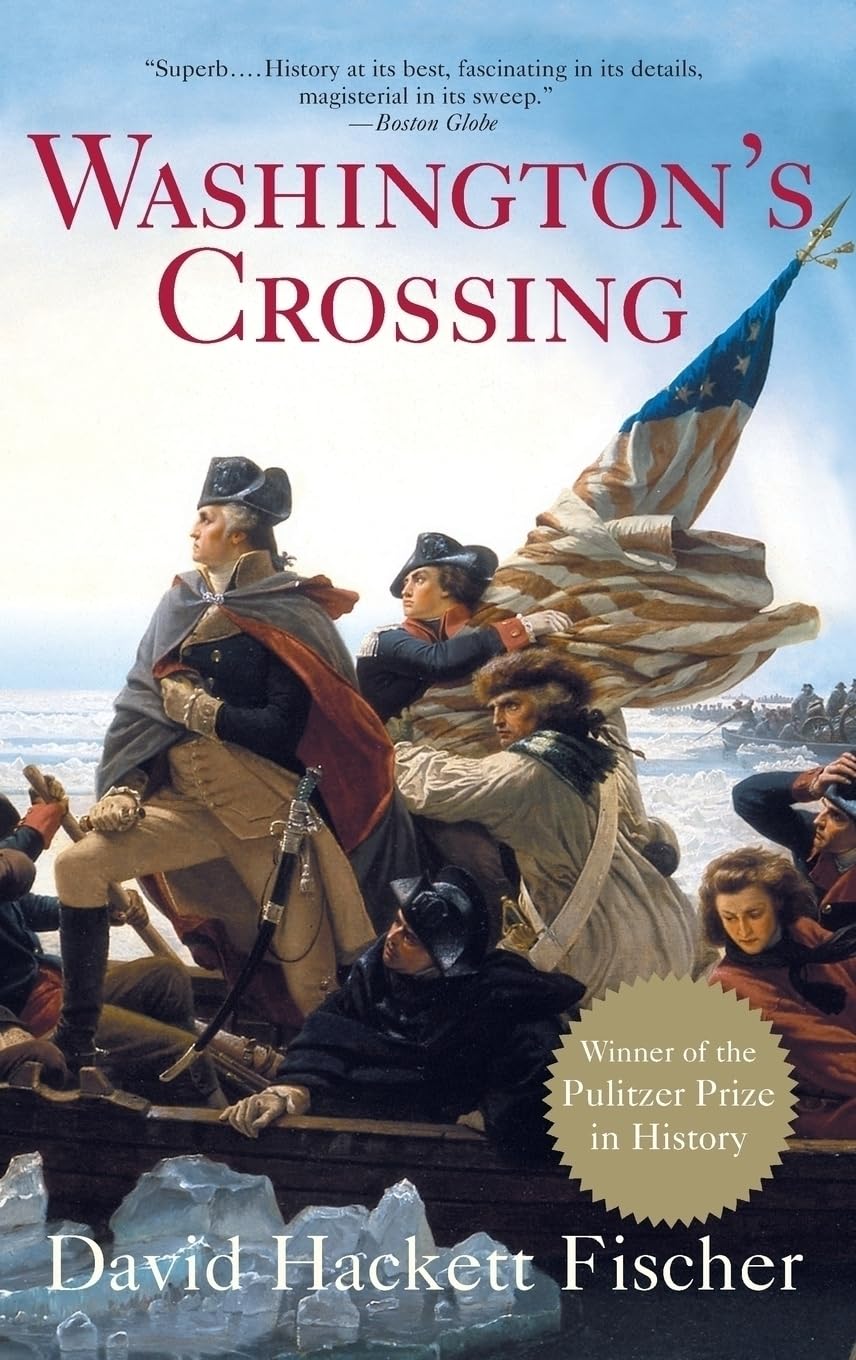
Washington's Crossing (Pivotal Moments in American History)
$15.73
by David Hackett Fischer



Six months after the Declaration of Independence, the American Revolution was all but lost. A powerful British force had routed the Americans at New York, occupied three colonies, and advanced within sight of Philadelphia. Yet, as David Hackett Fischer recounts in this riveting history, George Washington--and many other Americans--refused to let the Revolution die. On Christmas night, as a howling nor'easter struck the Delaware Valley, he led his men across the river and attacked the exhausted Hessian garrison at Trenton, killing or capturing nearly a thousand men. A second battle of Trenton followed within days. The Americans held off a counterattack by Lord Cornwallis's best troops, then were almost trapped by the British force. Under cover of night, Washington's men stole behind the enemy and struck them again, defeating a brigade at Princeton. The British were badly shaken. In twelve weeks of winter fighting, their army suffered severe damage, their hold on New Jersey was broken, and their strategy was ruined. Fischer's richly textured narrative reveals the crucial role of contingency in these events. We see how the campaign unfolded in a sequence of difficult choices by many actors, from generals to civilians, on both sides. While British and German forces remained rigid and hierarchical, Americans evolved an open and flexible system that was fundamental to their success. The startling success of Washington and his compatriots not only saved the faltering American Revolution, but helped to give it new meaning. Adult/High School-Another stirring effort by the author of Paul Revere's Ride (Oxford, 1994). Readers will again cheer American perseverance, inventiveness, and improvisation as Washington, his officers, and their men turn the early military defeats of Long Island and New York City into victory at Trenton and Princeton. The opening chapter is devoted to the painting Washington Crossing the Delaware. Then the author discusses the British, Hessian, and American military units that were involved in these campaigns and gives background on their officers. This is Fischer's strong suit: he tells stories and gives details that bring history alive. He makes the point that decisions made for varying reasons by converging sets of people determine history. In the hands of such a thorough researcher and talented writer, this is powerful stuff. The bulk of the book deals with the battles and their aftermath. The text is enriched by small reproductions of portraits, many by Charles Willson Peale, of the major players. The last chapter summarizes Fischer's points and would make a good teaching tool by itself. Judy McAloon, Potomac Library, Prince William County, VA Copyright © Reed Business Information, a division of Reed Elsevier Inc. All rights reserved. On December 22, 1776, Washington's adjutant wrote him that their affairs "were hasting fast to ruin." Two weeks later, after a harrowing nighttime crossing of the ice-choked Delaware River, Washington's victories at Trenton and Princeton so shocked the British that the price of government securities fell. Fischer's thoughtful account describes how Washington, in a frantic, desperate month, turned his collection of troops into a professional force, not by emulating the Europeans but by coming up with a model that was distinctly American. The army Washington fielded had innovative artillery, moved with startling speed, and even, in one of the first recorded instances, synchronized its watches. Trenton convinced many Britons that they were caught in a quagmire, and Americans that they could win. "A few days ago they had given up the cause for lost," a British businessman wrote. "Now they are all liberty mad again." Copyright © 2005 The New Yorker Washington's Crossing moves from myth to history by offering a convincing corrective to Leutze's painting. (Washington really did stand in the boat, since it was filled with ankle-deep water, but the crossing occurred at night. Nor were the Hessians drunk.) By framing "the fog of war, the chaos and confusion" of the crossing within its largest context--that of America's revolutionary struggle--Fischer interprets this event as a strategic, rather than merely symbolic or psychological, triumph ( New York Times Book Review ). It's a compelling argument, well supported by a cast of vivid, compassionate characters and good writing--even if Fischer sometimes gets carried away. And its message, about Americans fighting "for ideas of liberty and freedom," couldn't be more timely. Copyright © 2004 Phillips & Nelson Media, Inc. *Starred Review* Victorious since landing at New York in the summer of 1776, the British, by winter, were succeeding in their strategy to squelch the American rebellion. Many sunshine patriots, including a signer of the Declaration of Independence, accepted amnesty, while the small American army, ravaged by defeats in New York and the retreat across New Jersey, huddled along the Pennsylvania ban