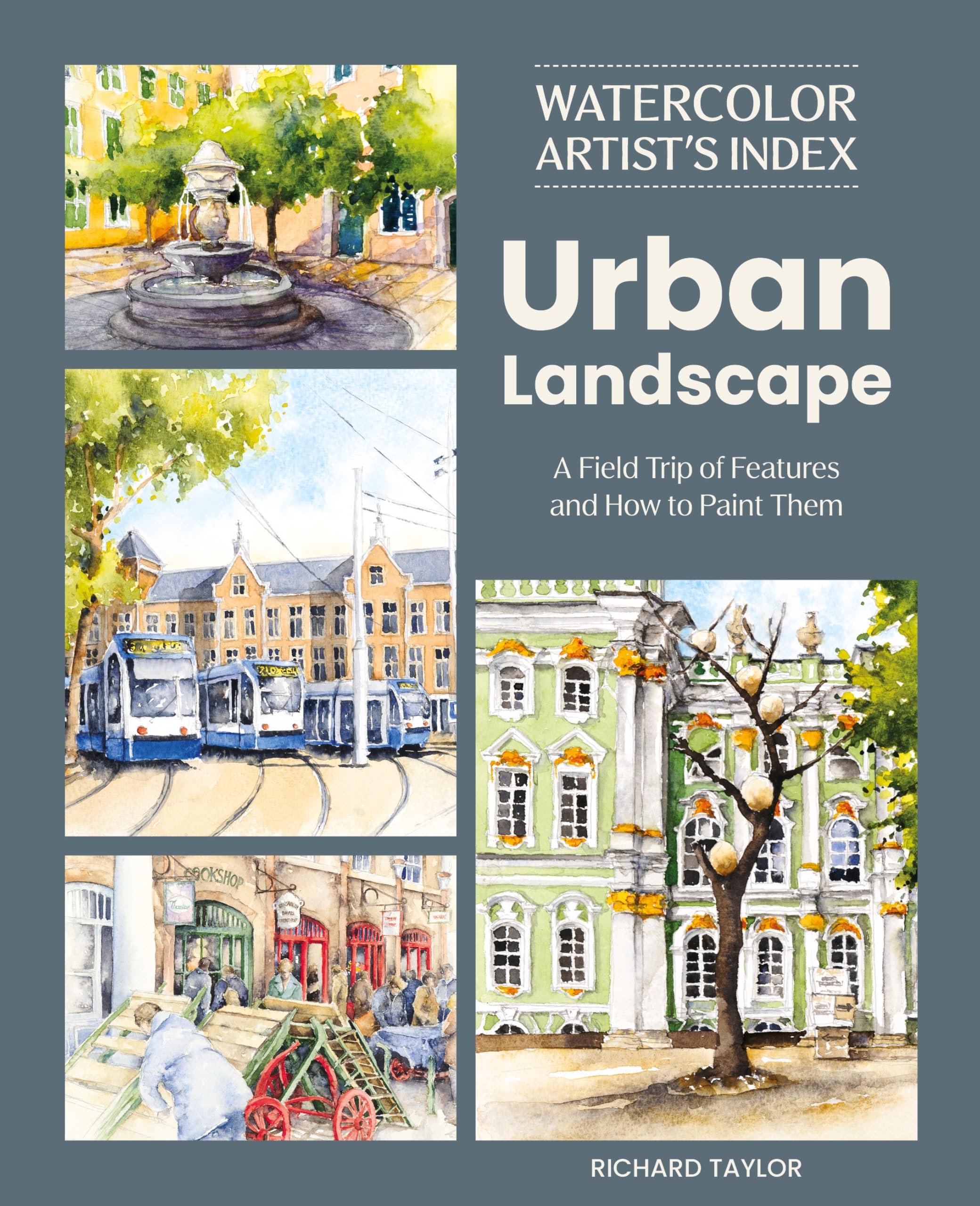
Watercolor Artist's Index of the Urban Landscape: A Field Trip of Features and How to Paint Them
$24.03
by Richard Taylor



A brilliant new manual of practical techniques for the urban landscape watercolor artist introductory section provides expert insight and guidance on materials, perspective, paint effects, light, and shade - arranged by urban location and then by type of feature for quick reference in the field or home studio - provides step-by-step techniques to capture the majesty, charm, or granular detail of a chosen subject: from paving cracks to rusted street signs - learn how to achieve a greater sense of shape, texture and form in your paintings - features stunning artwork from expert artist, author, and tutor Richard Taylor Take a whirlwind tour and explore greater range and depth in your art: from the soaring towers of New York City to the vibrant street life of London. Richard Taylor is a well-known artist and author who specializes in watercolour painting techniques. He demonstrates and teaches widely, has written a number of practical art books, and is an established contributor to the leisure painting press. Richard is a member of the Society of Architectural Illustrators and his work has been exhibited in galleries throughout Britain, including the Mall Galleries, London. I was born and grew up in the suburbs of North London, England. My formative years were spent among Georgian-fronted homes, modern high-rise appartment blocks, brick terraces, and a wealth of other building types. These, of course, fronted busy main streets and side roads. All of the trappings of the urban environment were part of my everyday life. And, of course, a short bus ride took me into the city itself, where the streets came to life by day and night. As my interest in drawing and painting grew, I became increasingly attracted to the bustle of urban living and the proliferation of the many new types of transport on the roads. But it was always the decaying, derelict buildings, the rusting iron gates, the cracked sidewalks, and the crooked, faded road signs that caught my attention the most. The sights, colors, sounds, and smells of the urban environment were truly in my blood. The aim of this book is to invite you to join me in my passion for recording the urban environment in watercolor. As you journey through the pages you will see a pattern—on the right-hand page will be a painting on a very specific theme. On the left-hand page will be a set of studies explaining elements found in the main painting. These will not always be evident in the main painting, but they will include the key elements that you will need to observe carefully. To take you through the stages of painting one picture would enable you to paint just that one picture. My aim is to encourage you to stand on your own artistic feet and to tackle any type of scene that you may encounter on your urban wanderings. You will also, from time to time, find step-by-step images. These take you through the three stages of my working practice in “visual real time,” allowing you to observe the buildup of washes and how the addition of the darkest paint can make the middle tones come alive. You might even opt to practice these mini-projects yourself. A few words about painting techniques. I often refer to “environmental” colors in my notes and annotations. By this I mean the colors of all the surrounding objects that will reflect light and cast shadowing onto the subject being studied. “Local” color might sound more appropriate, but this means something entirely different in art training (that is, the color of any one object without the influences of shade or reflections from other objects). On bright or dull days, these environmental colors will influence the way you see your subject. The urban environment often lacks much real color, but requires a lot of subtle variations of grays and neutral tones. My standard mixture for these tones is a combination of burnt umber and ultramarine blue. This can be tempered by introducing many levels of dilution. It can be watered down so as to appear almost translucent, or bolstered by using tube paints to act as the darkest of shadows. Sometimes the tone will vary, again, according to the environmental colors that surround you. These tones can also be achieved by creating “palette mud.” This is created by washing together the remnants of all of the colors you have mixed in your palette to create a muddy yet tinted wash. Finally, you will soon see that I don’t always take my painting out to the four corners or border lines of a precise rectangle. Sometimes a free flow of paint can give a sense of energy to a composition, drawing your eye in to, or out from, the central point. I don’t like any painting to be restricted—especially by four pencil lines! So, it’s over to you now to dip into the city-themed subjects in the following pages. Copy the studies, or go out and find your own. The fact that you are painting the urban environment is all that matters. Good luck and enjoy it!