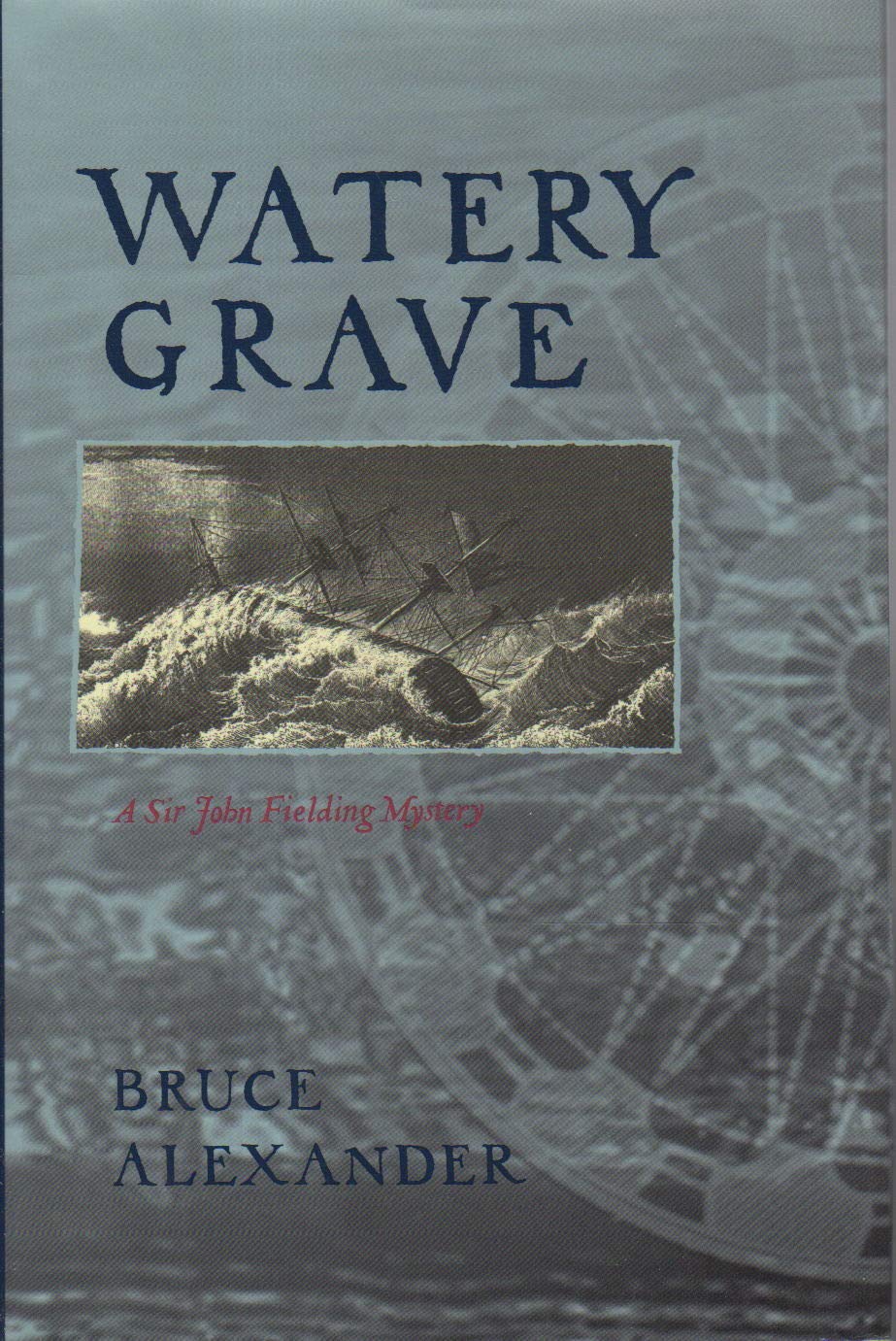



John Fielding was famous not only as cofounder of London's first police force, the Bow Street Runners, but also as a magistrate of keen intellect, fairness and uncommon detective ability. When a crime was committed, he often took it upon himself to solve it. What made this all the more remarkable was that he was blind. In Watery Grave, accompanied by his "eyes" (and the series' narrator), young Jeremy Proctor, Fielding encounters a case that hits close to home, as a stepson returns from the high seas with tales of typhoons and a captain overboard. Was it an accident, or was it murder? Fielding is asked to investigate, but discovers considerably more than he'd bargained for - including some secrets that might better have been left at the bottom of a watery grave. Sir John Fielding, a blind magistrate in 18th-century England, is called upon to help in a naval inquiry involving a possible murder on the high seas. One fact is indisputable. During a storm Capt. Josiah Markham was thrown overboard. A witness to this event, the first officer, claims the captain was pushed over the side by Lt. William Landon. Others, including the accused, say Landon was trying to save Markham but fierce seas yanked the captain from his grasp. This intriguing tale is told from the perspective of 14-year-old Jeremy Proctor, who works as an apprentice to the magistrate. The life as lived in this often harsh period is vigorously portrayed in Alexander's third Sir John Fielding novel (e.g., Murder in Grub Street, LJ 4/1/96). Recommended for most suspense collections.?Patricia Altner, Information Seekers, Bowie, Md. Copyright 1996 Reed Business Information, Inc. Sir John Fielding, the blind chief magistrate of the Bow Street Court, and his able assistant, orphan Jeremy Proctor, return in an all-new tale of mystery and intrigue. When the inebriated and incompetent captain of a British frigate is tossed overboard during a violent storm, an exemplary lieutenant is accused of murder. As a former naval officer, Sir John is intrigued by the case and by the contradictory testimony of the ship's crew. Although Sir John and Jeremy uncover evidence exonerating the unfortunate lieutenant, the court-martial proceeds as scheduled in order to provide a scapegoat and protect the Royal Navy from additional scandal. Unwilling to sanction injustice, Sir John intervenes, utilizing the civil court to bring the true culprit to trial. A superior evocation of eighteenth-century England featuring a most original sleuthing duo. Margaret Flanagan Months after the storm at sea in which Captain Josiah Markham perished, H.M.S. Adventure returns to England. Aboard her--among 150 rowdy seamen--are Tom Durham, stepson of Bow Street Court Magistrate Sir John Fielding, and acting captain Lt. James Hartsell, bursting with an accusation quite recently lodged: That he saw Lt. William Landon push Capt. Markham overboard. Drawn into the case by his interest in Tom, a former criminal remitted two years ago to the Adventure, and by the entreaties of his old friend Vice-Admiral Sir Robert Redmond, Landon's uncle, for his expertise in examining witnesses, blind Sir John (Murder in Grub Street, 1995, etc.) finds himself outside his jurisdiction and his authority. The harder he works to vindicate dispirited Landon, the more Sir Robert seems to set his face against the accused. The search for witnesses who can refute Hartsell's story takes Jeremy Proctor, Sir John's boy Friday, from ship to shore, through eye-opening conversations with lascars and bawds and Black Jack Bilbo's surprisingly delicate lecture on the facts of life. But the story runs out of steam and surprises long before the end, leaving only those two old lions Sir Robert and Sir John to settle their differences. Period buffs may savor Alexander's 1769 take on A Few Good Men. Even fans of Sir John, however, will probably judge his third outing his weakest. -- Copyright ©1996, Kirkus Associates, LP. All rights reserved.