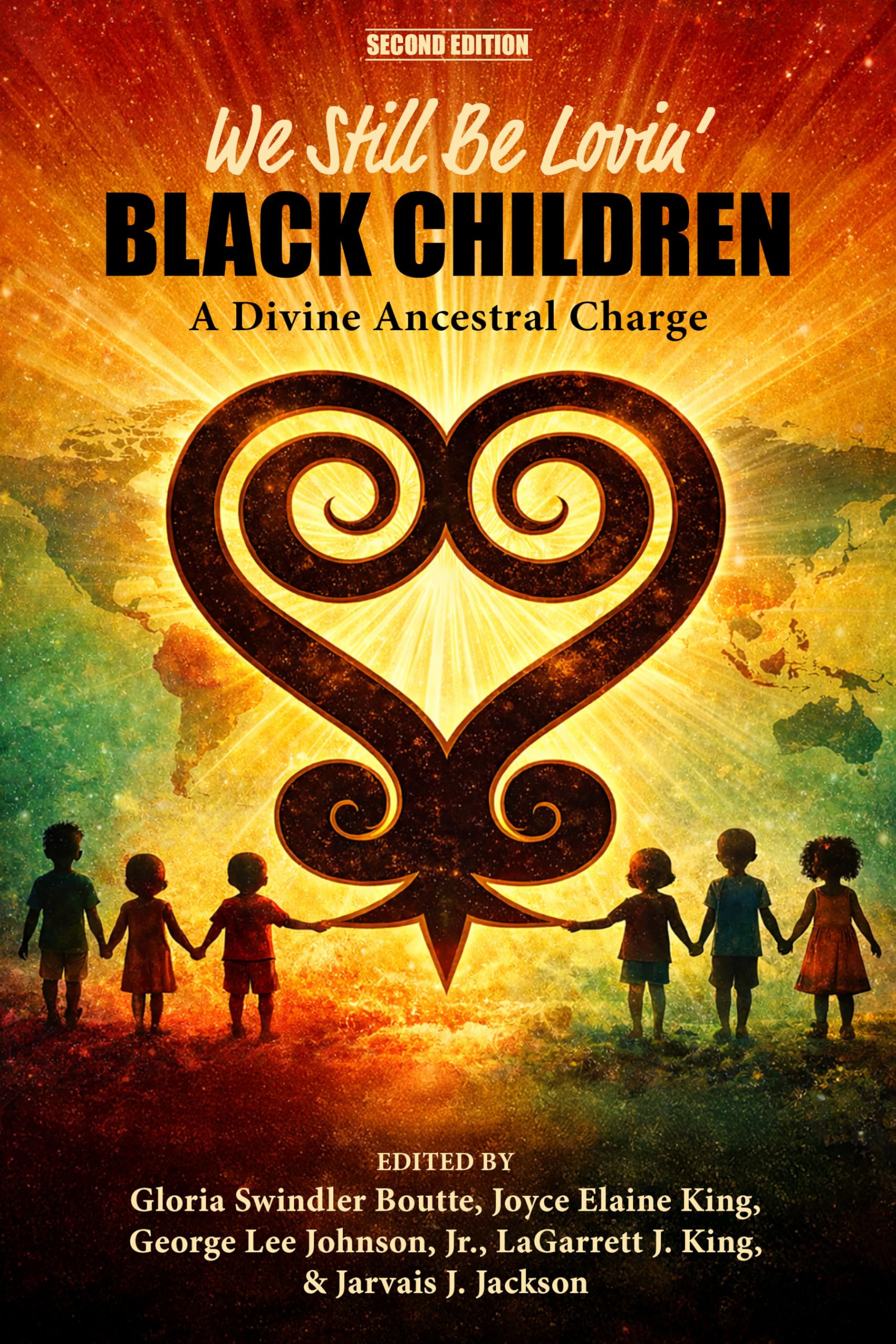
We Still Be Lovin' Black Children: A Divine Ancestral Charge
$21.95
by Gloria Swindler Boutte



We STILL be lovin’ Black children. Not sometimes. Not conditionally. Not when it is convenient. We loved them in the past. We love them now. We will love them in the future. In this expanded second edition, We Still Be Lovin’ Black Children: A Divine Ancestral Charge , leading scholars, educators, and community leaders deepen the call to center African Diaspora Literacy as a foundation for healing, identity, and collective thriving. Across classrooms, homes, and communities in the United States, Africa, and the Caribbean, contributors offer practical strategies, critical questions, cultural frameworks, and affirming activities that protect Black children’s spirits while nurturing their brilliance. At a time when Black histories are distorted, erased, or politicized, this book insists on truth-telling rooted in love. Grounded in African Indigenous Knowledge, Adinkra principles, intergenerational wisdom, and Pro-Black educational practices, authors demonstrate how literacy about the African diaspora is essential. This edition includes new chapters, updated chapters, expanded global perspectives, new resources for families and educators, and timely guidance for confronting anti-Blackness in schools, media, and public discourse. To love Black children is to teach them who they are. To teach them who they are is to protect their souls and spirits. To protect their souls and spirits is to secure our collective future. This is a love book. This is a liberation book. This is an urgent book. Perfect for courses such as: Foundations of Education; Black Education; African Studies; African American Studies; Introduction to Early Childhood Education; Dr. Gloria Swindler Boutte is a Carolina Distinguished Professor at the University of South Carolina. She is the author/editor of eight books: (1) Pro-Blackness in Early Childhood Education: Diversifying Curriculum and Pedagogy in K-3 Classrooms ; (2) Revolutionary Love: Nurturing the Brilliance of Young Black Children ; (3) Educating African American Students: And How Are the Children (2nd edition) ; (4) We Be Lovin’ Black Children: Becoming Learning to Be Literate About the African Diaspora (2022 Society of Professors of Education Outstanding Book Award); (5) African Diaspora Literacy: The Heart of Transformation in K-12 Schools and Teacher Education (2019 AESA Critics Choice Award); (6) Educating African American Students: And How Are the Children ; (7) Resounding Voices: School Experiences of People From Diverse Ethnic Backgrounds ; and (8) Multicultural Education: Raising Consciousness . She has more than 100 publications and presents nationally and internationally. She has received prestigious awards such as the Fulbright Scholar; Fulbright Specialist; National Council of Teachers of English (NCTE) Outstanding Educator in the English Language Arts―Elementary Section; an AERA Division K Legacy Award; AERA 2022-23 Fellow Award; and an American Educational Research Association (AERA) Social Justice in Education Award. She was the founder and Executive Director of the Center for the Education and Equity of African American Students (CEEAAS). She has served as a Visiting Scholar and presented her work internationally on every continent except for Antarctica. She has led/co-led Fulbright Hays Groups projects in Ghana, Nigeria, Sierra Leone, Cameroon, and Barbados. She has been a Visiting Scholar in Australia (twice), South Africa, Jamaica, Guyana, and Colombia. She has traveled to nine countries in Africa (at least one country in each region) and lived in Nigeria for a year and taught at the University of Uyo as a Fulbright Scholar. Dr. Joyce E. King holds the Benjamin E. Mays Endowed Chair for Urban Teaching, Learning and Leadership at Georgia State University (GSU) in the Department of Educational Policy Studies. She holds affiliated faculty status in the Department of African American Studies, the Women’s and Gender Studies Institute, the Partnership for Urban Health Research, and the Urban Studies Institute. Her publications in the Harvard Educational Review , the Journal of Negro Education , International Journal of Qualitative Studies in Education , and the Journal of African American History focus on a transformative role for culture in curriculum and urban teacher effectiveness, morally engaged, community-mediated inquiry and Black education research and policy. Her most recent book is Heritage Knowledge in the Curriculum: Retrieving an African Episteme (with E. Swartz). Dr. King is past president of the American Educational Research Association, President of the Board of Directors of the Institute for Food and Development Policy (FoodFirst.org), a member of the National African American Reparations Commission and a recipient of the Stanford University School of Education Alumni Excellence Award (2018). A recent essay, “To Create a More Perfect Union, We the People Need Reparations to Heal Our Wounded Souls,” is published on the