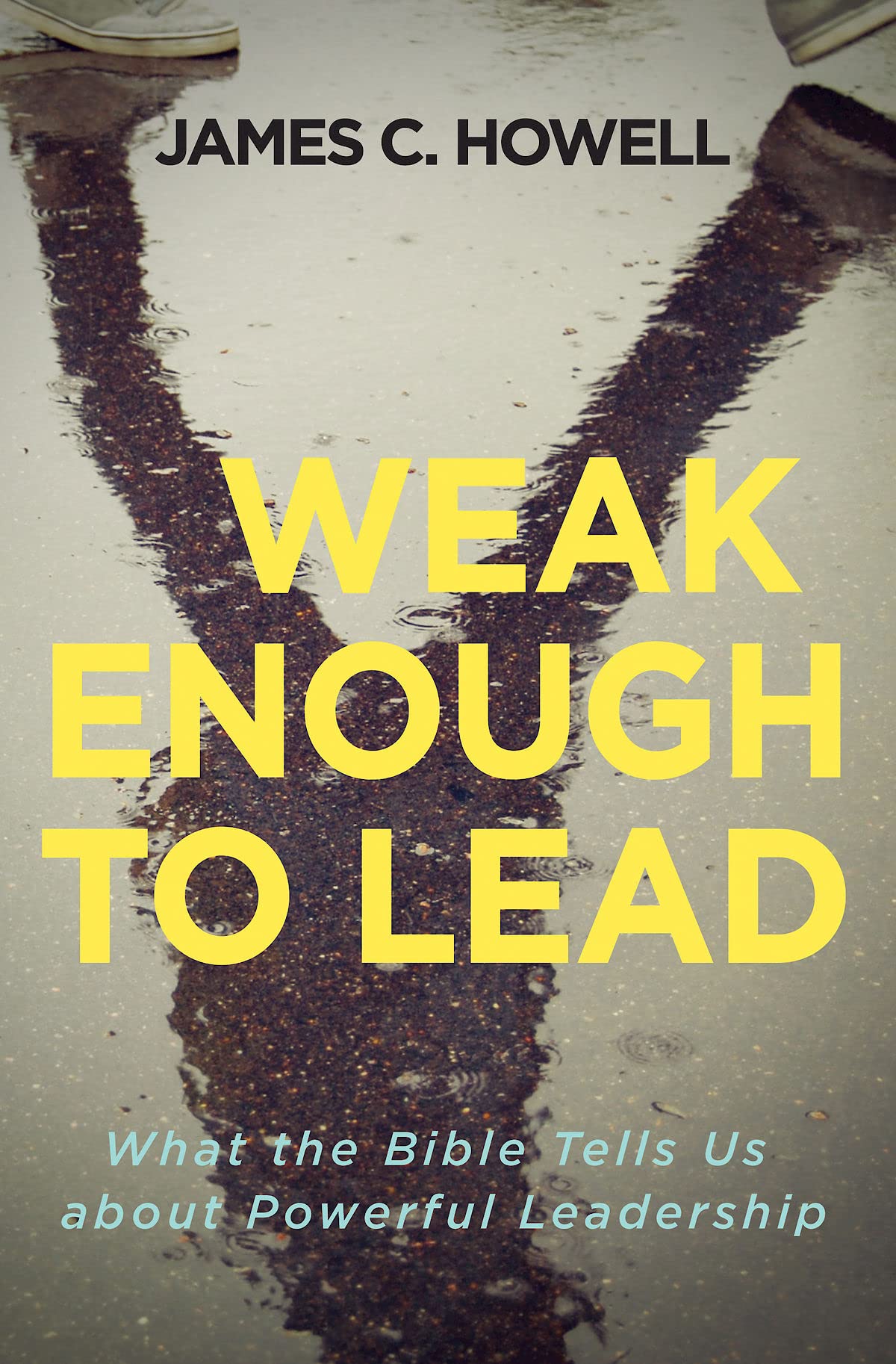
Weak Enough to Lead: What the Bible Tells Us about Powerful Leadership
$17.49
by James C. Howell



The Bible’s version of leadership is pretty different from—and sometimes alien to—that of the business world. It is also dissimilar from our usual assumptions about what makes a great leader in the church, where we tend to focus on preaching ability, strategic hutzpah, and managerial savvy. But what if the Bible actually points toward a different set of characteristics necessary for leadership? What if our weakness is an essential qualification? Do we know our limitations, our inabilities? Do we see clearly our vulnerable, broken selves? Do we really believe that God’s strength is perfected in our weakness, and do we lead with that as a core belief? James Howell’s Weak Enough to Lead is not a list of “leadership principles” from the Bible. This book is an examination of stories about leaders from the Old Testament, where we discover not only them but ourselves. How does family dysfunction or depression or tragic bad luck or larger historical forces figure into the leadership equation? How do biblical characters prosper despite themselves or stumble even while being holy? Can we get inside the head, heart, and the actual administration of King David and reckon with his strength and foibles? How is strength in leadership almost always the downfall of the biblical leader? What kind of leader would Jesus, Esther, Moses, Jeremiah, or Paul be today? Howell explores the careers, struggles, joys, and devastations of various biblical leaders, believing that immersion in scripture’s stories is what modern Christian leaders need—not to succeed so much as to be God’s people in the world. He roots this unique exploration of leadership in a prayer of Jehoshaphat: “We do not know what to do, but our eyes are upon you.” The Bible’s understanding of leadership is decidedly different from that of the business world! James C. Howell is the senior pastor of Myers Park United Methodist Church in Charlotte, NC, and the author of more than 20 books, including Weak Enough to Lead , Conversations with St. Francis , The Life We Claim , and The Beautiful Work of Learning to Pray . His podcast, “Maybe I’m Amazed,” blogs, and retreats are popular, as are his work on leadership and community activism. Weak Enough to Lead What the Bible Tells Us about Powerful Leadership By James C. Howell Abingdon Press Copyright © 2017 Abingdon Press All rights reserved. ISBN: 978-1-5018-4263-4 Contents Introduction: The Prayer of Jehoshaphat, Jesus: A Little Child Shall Lead Them, Hannah: Listening, and Letting Go, Saul: Tragically Flawed, David: The Natural, Kings and a Queen: Failures and Providence, Elijah: Loneliness and Renewal, Elisha: Mentoring and Humility, Micaiah: Yes-Men versus Truth-Tellers, Jeremiah: Courage and Its Costs, Amos, Second Isaiah: Judgment and Redemption, Genesis: Responsibility and Big Plans, Moses: Called, but Frustrated, Joshua and Samson: Commitment and Burnout, Priests: Thinking and Acting Institutionally, Sages: Elusive Wisdom, Peter and Paul: Downward Mobility, Epilogue: How Weakness Helps, Notes, Index of Names, CHAPTER 1 JESUS A Little Child Shall Lead Them Even though the words may feel familiar because we've heard them so many times, what could be more curious, and less promising, than Isaiah's prophecy, "And a little child shall lead them" (Isa 11:6)? When God came to save God's people, to lead them from their lonely exile into the promised salvation, God came as a child. Any Christian who would lead, at work, at home, in the community, at church, wherever, has to sort out this puzzle that our leader is (or was) a child. We could say Jesus was a child, in the same way that we consider childhood to be just a temporary stage along the way to adulthood. We might envision Jesus as some kind of wonder-child, a phenom, a one-in-a-zillion prodigy. Some of those early apocryphal Gospels depicted Jesus in his playpen, molding clay into birds before miraculously causing them to fly, or striking dead some boys who bullied him on the playground. Byzantine art depicted the infant Jesus as a miniature potentate, dressed in regal attire, with the stern gaze of a ruler, while sitting on his mother's lap. But the point of the incarnation is that Jesus was a child like other children. Jesus, our leader, was led by his mother. When she told him Let's go to the market or It's time for bed or Let's recite Psalm 8 together he followed. He was entirely and wonderfully dependent upon her. She nursed him, and rocked him when he cried out from a fever. She prepared all his food. She made and mended all his clothes. She taught him how to talk and how to pray. She delighted in his first steps and comforted him when he fell and scraped his knee. Every leader begins in such humility, for which we can be grateful. I'm not self-made. Someone loved me and was tender toward me. I've been totally dependent, and will be again someday — and am now, if I'm attentive to things. We coul