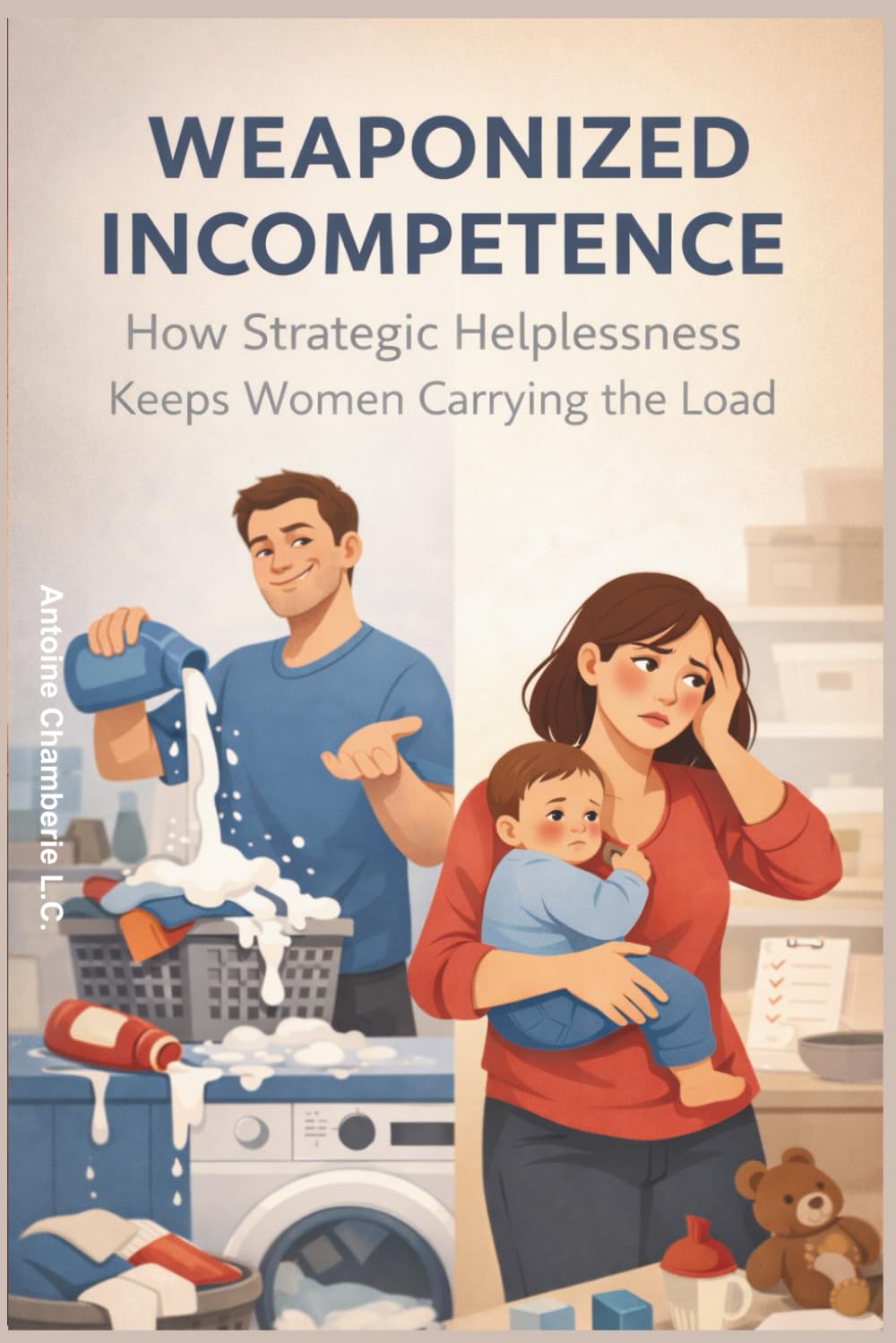
Weaponized Incompetence: How Strategic Helplessness Keeps Women Carrying the Load
$12.99
by ANTOINE CHAMBERIE



You’re not exhausted because you’re bad at managing your life. You’re exhausted because you’re managing everyone else’s . If you’ve ever wondered why you carry the schedules, the planning, the remembering, the follow-through — even when someone else is technically “helping” — this book gives a name to what’s happening. Weaponized incompetence isn’t about clumsiness. It’s about how responsibility quietly shifts to the person who notices, compensates, and absorbs the consequences when things fall apart. This book explains why: • Help often creates more work instead of less • “I don’t know how” becomes a permanent escape hatch • Mental load sticks to women even in otherwise loving relationships • Competence appears instantly at work — but disappears at home • Resentment grows not from effort, but from unequal ownership Rather than framing the problem as a communication failure or a personal shortcoming, Weaponized Incompetence examines the structure underneath the dynamic — how power, accountability, and consequences determine who ends up carrying the load. You’ll learn to recognize: The moment responsibility is silently transferred - The difference between effort and ownership - Why explaining tasks is itself labor - How unequal systems reproduce themselves without intention - Why “just ask for help” doesn’t work Most importantly, this book does not tell you to try harder, communicate better, or be more patient. It gives you: Language to name what you’re experiencing - Frameworks to understand why the imbalance persists - Clear distinctions between help, delegation, and shared responsibility - Ways to stop compensating without creating chaos - Relief from the belief that you are failing This is not a book about blaming men. It’s a book about seeing the system clearly — so you can stop carrying what was never meant to be yours alone. If you feel tired in ways you can’t explain… If the house looks “fine” but you’re still depleted… If help somehow leaves you doing more, not less… The problem isn’t you. And the answers are within reach. Weaponized Incompetence offers a clear, unsparing examination of a dynamic many women recognize immediately but struggle to name. Rather than focusing on individual intent or interpersonal conflict, this book exposes how responsibility quietly migrates toward those most willing to absorb it — and how strategic helplessness allows unequal systems to persist without overt refusal or cruelty. With careful attention to emotional labor, mental load, and the uneven distribution of accountability inside intimate relationships, Paulina Falcón Lara dismantles the comforting myths that keep imbalance intact: that some people are "just bad at these things," that effort matters more than outcome, and that love requires endless accommodation. What makes this book particularly powerful is its precision. It does not frame exhaustion as burnout alone, or resentment as communication failure. Instead, it shows how women become the invisible infrastructure of households and relationships — not because they choose power, but because someone must prevent collapse. Written with clarity, restraint, and deep psychological insight, Weaponized Incompetence is not a guide to fixing partners or winning arguments. It is a framework for understanding why so many women feel simultaneously needed and unseen, capable and depleted — and why fairness cannot be measured by intention alone. This book will resonate with anyone who has ever wondered why help still feels like work, why rest never fully arrives, and why carrying everything eventually erodes intimacy itself. This book was not born from a single argument or breaking point. It was born from a quieter realization: that exhaustion can exist even when no one is openly refusing to help. Many women arrive at Weaponized Incompetence because they are functioning — often exceptionally well — and still feel depleted. They are not doing everything alone. Their partners may participate, assist, and express goodwill. And yet the responsibility never seems to lift. I wrote this book to name why. What I saw, again and again, was not laziness or malice, but a structural pattern: responsibility migrating toward whoever would absorb it, competence becoming obligation, and helplessness being rewarded with relief. Over time, one person becomes the manager of the system, while the other remains a participant in it. This dynamic is easy to dismiss because it rarely looks dramatic. It hides behind confusion, forgetfulness, and "I don't know how." It survives because things keep working — at a cost that remains largely invisible. This book is not about blaming men, and it is not about teaching women how to manage better or communicate more gently. It is about clarity. About understanding the difference between effort and accountability, between helping and owning, between not knowing and not learning. Most of all, it is about permission. Permission to trust your ex