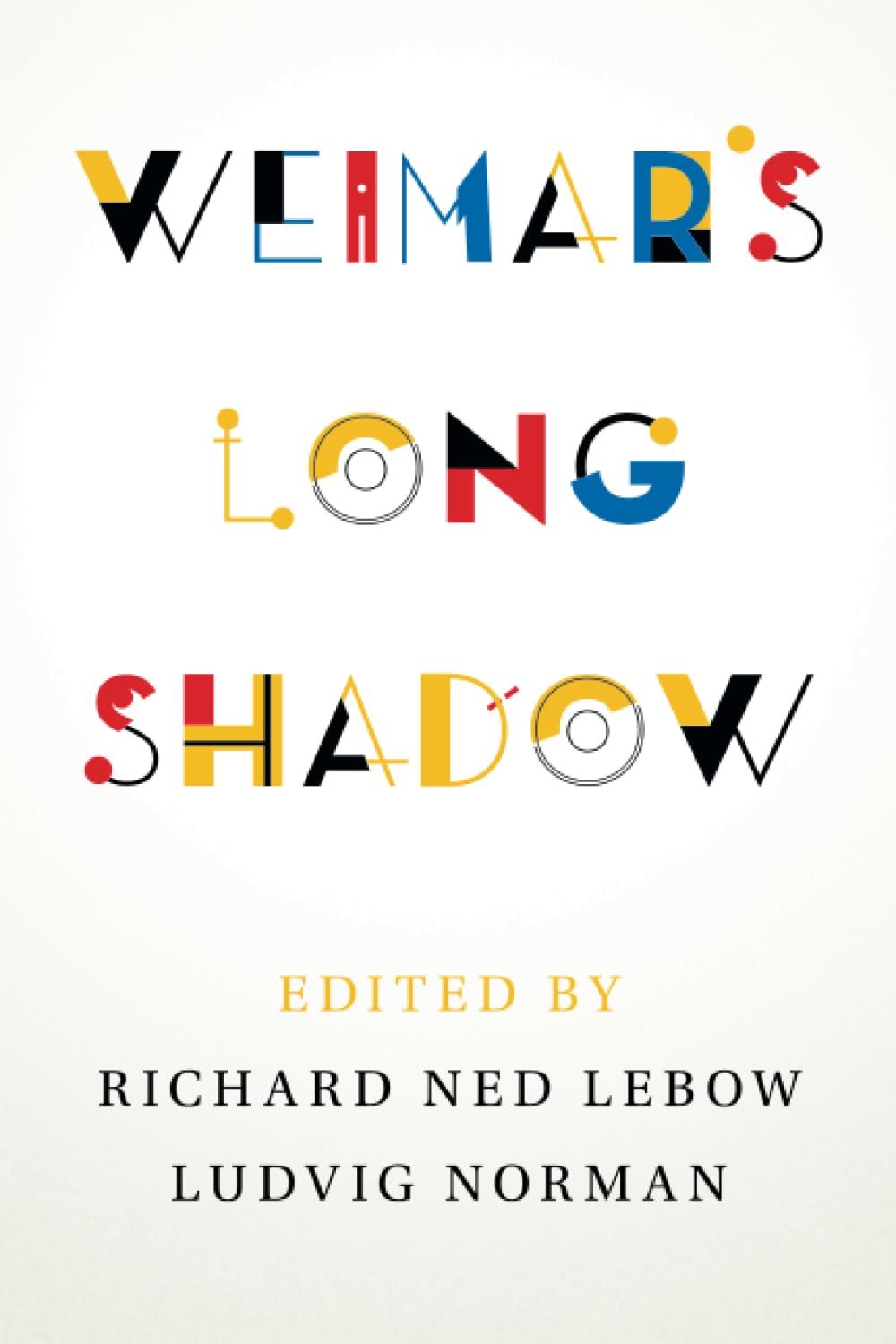



Weimar casts a long shadow over post-war political thought. The Weimar Republic is used to understand contemporary threats to democracy and to critique or defend modernity. It has generated a series of political lessons that are invoked whenever democracies are challenged. This book questions the historical validity of most of these lessons and their applicability to contemporary political orders. It shows how Weimar lessons are often influenced by partial and superficial readings of events, often intended to advance particular political projects. The chapters give detailed accounts of how so-called Weimar lessons have influenced, if not shaped, political debates in Germany, elsewhere in Europe, and the United States. ‘Weimar's Long Shadow magnificently captures the relevance of Germany's first failed experiment in democracy for our own troubled times. The authors do not exaggerate the similarities. Rather, in essays that range from treatments of Strauss and Trumpian Straussians, to militant and social democracy, and the TV series Babylon Berlin, they illuminate concerns central to us now.' David Dyzenhaus, University Professor of Law and Philosophy, Toronto ‘This stimulating book shows that Weimar is more than a negative model for the collapse of democratic regimes. It makes a strong case for using analogies as a fruitful device for a more careful consideration of the complexities of modernity. The case of Weimar therefore continues to be of great systematic value to both international historians and political scientists.' Wolfram Pyta, University Professor and Head of the Department of Modern History, University of Stuttgart ‘As the paradigm of democratic fragility, the Weimar Republic has both sensitized and blinded thinkers to the dangers of later situations. Even as they anatomize the mechanisms that flatten analogy into ‘lessons learned,' these essays exemplify a better use of history: open-ended engagement with cases to generate questions for the present.' Dorothy Noyes, The Ohio State University Invokes the political and cultural lessons drawn from the collapse of the Weimar Republic to understand contemporary threats to democracy. Richard Ned Lebow is Professor of International Political Theory, Emeritus at King's College London; Honorary Fellow of Pembroke College at the University of Cambridge and James O. Freedman Presidential Professor, Emeritus at Dartmouth College. Among his most recent books are The Quest for Knowledge in International Relations (Cambridge, 2022) and, co-edited with Ludvig Norman, Robustness and Fragility of Political Orders (Cambridge, 2022). He is a Fellow of the British Academy and the recipient of numerous book awards. Ludvig Norman is Associate Professor of Political Science at Stockholm University and Senior Fellow in the Institute of European Studies at the University of California, Berkeley. His most recent works include Dilemmas of European Democracy, co-edited with Niklas Bremberg (2023), Robustness and Fragility of Political Orders, co-edited with Richard Ned Lebow (Cambridge University Press, 2022), as well as many articles in journals including Democratization, European Journal of International Relations, Journal of Common Market Studies and Political Studies.