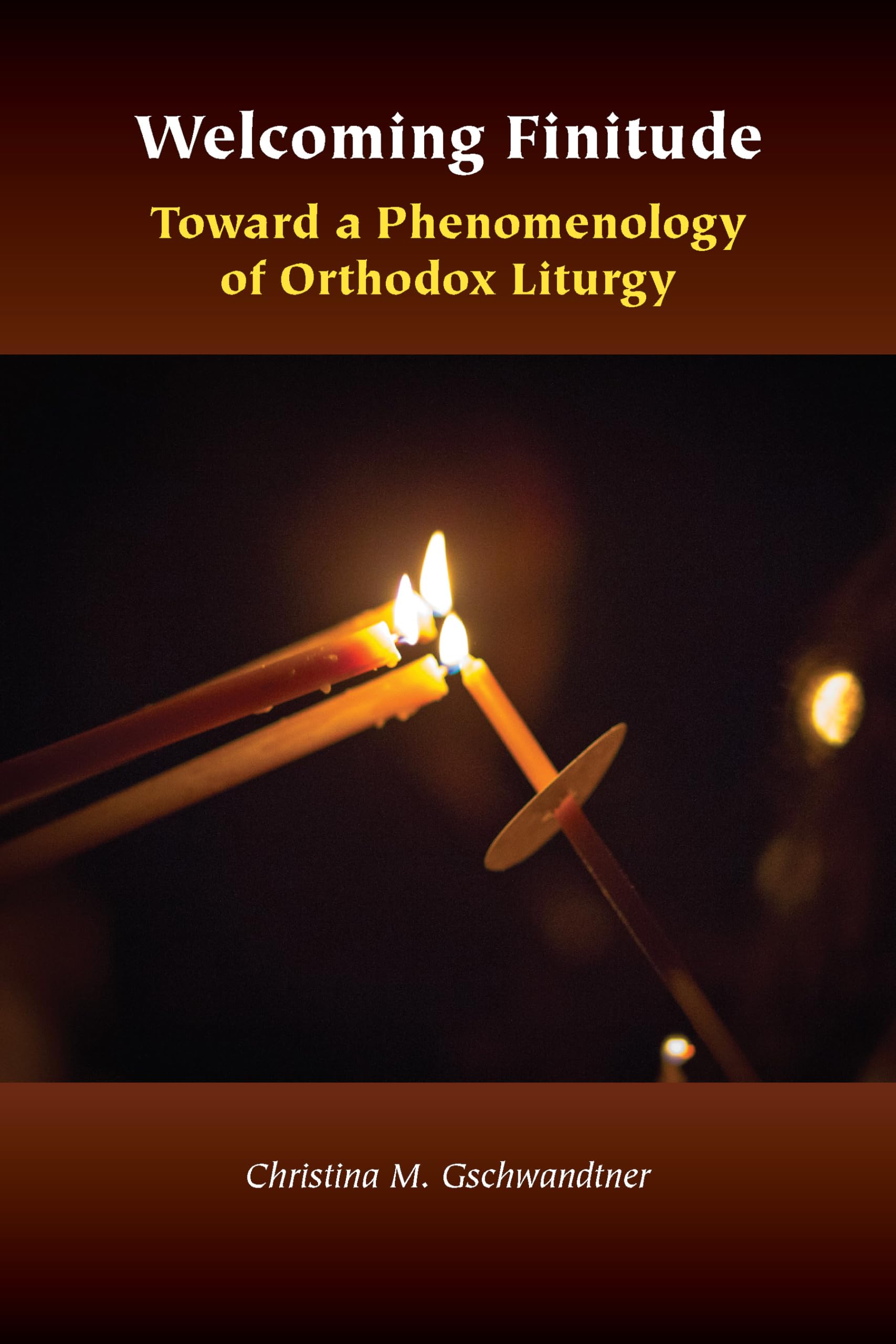
Welcoming Finitude: Toward a Phenomenology of Orthodox Liturgy (Orthodox Christianity and Contemporary Thought)
$35.00
by Christina M. Gschwandtner



What does it mean to experience and engage in religious ritual? How does liturgy structure time and space? How do our bodies move within liturgy, and what impact does it have on our senses? How does the experience of ritual affect us and shape our emotions or dispositions? How is liturgy experienced as a communal event, and how does it form the identity of those who participate in it? Welcoming Finitude explores these broader questions about religious experience by focusing on the manifestation of liturgical experience in the Eastern Christian tradition. Drawing on the methodological tools of contemporary phenomenology and on insights from liturgical theology, the book constitutes a philosophical exploration of Orthodox liturgical experience. Gschwandtner writes with a welcome transparency and obvious wellspring of knowledge that runs extremely deep. . . . [S]cholars of whatever sort will find food for thought in Gschwandtner’s work and an addition to the subfield of the phenomenology of religion that is ready for comparison with other studies that either do not overtly cover liturgical matters or do so from a differing tradition. ― Phenomenological Reviews This book is a boon for liturgical theologians who wish to ground their analysis more rigorously within the lived experience of liturgical ritual. It is also a superb survey and critique of the discourse on liturgy in contemporary French phenomenology. ― Worship This is a brilliant book. One does not usually begin a book review with such a blunt statement, but that is the most significant point of this review. . . The work’s methodological strength is the willingness to grapple with complexities and a refusal of simplistic either/or pronouncements. The result is a rich and nuanced phenomenological description of Orthodox liturgy. ---Tamsin Jones, Journal of Orthodox Christian Studies Gschwandtner writes with a welcome transparency and obvious wellspring of knowledge that runs extremely deep. . . . [S]cholars of whatever sort will find food for thought in Gschwandtner’s work and an addition to the subfield of the phenomenology of religion that is ready for comparison with other studies that either do not overtly cover liturgical matters or do so from a differing tradition. ― Phenomenological Reviews Christina M. Gschwandtner teaches Continental Philosophy of Religion at Fordham University. She is the author of Reading Jean-Luc Marion: Exceeding Metaphysics ; Postmodern Apologetics? Arguments about God in Contemporary Philosophy (Fordham); Degrees of Givenness: On Saturation in Jean-Luc Marion ; and Marion and Theology , besides articles and translations at the intersection of phenomenology and religion.