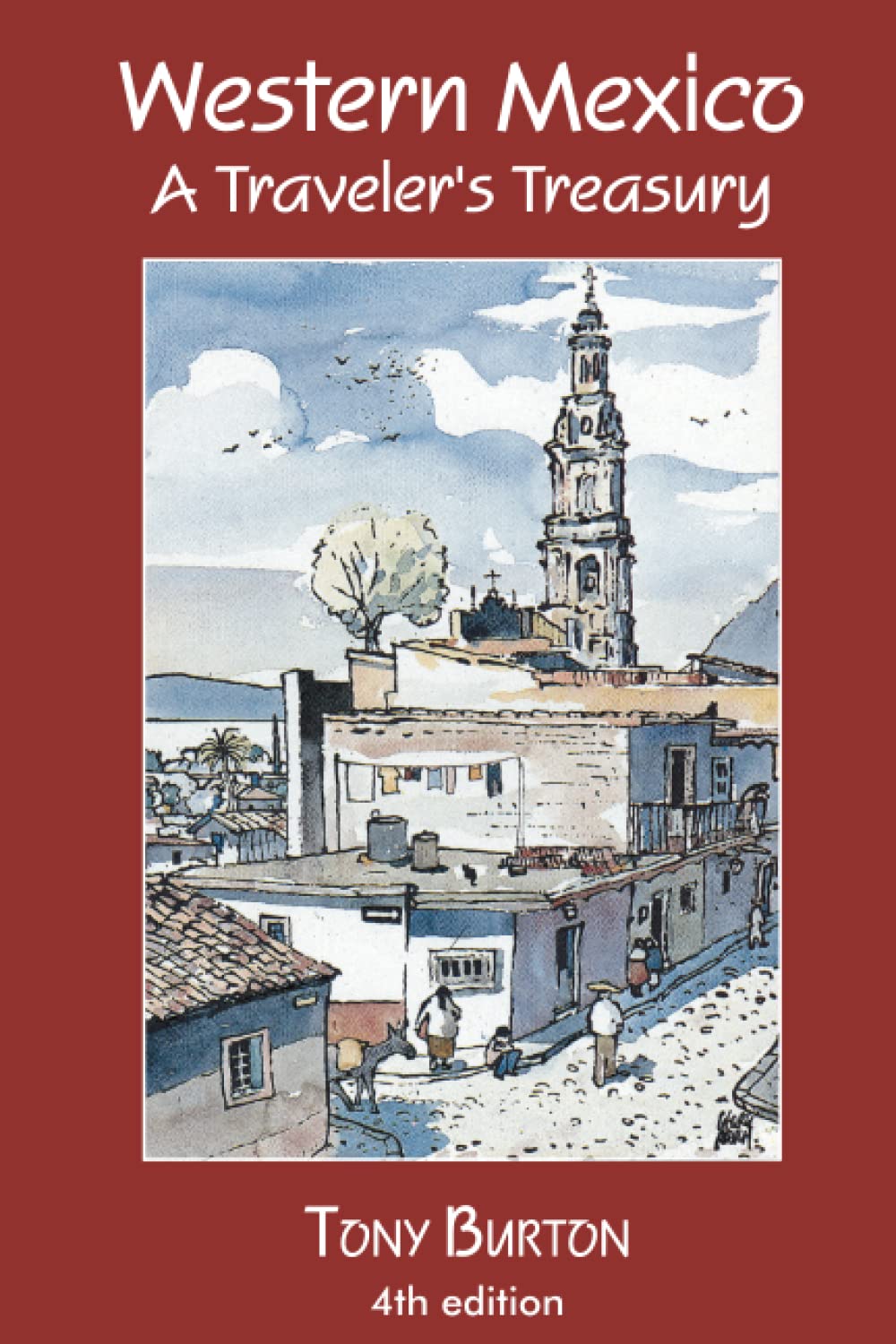



Award-winning travel writer Tony Burton reveals the magic of Western Mexico. Relaxed and intimate, this easy-to-read yet authoritative account features more than 35 original drawings by Canadian artist Mark Eager and 10 maps. Enjoy the author’s unique insights into local history, ecology and traditions. Now in its fourth edition, the book remains a favorite among knowledgeable travelers visiting this region of Mexico. The 4th edition is one-third larger than the previous editions, and includes dozens of new places worth exploring. It incorporates several new chapters, including four devoted to the region around Zacatecas. Every chapter has new material. Maps have been redrawn and travel directions updated.A mixture of interests is represented. Included are historical sights such as Zacatecas, Lagos de Moreno and San Blas; artistic colonies like Ajijic; and lakeside communities, including Chapala and Pátzcuaro. Alongside them are ecological wonders, such as Manantlán and the monarch butterflies; old mining towns like Angangueo and Bolaños; coastal resorts such as Barra de Navidad and Puerto Vallarta; Indian villages like Angahuan, and a host of others.Many of these smaller places in Western Mexico offer a glimpse of the Mexico behind the mask; they are places where Mexico has retained her ancient culture and her ancient traditions.All the destinations in parts one and two are within day-trip range (maximum three hours driving time) from Guadalajara (Mexico’s second city) or nearby Lake Chapala, a popular retirement center for Americans and Canadians. In part three, all the locations described are worth at least an overnight stay, though Tapalpa, Mazamitla and Tamazula are still within three hours driving time of Guadalajara-Chapala. Parts four to nine describe longer, three or four day trips, which are all well worth the investment of extra time.No fewer than 17 of the towns featured in the book have received the federal designation of "Pueblo Mágico" (Magic Town), in recognition of their cultural, historical or ecological significance, and facilities for visitors. There are now many excellent boutique hotels, some of them in quite unexpected places, making it far easier to explore the less traveled areas of Western Mexico. Whether your interests lie in art, architecture and archaeology; fiestas and folklore; unusual sights and natural wonders, or in Indian villages and indigenous handicrafts, this book will help you discover for yourself Western Mexico's many hidden treasures. Whether you're an intrepid on-the-road adventurer or a relaxed armchair traveler, Tony Burton's "Western Mexico: A Traveler's Treasury" is an ideal companion... One factor that lends special appeal to this singular travel book is Burton's departure from the stock formula found in conventional guides. He adheres to a more organic approach, drawing on personal experience and meticulous research to divulge the virtues and peculiarities of every destination. Another major strength is the author's attention to historical details that enrich the individual profile of each place. In some cases he scratched up intriguing facts by chatting with the local people, in others he tapped on tireless study of a vast array of previously published works. The bibliography lists writings going back as far as 1899, as well as "Lake Chapala through the Ages," Burton's own compilation of excerpts from works by other travel writers covering the era of 1530-1910. Above all, the British-born geographer is a bold adventurer who delights in departing from the main travel routes to explore back roads and discover unexpected corners that other travelers and writers often see as nothing more than dots on the map. He has a knack for digging up the idiosyncrasies of each destination he visits, be it local legends and folklore, off-beat museums, geological characteristics, mining deposits of minerals, stones and precious metals, or an outstanding restaurant, inn or spa worthy of mention. First published in 1993, the revised and expanded fourth edition of "Western Mexico"... opens with what qualifies as the most comprehensive guide to the Lake Chapala region available in English. "The next segment explores the agricultural valley and the Sierra highlands stretching west from Guadalajara. Part three covers Tapalpa, Mazamitla and other high altitude spots, plus the city of Colima. From there the text follows a route northeast of Guadalajara into the region of Los Altos and beyond Jalisco's borders to León, Guanajuato and Aguascalientes, continuing into Zacatecas and the far-flung northern "hand" of Jalisco. Material in parts six and seven spans the Pacific coast from San Blas, Nayarit to Cuyutlán, Colima. The final chapters thoroughly survey the state of Michoacán. The development of Puerto Vallarta and the birth of the Paricutín volcano stand out among the book's fascinating historical accounts. Expositions on Jalisco's Manantlán Biosphere Reserve and the Monarch b