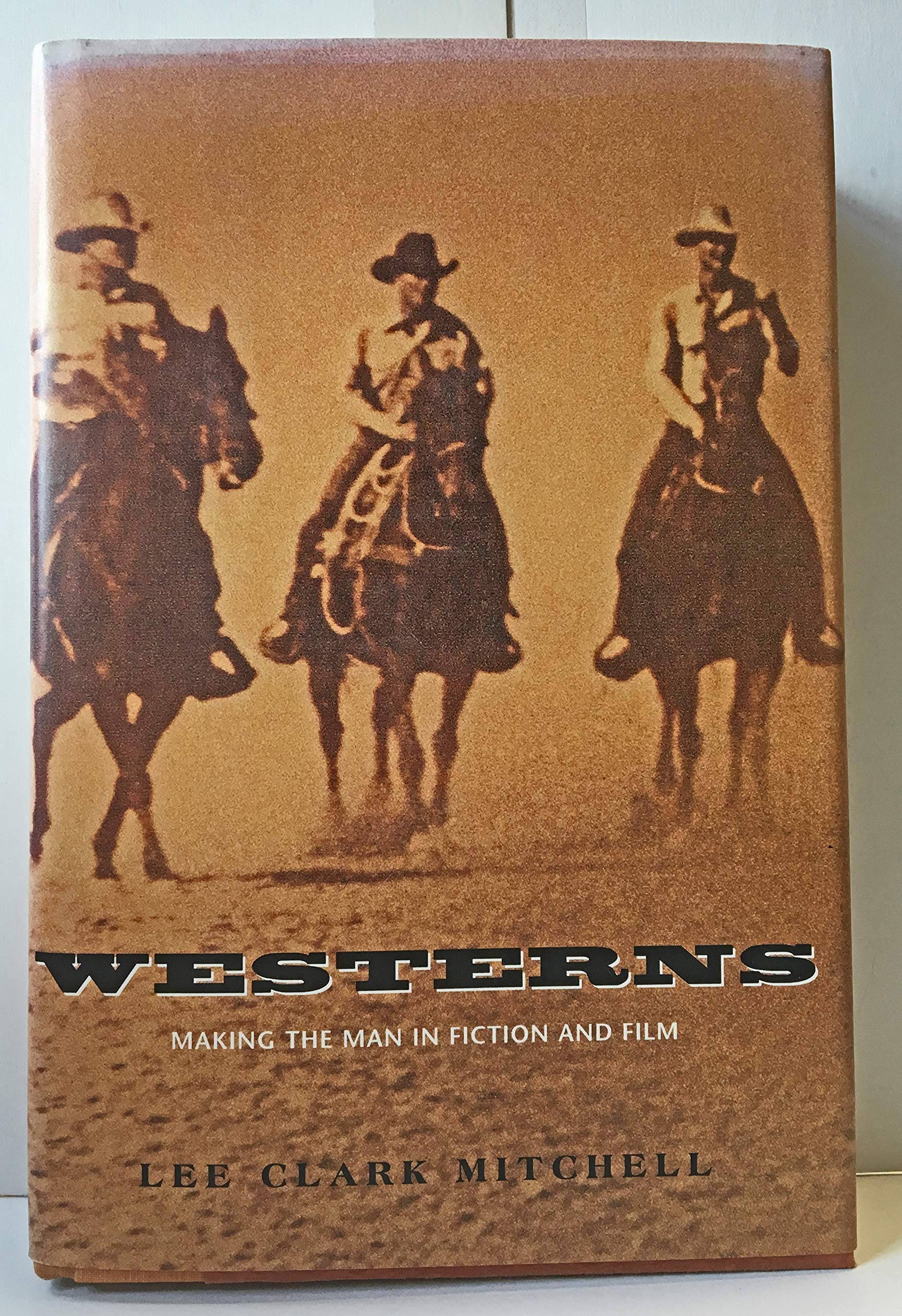



A history of the Western in fiction and on film that shows how it reflects the changing obsessions and fears American culture Ranging from the novels of James Fenimore Cooper to Louis L'Amour, and from classic films like Stagecoach to spaghetti Westerns like A Fistful of Dollars , Mitchell shows how Westerns helped assuage a series of crises in American culture. This landmark study shows that the Western owes its perennial appeal not to unchanging conventions but to the deftness with which it responds to the obsessions and fears of its audience. And no obsession, Lee Mitchell argues, has figured more prominently in the Western than what it means to be a man. Though both these books are on the Western in film and fiction, they differ sharply in their approach. Mitchell's work has two basic premises. First, he argues that overwhelmingly popular pieces obliquely raises critical contemporary anxieties in a manner that denies a straightforward reading, allowing competing groups to read it according to their own beliefs. For example, High Noon could be seen as both pro- and anti-McCarthyism. Second, he states that Westerns have always been about the problems of becoming a man, a question for which each generation seeks its own answer. These are interesting premises, but they would have benefited from less build-up and a wider range of illustrative examples. Unlike Westerns, which concentrated solely on A pictures, Reel Cowboy is devoted to B Westerns. Rainey is obviously extremely knowledgeable about his subject, but other than the stated goal of discovering and preserving such movies, his purpose and unifying theme are difficult to discern. In Part 1, he discusses the careers of B Westerns stars, both silent and talkie, and shows how their films fall into three categories: realistic, semirealistic, and mythic. Part 2 offers brief biographies of Western writers and their film credits, with special attention given to Zane Grey. Part 3 does the same in more detail for three authors who wrote about the great Northwest and Alaska (e.g., Jack London), none of whom are normally considered writers of Westerns. The last section details the experiences of some Western movie stars who worked in circuses and Wild West shows either on their way up or down the professional ladder. Both books are appropriate for comprehensive film collections.?Marianne Cawley, Enoch Pratt Free Lib., Baltimore Copyright 1996 Reed Business Information, Inc. “Elegantly written. . . . Provocative . . . characterized by [Mitchell’s] own tendency to shoot from the hip.” -- J. Hoberman ― London Review of Books ”[Mitchell’s] book would be worth reading just for the way he relates Benjamin Spock’s Baby and Child to the postwar Western." ― The Observer ”Integrating a careful handling of historical context with a keen eye for textual nuances, Mitchell reconstructs the Western’s aesthetic tradition of the 19th century.” -- Aaron M. Wehner ― San Francisco Review Lee Clark Mitchell is Holmes Professor of Belles-Lettres and Chair of the Department of English at Princeton University.