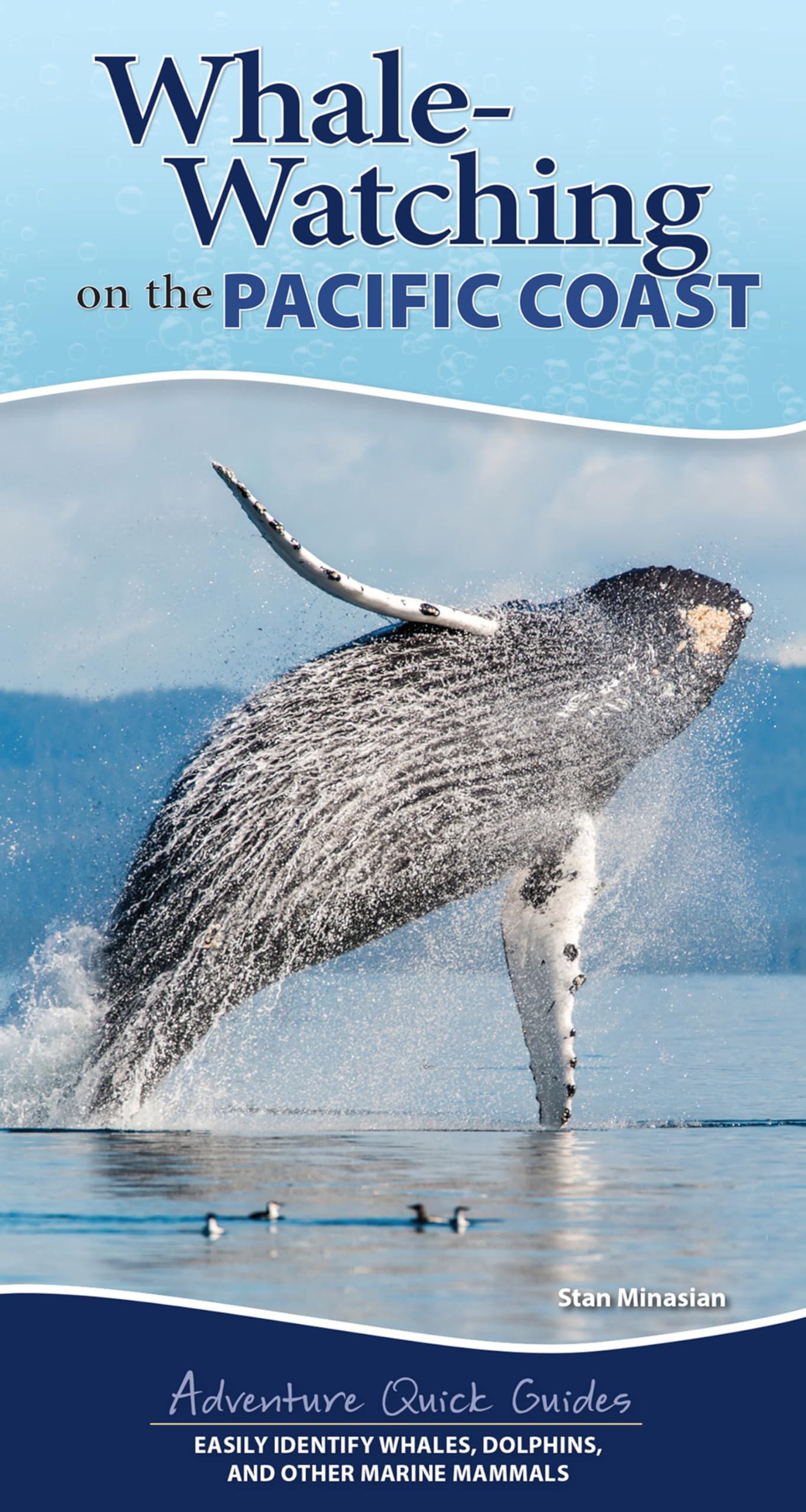
Whale-Watching on the Pacific Coast: Easily Identify Whales, Dolphins, and Other Marine Mammals (Adventure Quick Guides)
$7.90
by Stan Minasian



Identify marine mammals on your whale-watching trips and beach outings along the coast of the Pacific Ocean. Seeing a whale is an experience unlike any other. You wait, you hope, and when a beautiful creature breaks the ocean surface, the moment is as thrilling as it is unforgettable. Whether you’re a tourist on vacation or a local resident on a day trip, keep this booklet close at hand. Written by environmental educator and Emmy Award-winning documentary film producer Stan Minasian, it features more than 20 species of whales, dolphins, and porpoises. When you spot a marine mammal in the Pacific Ocean, check this guide to identify it and learn more about it! The tabbed booklet is applicable to the coastal waters of California, Oregon, Washington, Canada, and Alaska. It provides a brief introduction to cetaceans (marine mammals) and outlines what to expect when watching whales from land or while on a cruise. The guide also presents the best land-based locations for whale-watching, organized by state. The pocket-size format is much easier to use than laminated foldouts, and the tear-resistant pages help to make the spiral-bound book durable in the field. As an added bonus, the guide introduces present-day threats to whales and discusses US laws that help to protect whales, including the Marine Mammals Protection Act. The booklet documents specific requirements that whale-watching vessels must adhere to, like how far away they must remain from various whale species, and it even outlines details about a phone hotline and a smartphone app that you can access if you spot a whale in trouble. Book Features: Pocket-size format—easier than laminated foldouts - Professional photographs for quick identification - Whale-watching locations organized by state - Easy-to-use information for even casual observers - Suggestions for choosing an eco-friendly whale-watching vessel - Whale-watching “what to know” and “what to bring” tips from an expert Stan Minasian is an author, lecturer, Emmy Award-winning documentary film producer, and environmental educator. He has written, edited, and produced 16 documentaries on marine mammal and natural history issues that have been broadcast on Animal Planet, the Discovery Channel, Outdoor Life Network, National Geographic TV, Turner Broadcasting Systems, PBS, and internationally. He is a marine mammal authority, former member of the US Coast Guard Special Forces, certified diver, and surface and underwater cinematographer. Stan is the senior author of The World’s Whales: A Complete Illustrated Guide, published by Smithsonian Books. From his home in the San Francisco Bay Area, Stan has led over 200 whale-watching trips from coastal waters to the Farallon Islands and the Cordell Banks. His educational website to date has had more than 3 million visitors. Along the West Coast, three species of great whales and a variety of smaller cetaceans can often be observed from land and from whale-watching vessels. The first four species listed here are those nearly all whale-watchers set out to see. Gray Whales Each year, approximately 16,500 gray whales partake in one of the longest migrations of any mammal on Earth. Their 10,000-mile round-trip takes them from the Bering and Chukchi Seas, where they gorge on amphipods (tiny crustaceans), moving south along the coasts of Washington, Oregon, and California, destined for the warm-water lagoons of Baja California (Mexico). Arriving in these lagoons from December through February, each pregnant female gives birth to a single 17- to 20-foot calf, usually every other year. The calf nurses from the mother, gaining weight. Humpback Whales Humpback whales are well-known for their songs, which are apparently sung only by lone males. These songs can last as long as 20 minutes, after which they are repeated, often with slight changes. There are four distinct humpback populations. The Central American population feeds off the West Coast of the US and breeds along the Pacific Coast of Central America. The Mexico population feeds from California to Alaska and breeds off the coast of Mexico. The Hawaiian population feeds in the North Pacific and breeds off the Hawaiian Islands. The Western North Pacific population feeds in the far northern Pacific, mostly in the West Bering Sea, and seemingly breeds in the Pacific Ocean off the coast of Asia. Blue Whales Blue whales are among the largest animals that have ever existed on Earth, at up to 100 feet and weighing over 165 tons. Their tail alone measures 15 feet across and their heart is as large as a Volkswagen Beetle. They feed exclusively on krill, swimming through swarms of these small crustaceans with their mouths wide open, taking in tons of water and straining the organisms through their baleen plates. Some individual blue whales may take in as much as 7,000 pounds of krill per day. The historic blue whale population was estimated to have been 350,000. Yet, decades of uncontrolled whaling reduced their numbers