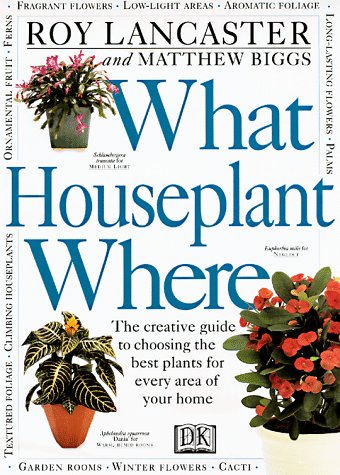



With more than four hundred beautiful full-color photographs, a valuable guide presents a vast array of houseplants designed for various home locations and conditions for year-round gardening. 15,000 first printing. Anyone who's ever mourned a failed potted plant will welcome the encouragement and practical advice this simple, colorful guide offers. The authors use several criteria--foliage and floral effects, trailing or climbing habits, and suitability for particular locations, such as bathrooms--to identify the best plant candidates for each part of the home. Concise plant listings are grouped in such sections as "Houseplants for Large Rooms," "Herbs for the Kitchen," and "Houseplants with Bold-Colored Flowers," and each listing includes plant size, care instructions, and is accompanied by a detailed photograph of leaves, flowers, and fruit (where appropriate). A section at the front gives tips on plant placement, general maintenance, and propagation; for convenience, the index lists both common and Latin names. With detailed listings for more than 400 plants and suggestions for many more, it's a great resource for every houseplant lover. Aimed at the beginner as well as the experienced houseplant gardener, this book is arranged by room characteristics or the physical features of plants (e.g., needing full light, bearing fragrant flowers). Each two-page section describes about nine plants and includes a color photograph of each. Cultural information is brief and can be misleading. For example, about poinsettias the authors say "with patience they can be encouraged to flower for a second year or more." However, they don't mention that in order to bloom poinsettias need total darkness for 14 hours each night for eight weeks starting in late September. Boxes in each section list other plants that fit the category, but not all are covered in the book. While the photographs are lovely and the layout is attractive, there are better books for beginners, including Pat Regel's The Houseplant Survival Guide (Taunton, 1997) for clear, detailed instructions on houseplant care and Ingrid Jantra and Ursula Kr?ger's The House Plant Encyclopedia (LJ 3/15/97) for information about individual species.ASue O'Brien, Downers Grove P.L., IL Copyright 1998 Reed Business Information, Inc. In this handy guide for choosing and growing houseplants, the authors have devoted a lengthy chapter to the subject of locations: houseplants for sunny windowsills, full light, dry atmospheres, and large rooms, etc. Each entry includes the plant's requirements for light, temperature, humidity, feeding, and watering, along with a color photograph and physical description. A section on floral effect suggests plants on the basis of their color, scent, and shape of flower; a section on foliage effect suggests plants for their decorative leaves (shapes, sizes, colors, textures, and even scents are considered). A section on specialist plants discusses succulents, ferns, palms, orchids, and bromeliads. The authors offer tips on everyday care, long-term maintenance, propagation, and pest and disease control. There are color photographs of more than 400 plants. George Cohen Features more than 400 houseplants for all indoor environments, from large, sunny living rooms to smaller spaces with limited natural light Includes practical suggestions for problem situations and expert advice on all aspects of caring for your plants throughout the year. END Roy Lancaster worked at the University of Cambridge Botanic Gardens and the Hillier Nurseries in Hampshire before becoming the first curator of the Sir Harold Hillier Gardens and Arboretum in 1970. Since 1980 he has been a freelance writer, plant explorer, and broadcaster. He has written many books, including What Plant Where and What Perennial Where (also published by DK),and regularly contributes to various magazines, including the Royal Horticultural Society's journal The Garden. Matthew Biggs studied horticulture at Pershore College and The Royal Botanic Gardens, Kew. His broadcasting career began on London News Radio and continued on many radio and television gardening programs. Matthew is particularly fascinated by houseplants and has traveled widely to see them both wild and cultivated in places as far afield as the Caribbean and Indonesia.END Anyone who has successfully grown plants at home will know the satisfaction of cultivating healthy and attractive houseplants. They offer many different ornamental effects and bring the natural world indoors - a particularly welcome feature in homes without gardens. Many people are discouraged from growing houseplants by an initial lack of success. IN this book, we not only offer advice for caring from each plant, but also on where to site it. This is a crucial part of successful cultivation, and a plant's native origins can provide some valuable clues to the kind of indoor environment in which it will thrive. TABLE OF CONTENTS: Where do Houseplants Come From?;