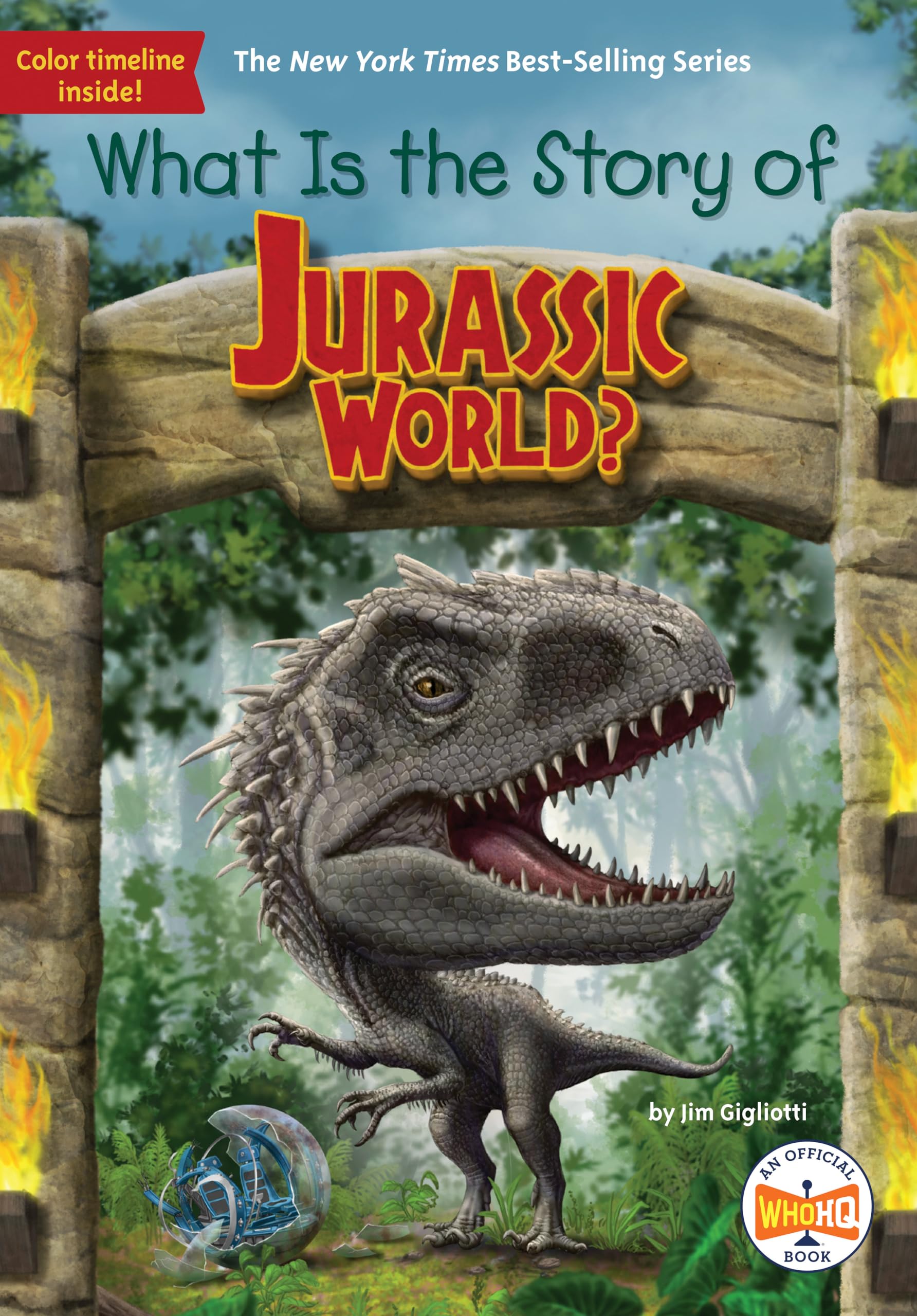



Prepare to be thrilled by an imaginary world where dinosaurs have been brought back to life and roam alongside humans in this Who HQ book all about Jurassic World ! Discover the action-packed history of Jurassic World and how dinosaur fans of all ages came to love the series' movies, books, TV shows, and even theme park rides. From the 1990 Michael Crichton novel to the movies still releasing today, young readers will love stepping into this world where dinosaurs rule. The Jurassic World franchise has thrilled fans for decades by building a world where science and adventure meet, raising the question: Could dinosaurs and humans ever really live together? Jim Gigliotti is a writer based in Southern California. A former editor at the National Football League, he has written more than 50 books for readers of all ages, including biographies for young readers on Olympian Jesse Owens, baseball star Roberto Clemente, scientist Nikola Tesla, and musician Stevie Wonder. What Is the Story of Jurassic World? One day in the late 1980s, when author Michael Crichton and his wife were preparing for the birth of their first child, the famous writer bought a stuffed dinosaur. Then he bought another. And another. And still another. He bought so many stuffed dinosaurs, in fact, that his wife finally stopped him and said, “Why is this happening?” It was happening because Michael Crichton had loved dinosaurs ever since he was young. He knew that many other children felt the same way. And he decided right then that he would write a book with dinosaurs in it. The book, which reached stores in November 1990, was called Jurassic Park. The idea behind Crichton’s story went like this: Sixty-five million years ago, a mosquito landed on a dinosaur. The mosquito bit the dinosaur, sucking a small amount of blood from the animal, then buzzed off to rest on a tree. But the mosquito was caught in a sticky, sap-like substance on the tree called resin. The insect couldn’t escape, and it died. After that, the resin expanded to surround the dead insect and hardened into amber. So the insect was perfectly preserved in amber. The story then jumped ahead to the late twentieth century, when workers on a remote island in Central America dug up that same piece of amber. A scientist inserted a probe into the amber and removed the mosquito blood, which contained the dinosaur blood that the insect had sucked. The scientist took the genetic building blocks from the dinosaur blood and re-created the long-extinct creature. A businessman saw an opportunity in this amazing technology. He hired scientists to create several different species of dinosaurs, then bought the Central American island and built a theme park where the animals could live and people could visit them. The dinosaurs in Michael Crichton’s story weren’t described as just pictures in a book or bones in a museum. Visitors to the theme park could see and hear the incredible living creatures for themselves. Of course, many safety precautions were put in place, but things didn’t go exactly as planned. It was the beginning of an exciting—and terrifying—adventure tale. In 1993, Universal Pictures produced Jurassic Park , the first of several movies based on Crichton’s book. The combination of realistic science, awe-inspiring dinosaurs, and a thrilling story made the film the biggest blockbuster up to that time in movie history and launched one of the most successful franchises of all time. Since then, Michael Crichton’s book Jurassic Park has grown into Jurassic World—an entire world of movies, books, games, theme park encounters, and more. Let’s dig into the story of Jurassic World! Chapter 1: The Jurassic Age Why are so many people fascinated by dinosaurs? A paleontologist (say: PAY-lee-on-TAH-lo-jist) named Stephen Jay Gould once famously said it is because they are “big, fierce, and extinct.” A paleontologist is a scientist who studies fossils to learn about ancient life forms. Fossils are any traces of plant or animal lifelike the bones or teeth of a dinosaur—that have been preserved in the earth’s crust. Gould’s quote meant that even though many dinosaurs might have been huge, scary animals, we aren’t afraid of them because they don’t exist anymore. They last roamed the earth about sixty-five million years ago. It is true that many dinosaurs were big. Scientists estimate the dinosaur Argentinosaurus (say: ar-jen-TEEN-uh-SORE-us) was the largest land animal ever. They believe the four-legged giant was as long as 130 feet and as tall as 65 feet. Not many animals were as fierce as Tyrannosaurus rex (say: tu-RAN-uh-SORE-us REX). T. rex , as it also is known, could bite with a force of eight to ten thousand pounds per square inch. That’s more than double the bite of a saltwater crocodile, which has the most powerful bite of any animal alive today, and more than fifty times the bite of a human! An