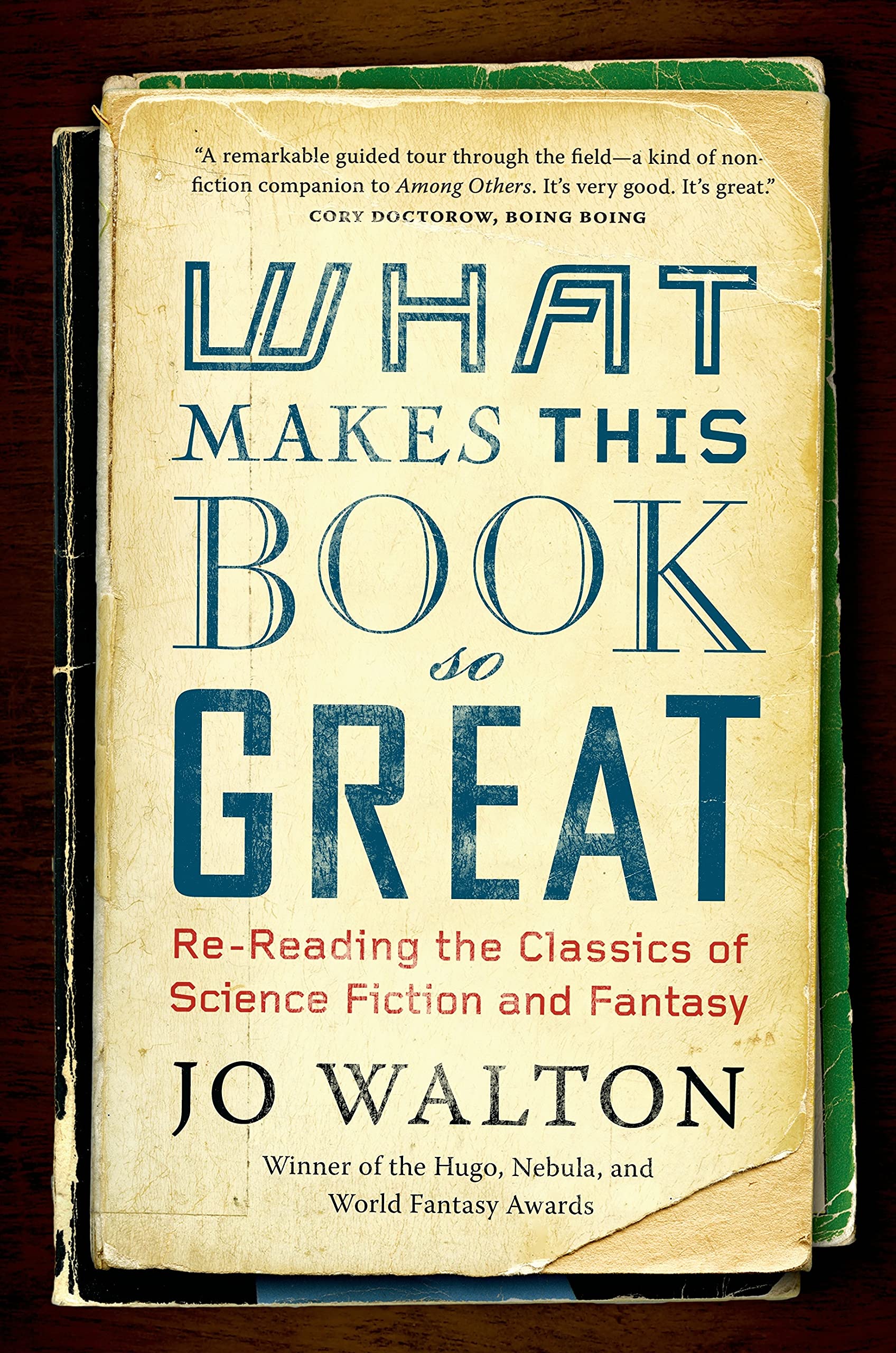



As any reader of Jo Walton's Among Others might guess, Walton is both an inveterate reader of SF and fantasy, and a chronic re-reader of books. In 2008, then-new science-fiction mega-site Tor.com asked Walton to blog regularly about her re-reading ― about all kinds of older fantasy and SF, ranging from acknowledged classics, to guilty pleasures, to forgotten oddities and gems. These posts have consistently been among the most popular features of Tor.com. Now this volume presents a selection of the best of them, ranging from short essays to long reassessments of some of the field's most ambitious series. Among Walton's many subjects here are the Zones of Thought novels of Vernor Vinge; the question of what genre readers mean by "mainstream"; the underappreciated SF adventures of C. J. Cherryh; the field's many approaches to time travel; the masterful science fiction of Samuel R. Delany; Salman Rushdie's Midnight's Children; the early Hainish novels of Ursula K. Le Guin; and a Robert A. Heinlein novel you have most certainly never read. Over 130 essays in all, What Makes This Book So Great is an immensely readable, engaging collection of provocative, opinionated thoughts about past and present-day fantasy and science fiction, from one of our best writers. "For readers unschooled in the history of SF/F, this book is a treasure trove."― Publishers Weekly JO WALTON won the Best Novel Hugo and Nebula Awards for Among Others (2011) and the World Fantasy Award for Tooth and Claw (2003). She is the only writer other than Ursula K. Le Guin to win Best Novel in all three awards. Aside from her many other acclaimed novels, she has written extensively about SF and fantasy for Tor.com and other venues for over two decades. She lives in Montreal. What Makes This Book So Great By Jo Walton Tom Doherty Associates Copyright © 2015 Jo Walton All rights reserved. ISBN: 978-0-7653-3194-6 JULY 16, 2011 1. Introduction This book is made up of a series of blog posts I wrote on Tor.com between July 2008 and February 2011. They appear here in order, and with their original dates. These are about a fifth of the total posts I made during that time. You don’t have to read them in order, but sometimes one will refer back to another and develop an argument. I wrote them as blog posts, and so they are inherently conversational and interactive—they were written in dialogue with each other and also with the people reading and commenting. I think they are still interesting when taken out of that context, but if reading them here makes you splutter “but, but” and reach for the follow-up key, the posts are still online, and I am still reading comments. Interaction remains a possibility. I’m still writing new posts too. (If, however, you are reading this in a far distant future in which this is no longer a possibility, hello! Nobody would have liked to talk to someone from your world more than I would, and any regrets are on both sides.) The brief I was given when I started writing for Tor.com was to talk about what I was re-reading. Patrick Nielsen Hayden said that I was always saying “smart things about books nobody else had thought about for ages,” and that’s what I tried to do. You won’t find any reviews here. Reviews are naturally concerned with new books, and are first reactions. Here I’m mostly talking about older books, and these are my thoughts on reading them again. There are posts on books in many genres and published between 1871 and 2008, but the emphasis is on older science fiction and fantasy. There are also posts here about the act of reading and re-reading, and about the genres of science fiction and fantasy and the boundaries between them. When I talk about books that aren’t science fiction and fantasy, I’m looking at them from a genre perspective, whether it’s how George Eliot should have single-handedly invented science fiction or wishing wistfully that A. S. Byatt had read Delany. My general approach to the books in these pieces is as a genre-reader, but not as a generic reader. There’s no impersonality here, no attempt at objectivity. These are my thoughts and opinions, for what they’re worth, my likes and dislikes, my quirks and prejudices and enthusiasms. I select the books I re-read based on what I feel like reading at the moment, so these are my tastes. I do from time to time write about books I don’t enjoy, for one reason or another, but what you’ll mostly find are attempts to consider the question I ask in the title of this collection—what makes this book so great? JULY 15, 2008 2. Why I Re-read There are two kinds of people in the world, those who re-read and those who don’t. No, don’t be silly, there are far more than two kinds of people in the world. There are even people who don’t read at all. (What do they think about on buses?) But there are two kinds of readers in the world, though, those who re-read and those who don’t. Sometimes people who don’t re-read look at me oddl