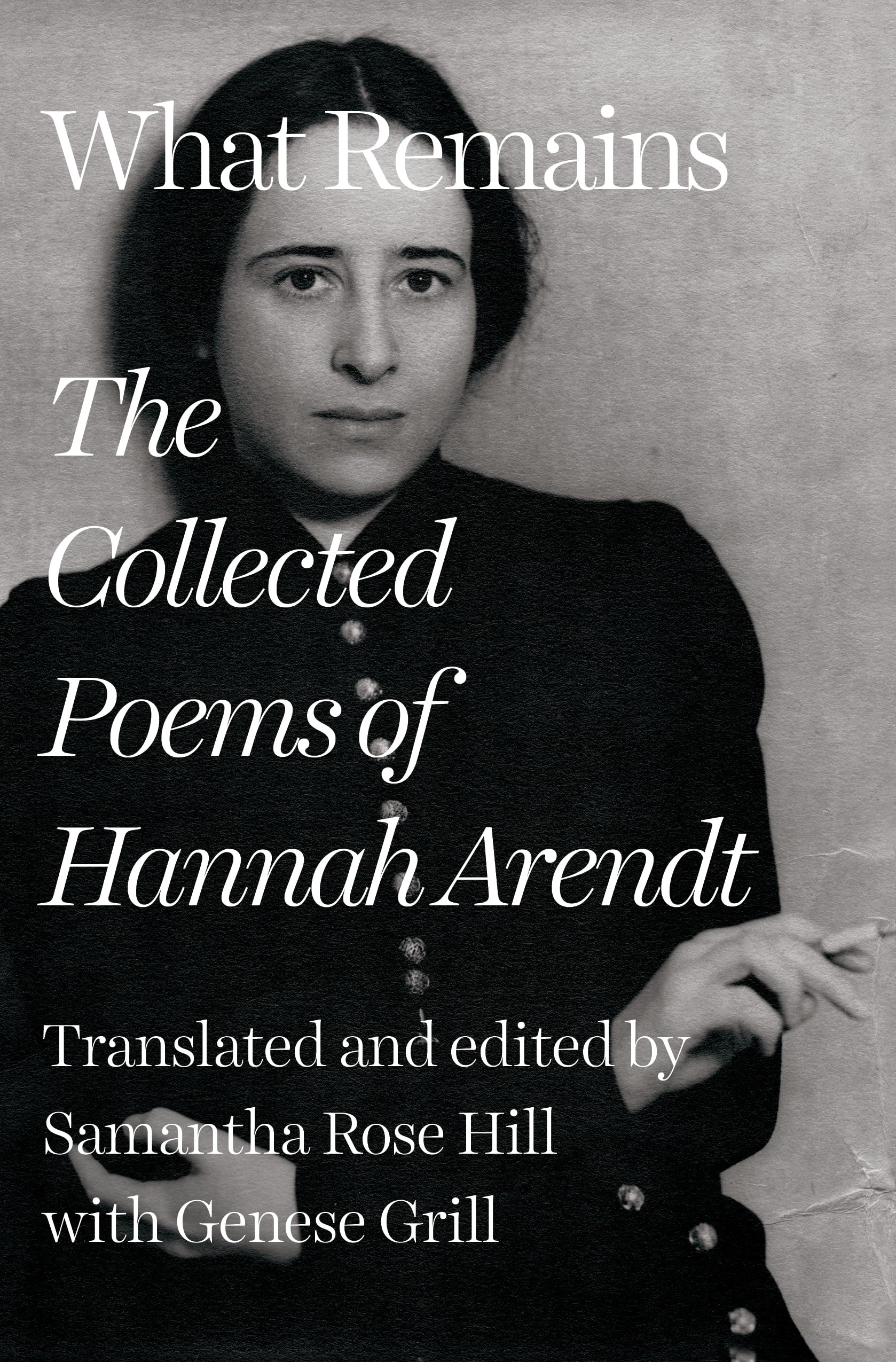



A landmark literary event, What Remains collects Arendt’s complete poetic oeuvre―never before published in English. Internationally renowned as one of the twentieth century’s foremost public intellectuals, Hannah Arendt was also intensely private. Though she often acknowledged that the language of poetry―especially that of Dickinson, Goethe, and Lowell―informed her work, only a few people knew that Arendt herself wrote poems. In fact, between 1923 and 1961, Arendt wrote seventy-four poems, many of them signposts in an otherwise unwritten autobiography. For nearly forty years after her death, these poems remained hidden among the archives of the Library of Congress, until 2011, when they were rediscovered by scholar and translator Samantha Rose Hill. Now, for the first time in English, Hill and Genese Grill present Arendt’s poems in chronological order, taking us from the zenith of the Weimar Republic to the Cold War, and from Marburg, Germany, to New York’s Upper West Side. Throughout, Arendt uses poetry to mark moments of joy, love, loss, and reflection. In “W. B.,” written in 1942, she remembers Walter Benjamin, who died near the French-Spanish border while attempting to flee the Nazis: “Gentle whispering melodies / Sound from the darkness. / We listen so we can let go.” So, too, she reflects on mutability and transience in 1946: “I know that the houses have fallen. / We entered the world in them, wonderfully sure, that they / were more durable than ourselves.” She tries to understand her place in the world: “Ironically foolish, / I’ve forgotten nothing, / I know the emptiness, / I know the burden, / I dance, I dance / In ironic splendor.” A gift to all readers of Arendt, this stunning, dual-language edition provides an unparalleled view into the inner sanctum of one of our most original thinkers. 1 illustration "A new volume of [Arendt’s] poetry reveals that the author of sobering works like The Origins of Totalitarianism and The Human Condition was writing ardent and intimate verse in her off-hours." ― Srikanth Reddy, The Paris Review "The strongest contribution of What Remains is its bright illumination of Arendt’s overall body of work―her intellectual dissection of authoritarian rule, her sorrow in the face of the fracturing of the society she knew, and her deep love for the world." ― Hannah Joyner, Open Letters "In What Remains: The Collected Poems of Hannah Arendt , translator and editor Samantha Rose Hill, with Genese Grill, has given us that rare thing―a testament to what poetic thinking might be, available to all readers, and keenly attuned to our political moment. In their hands, this is less an academic volume than a story well told. . . . This work should deepen our attachment to Arendt not simply as a philosopher but also as a thinker whose value stands above disciplines, a human person who left a record of a life lived awake and alive. Arendt turned to poetry both for release and for reflection. This book reminds us of what poetic thinking is and why we need it now." ― Katie Peterson, Los Angeles Review of Books " What Remains reveals, or confirms, Arendt’s status as a poetic thinker . . . although she can come across as sentimental, Arendt is also thinking about desire, death, melancholy, and the consolations of nature―and how to fashion a metaphor-laden language to do it all justice." ― Brian Dillon, 4Columns "These delightful poems provide a window into Arendt’s vibrant engagements with the world.... This volume is a treasure for fans of Arendt and poetry." ― Julie R. Enszer, Jewish Book Council "In truth, Arendt the poet exhibits a real though not illimitable talent, a mind whose natural tilt is toward prose but which has a second-natural command, acquired through years of faithful recitation, of the volkslied and the ode." ― Kelly M.S. Swope, Marginalia Review of Books "Arendt’s work on totalitarianism and her direct experience of escaping Europe are reflected in her poems, which are also in direct, at times allusive conversation with the German poets she treasured, including Goethe, Hölderlin, and Rilke. Their strength lies in their tenderness and self-exposure . . . These unsparing, literate, and surprisingly candid poems offer a fascinating new angle on one of the 20th century’s great minds." ― Publishers Weekly "Readers well versed in Arendt’s influential political philosophy may not know that she also wrote poetry as a private affair. As quoted in editor/translator Hill’s introduction, Arendt saw poetry as the art whose ‘end product remains closest to the thought that inspired it.’ . . . Accessible distillations of heart and mind; readers don’t have to know Arendt’s philosophy (or philosophy generally) to read this work profitably and with pleasure." ― Library Journal (starred review) "These poems construct a most personal, subtle, and affecting autobiography. They are intense, emotional and yet do not yield to our voyeurist