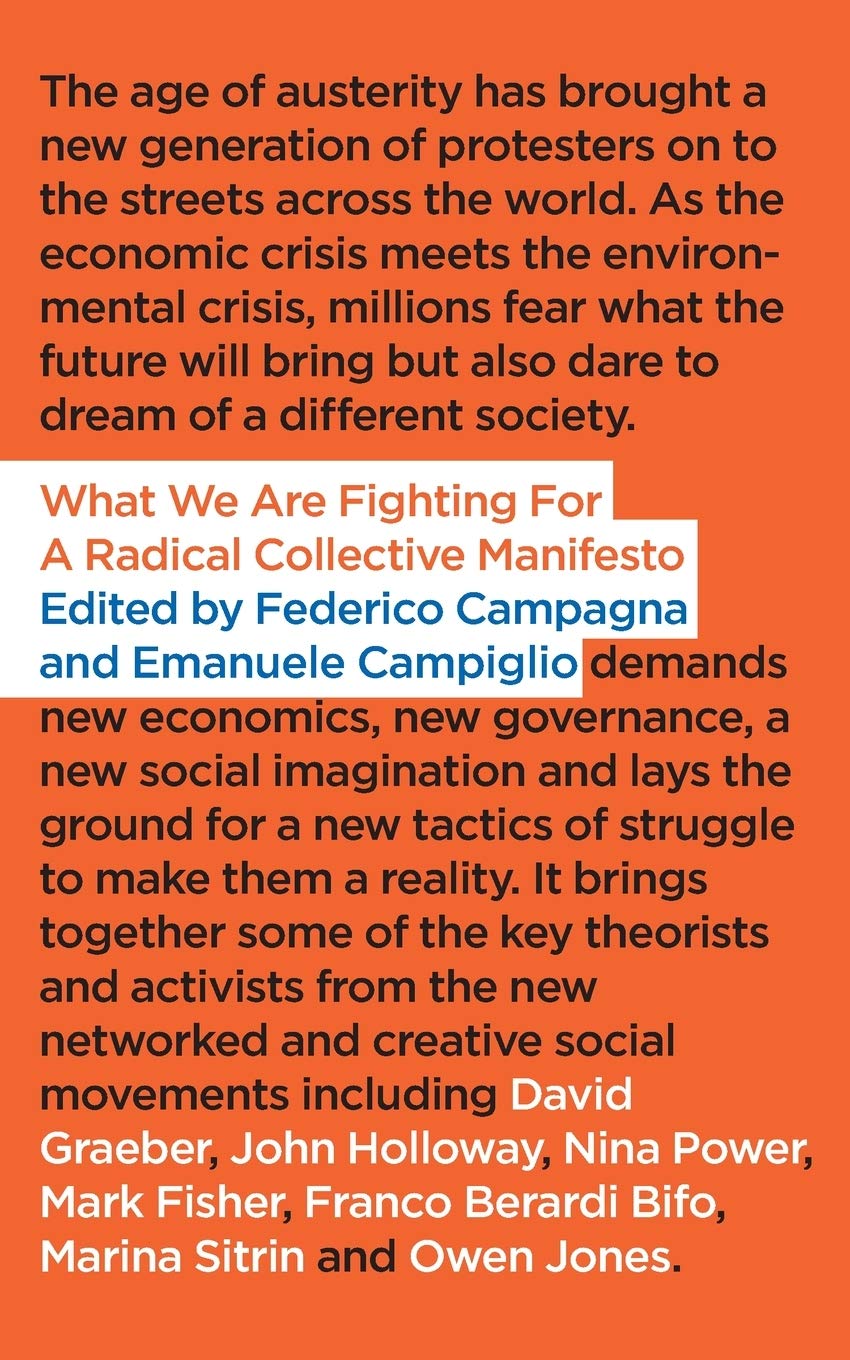



*Shortlisted for the Bread and Roses Prize, 2013* From the pens of major figures of the anti-austerity movement, comes the first radical, collective manifesto of the new decade. From participatory democracy to media reform, from direct action to communal living, What Are We Fighting For is a bold look at alternatives to the economic, social and political travesty of contemporary capitalism. Chapters from Owen Jones, David Graeber, John Holloway, Nina Power, Mark Fisher, Franco Berardi Bifo and Marina Sitrin show a multifaceted but collective desire for a better world. Anarchists, communists, feminists and autonomists come together to inspire us to think beyond neoliberalism. "Here are the first flowers of spring: the beginning of an epochal dialogue about the human future. Inspired by the Occupy movements across the world, What We Are Fighting For should inspire all of us to join the conversation." - Mike Davis, author of Planet of Slums and City of Quartz "This collection provides a rallying point for all those who resist the dogmas of contemporary politics and seek a fresh set of alternatives. What We Are Fighting For is a manifesto full of urgent, articulate responses to the current situation." - Simon Critchley, Hans Jonas Professor of Philosophy at the New School, New York, and author of The Faith of the Faithless (2012). Federico Campagna is a writer and activist. He is one of the founders of the journal Through Europe and contributes to a number of magazines and radio programmes in Italy and the UK. He organised the 'What are we struggling for?' conference at the ICA, London, and is the editor of Franco Berardi Bifo's forthcoming reader. Emanuele Campiglio is a Researcher at the New Economics Foundation. What We Are Fighting For A Radical Collective Manifesto By Federico Campagna, Emanuele Campiglio Pluto Press Copyright © 2012 Federico Campagna and Emanuele Campiglio All rights reserved. ISBN: 978-0-7453-3285-7 Contents Acknowledgements, vii, Preface: Exodus Without Promised Land Christian Marazzi, viii, Notes on Contributors, xii, Introduction: What Are We Struggling For? Federico Campagna and Emanuele Campiglio, 1, Part 1 New Economics, 1 Participatory Economics from Capitalism Michael Albert, 11, 2 Let Ideas and Art be International, Goods be Homespun and Finance Primarily National Ann Pettifor, 18, 3 A New Local Financial System for Sustainable Communities Milford Bateman, 29, 4 The Struggle for Meaning Shaun Chamberlin, 42, Part 2 New Governance, 5 Towards a New Model Commune Richard Seymour, 55, 6 People and Power: Four Notes on Democracy and Dictatorship Peter Hallward, 61, 7 Practical Utopianism and Ecological Citizenship Mark J. Smith, 73, 8 Occupy: Making Democracy a Question Marina Sitrin, 85, Part 3 New Public, 9 New Class Politics Owen Jones, 97, 10 'An Excess of Democracy' Hilary Wainwright, 104, 11 A Programme of Media Reform Dan Hind, 115, 12 Renewing Intersectionality Zillah Eisenstein, 123, Part 4 New Social Imagination, 13 Post-Capitalist Desire Mark Fisher, 131, 14 The Transversal Function of Disentanglement Franco Berardi 'Bifo', 139, 15 Why Do We Obey? Saul Newman, 146, 16 Squandering Federico Campagna, 153, Part 5 Tactics of Struggle, 17 Revolution at the Level of Common Sense David Graeber, 165, 18 Winning the Media War: Why There is no Such Thing as a Bad Protester Nina Power, 176, 19 Reforming the Unreformable Alberto Toscano, 182, 20 Direct Action and Unmediated Struggle South London Solidarity Federation, 190, Afterword: Rage Against the Rule of Money John Holloway, 199, CHAPTER 1 Participatory Economics from Capitalism Michael Albert In the words of the great British economist John Maynard Keynes: '[Capitalism] is not a success. It is not intelligent, it is not beautiful, it is not just, it is not virtuous – and it doesn't deliver the goods. In short, we dislike it, and we are beginning to despise it. But when we wonder what to put in its place, we are extremely perplexed.' Let's see if we can undo some of the perplexity. First, what's the real problem with capitalism? ... Capitalism is theft. The harsh and subservient labours of most citizens fantastically enrich an elite who, if they so choose, don't have to labour at all. On the upper West Side of New York City, within a mile of one another, there exist neighbourhoods in which the average disposable income is, on the poorer side, about $5,000 per year, and, on the richer side, about $500,000 per year. The richest people in the US have wealth unparalleled in history. The poorest people in the US live under bridges inside threadbare cardboard shelters, or they stop living at all. This gap is not explained by a difference in industriousness, in talent, etc. It is a social product, a theft, and the gap between rich and poor nations, as we all know, is even more dramatic. Capitalism is alienation and anti-sociality. Within capitalism the motives