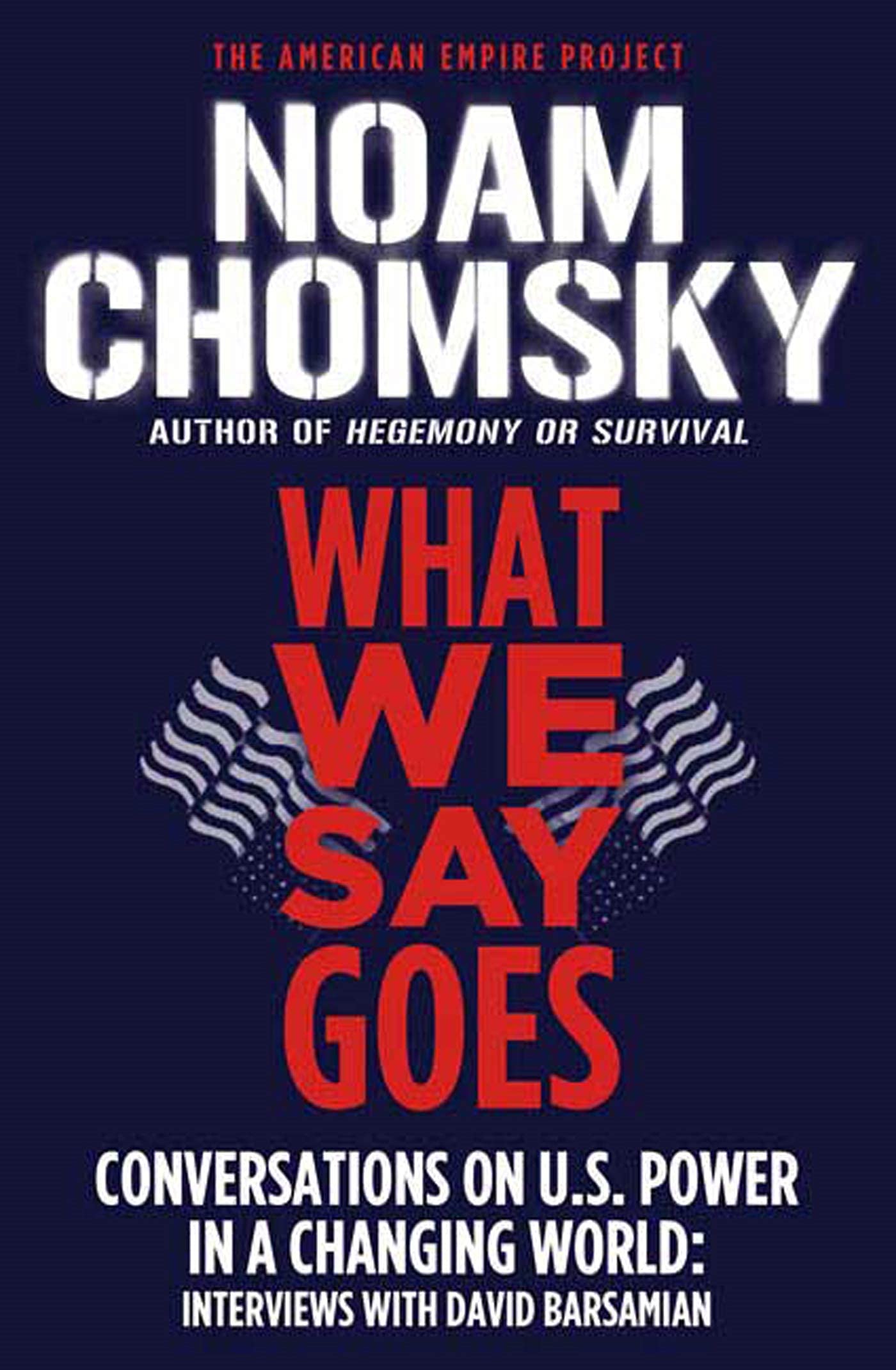
What We Say Goes: Conversations on U.S. Power in a Changing World (American Empire Project)
$10.87
by Noam Chomsky



An indispensable set of interviews on foreign and domestic issues with the bestselling author of Hegemony or Survival , "America's most useful citizen." ( The Boston Globe ) In this collection of conversations, conducted in 2006 and 2007, Noam Chomsky explores the most immediate and urgent concerns: Iran's challenge to the United States, the deterioration of the Israel-Palestine conflict, the ongoing occupations of Iraq and Afghanistan, the rise of China, and the growing power of the left in Latin America, as well as the Democratic victory in the 2006 U.S. midterm elections and the upcoming presidential race. As always, Chomsky presents his ideas vividly and accessibly, with uncompromising principle and clarifying insight. This volume from a long-established, trusted partnership, What We Say Goes shows once again that no interlocutor engages with Chomsky more effectively than David Barsamian. These interviews will inspire a new generation of readers, as well as longtime Chomsky fans eager for his latest thinking on the many crises we now confront, both at home and abroad. They confirm that Chomsky is an unparalleled resource for anyone seeking to understand our world today. “Chomsky criticizes those journalists and public intellectuals who, in reporting and commenting on events, do not question the assumptions under which the country acts and have framed the debate so that only the details are fodder for discussion. Chomsky's points are challenging.” ― Library Journal Noam Chomsky is the author of numerous bestselling political works, including Hegemony or Survival and Failed States . A laureate professor at the University of Arizona and professor emeritus of linguistics and philosophy at MIT, he is widely credited with having revolutionized modern linguistics. He lives in Tucson, Arizona. David Barsamian , director of the award-winning and widely syndicated Alternative Radio, is a winner of the Lannan Foundation's Cultural Freedom Fellowship and the ACLU's Upton Sinclair Award for independent journalism. He lives in Boulder, Colorado. His interviews with Noam Chomsky have been published as books, including Imperial Ambitions and Global Discontents . What We Say Goes Conversations on U.S. Power in a Changing World By Chomsky, Noam Metropolitan Books Copyright © 2007 Chomsky, Noam All right reserved. ISBN: 9780805086713 Chapter 1 James Traub, in the New York Times Magazine, writes, “Of course, treaties and norms don’t restrain the outlaws. The prohibition on territorial aggression enshrined in the UN Charter didn’t faze Saddam Hussein when he decided to forcibly annex Kuwait.” Then he adds, “When it comes to military force, the United States can, and will, act alone. But diplomacy depends on a united front.”1 As Traub knows very well, the United States is a leading outlaw state, totally unconstrained by international law, and it openly says so. What we say goes. The United States invaded Iraq, even though that’s a radical violation of the United Nations Charter. If he knows that, why doesn’t he write it in the article? If he wrote that, then he wouldn’t be writing for the New York Times. There is a certain discipline that you have to meet. In a well-run society, you don’t say things you know. You say things that are required for service to power. That reminds me of the story of the emperor Alexander and his encounter with a pirate. I don’t know if it happened, but according to the account from Saint Augustine, a pirate was brought to Alexander, who asked him, How dare you molest the seas with your piracy? The pirate answered, How dare you molest the world? I have a small ship, so they call me a pirate. You have a great navy, so they call you an emperor. But you’re molesting the whole world. I’m doing almost nothing by comparison.2 That’s the way it works. The emperor is allowed to molest the world, but the pirate is considered a major criminal. Eighteen Pakistani civilians were killed in a U.S. missile attack on Pakistan in January 2006. The New York Times, in an editorial, commented, “Those strikes were legitimately aimed at top fugitive leaders of Al Qaeda.”3 That’s because the New York Times agrees, and always has, that the United States should be an outlaw state. That’s not surprising. The United States has the right to use violence where it chooses, no matter what happens. If we hit the wrong people, we might say, “Sorry, we hit the wrong people.” But there should be no limits on the right of the United States to use force. The Times and other liberal media outlets are exercised about domestic surveillance and invasions of privacy. Why doesn’t that concern for law extend to the international arena? Actually, the media are very concerned, just like James Traub, with violations of international law: when some enemy does it. So the policy is completely consistent. It should never be called a double standard. It’s a single standard of subo