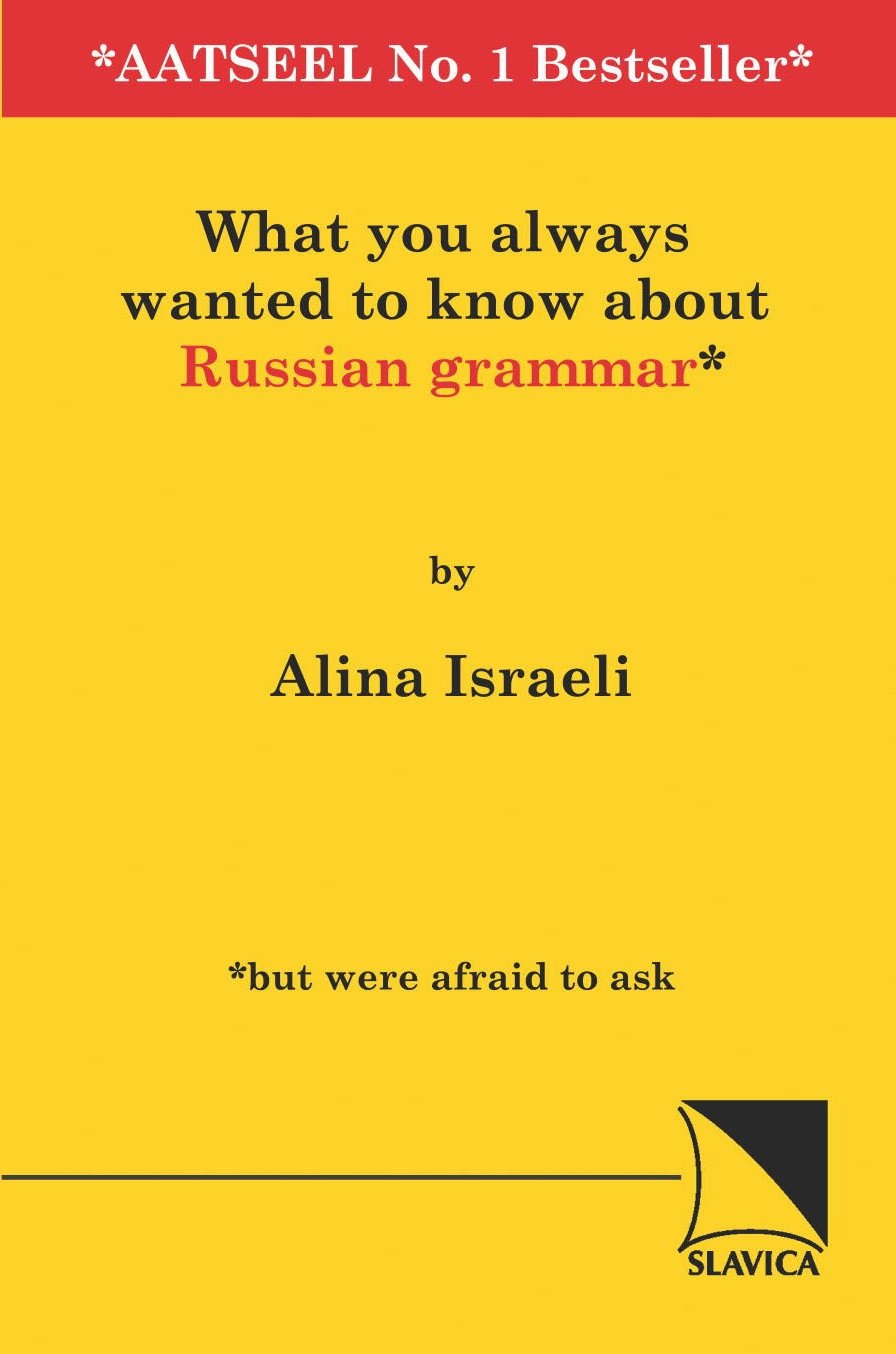
What You Always Wanted to Know About Russian Grammar: But Were Afraid to Ask
$34.95
by Alina Israeli



What You Always Wanted to Know about Russian Grammar (*But Were Afraid to Ask) begins where textbooks and conventional grammars leave off: with the perplexing, poorly explained, often maddening aspects of Russian that drive English-speaking students and even their teachers and professors crazy! The author provides authoritative and thoroughly researched answers to 65 thorny questions submitted over a 10-year period by the readers of her regular column in the newsletter of the American Association of Teachers of Slavic and East European Languages (AATSEEL). Many of the questions deal with puzzling (quasi-)synonyms: when do I say this and when do I say that, and why? Other questions deal with contradictions: why does the textbook tell me to say this, but native speakers of Russian say that? Or why do older Russians say this, but younger Russians say that? In answering these questions, Dr. Israeli, a native speaker, draws on her decades of linguistic scholarship, lifelong love of puzzles, and general sense of humor to present the clearest, easiest-to-understand, and most humorous explanations of Russian grammar that you will ever read, most of them supported with real-life examples drawn from historical and contemporary prose, media, and the Internet. If you are an advanced student or instructor of Russian who has been struggling with the finer points of Russian grammar (and who among us hasn t?), this book is for you! ... With seven chapters, five or which are dedicated to parts of speech (verbs, nouns, adjectives, prepositions, and adverbs), one dedicated to numerals, and one dedicated to problems of syntax, Israeli takes up some of the most complicated, which is to say the most interesting, issues of Russian grammar. Indeed, Israeli addresses issues that even experts in the field find challenging.... Israeli's book constitutes a significant contribution to our field in her successful analysis of the dynamics of language change, both retrospectively and currently.... I highly recommend this book as a standard reference for every teacher of Russian at the intermediate or advanced levels, who will undoubtedly find its explanations extraordinarily helpful because they clarify the nuances of meaning available in one or another linguistic choice, nuances that few native speakers of Russian can articulate clearly beyond identifying an instinctive sense of one or another choice being best in a particular linguistic context. Indeed the volume's only flaw is its brevity. I wish there were more essays in each chapter, and will simply wait for a successor volume to be published. Indeed, while I enjoyed reading the volume from cover to cover, I imagine using it most productively as a reference to draw upon when faced with a thorny problem of translation or a question from an advanced student. Even when the solution to a given problem is too complicated for students to master in their spontaneous speech at their current level of instruction, Israeli's answer will inspire learners with the complexity of human language and culture, in general, and of Russian language and culture in particular, and will help us all appreciate the beauty of this living language. --Benjamin Rifkin, Slavic and East European Journal Alina Israeli was born and grew up in what she still calls Leningrad. From an early age she was fond of problems and puzzles and ended up in a mathematical high school and then at the math department at Leningrad University. Meanwhile (that is from a very early age) she was studying foreign languages: first French, then English, later Italian and Polish. Eventually she realized that she had confused her love of puzzles and logic with a love of math and became a student in the Russian department at Leningrad State University, where she began studying linguistics. In the mid-1970s she emigrated under the pretense of going to Israel (where she has never been to this day) and arrived in the US where she soon started studying Slavic linguistics at Yale. Ever since, she has been teaching Russian to Americans, which presented an interesting and never ending puzzle, bits of which she unravels in this book.