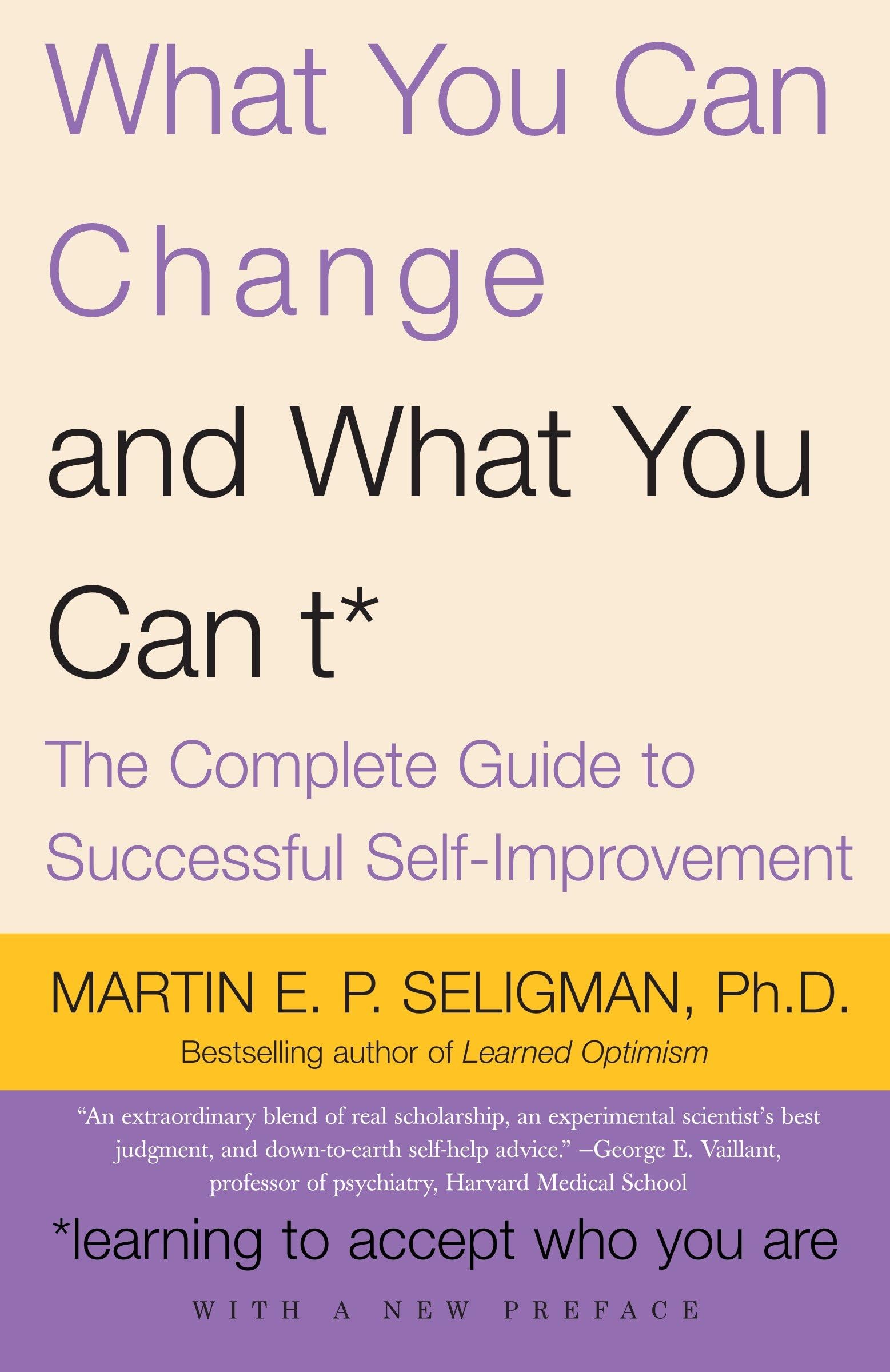
What You Can Change and What You Can't: The Complete Guide to Successful Self-Improvement
$12.70
by Martin E.P. Seligman



Wise, direct, and very useful, a science-based book that can help anyone make long-lasting change. In the climate of self-improvement that pervades our culture, there is an overwhelming amount of information about treatments for everything from alcohol abuse to sexual dysfunction. Much of this information is exaggerated if not wholly inaccurate. As a result, people who try to change their own troubling conditions often experience the frustration of mixed success, success followed by a relapse, or outright failure. To address this confusion, Martin Seligman has meticulously analyzed the most authoritative scientific research on treatments for alcoholism, anxiety, weight loss, anger, depression, and a range of phobias and obsessions to discover what is the most effective way to address each condition. He frankly reports what does not work, and pinpoints the techniques and therapies that work best for each condition, discussing why they work and how you can use them to change your behaviors. Inside you’ll discover the four natural healing factors for recovering from alcoholism; the vital difference between overeating and being overweight; the four therapies that work for depression, the pros and cons of anger—and much more. “So much more sensible and lucid than most self-help gurus—constantly rewards anyone interested in individual psychology. Absolutely splendid.” — Booklist “Extremely well-written. . . . Throughout, Seligman uses outcome studies to identify what works in making change.” — Library Journal “Enlightening. . . . Seligman’s observations and theories are positive, realistic and sound.” — Publishers Weekly MARTIN E.P. SELIGMAN, PH.D., professor of psychology at the University of Pennsylvania and a past president of the American Psychological Association, is a leading motivational expert and an authority on learned helplessness. His many books include Learned Optimism , What You Can Change and What You Can't , Authentic Happiness , and The Optimistic Child . Dr. Seligman's research has been supported by the National Institute of Mental Health, the National Institute on Aging, the National Science Foundation, the MacArthur Foundation, and the Guggenheim Foundation. 1 What Changes? What Doesn't Change? TWO WORLDVIEWS are in collision. On the one hand, this is the age ofpsychotherapy and the age of self-improvement. Millions are struggling to change: We diet, we jog, we meditate. We adopt new modes of thought to counteract our depressions. We practice relaxation to curtail stress. We exercise to expand our memory and to quadruple our reading speed. We adopt draconian regimes to give up smoking. We raise our little boys and girls to androgyny. We come out of the closet or we try to become heterosexual. We seek to lose our taste for alcohol. We seek more meaning in life. We try to extend our life span. Sometimes it works. But distressingly often, self-improvement and psychotherapy fail. The cost is enormous. We think we are worthless. We feel guilty and ashamed. We believe we have no willpower and that we are failures. We give up trying to change. Trudy, like tens of millions of Americans, is desperate because she believes, quite incorrectly, that she is a failure. She finds herself even worse off after ten years of trying everything to lose weight. Trudy weighed 175 pounds when she graduated from Brown a decade ago. Four times since, she has slimmed to under 125: Weight Watchers, Nutri-System, six months under the care of a private behavior therapist, and, last year, Optifast. With each regime the weight came off quickly, if not painlessly. Each time the fat returned, faster and more of it. Trudy now weighs 195 and has given up. In its faith that we can change anything, the self-improvement movement expects Trudy to succeed in her fight against fat, even though she is such an obvious loser in the weight game. On the other hand, there is a view that expects Trudy to fail. For this is not only the age of self-improvement and therapy, this is the age of biological psychiatry. The human genome will be nearly mapped before the millennium is over. The brain systems underlying sex, hearing, memory, left-handedness, and sadness are now known. Psychoactive drugs--external agents--quiet our fears, relieve our blues, bring us bliss, dampen our mania, and dissolve our delusions more effectively than we can on our own. Our very personality--our intelligence and musical talent, even our religiousness, our conscience (or its absence), our politics, and our exuberance--turns out to be more the product of our genes than almost anyone would have believed a decade ago. Identical twins reared apart are uncannily similar in all these traits, almost as similar as they are for height and weight. The underlying message of the age of biological psychiatry is that our biology frequently makes changing, in spite of all our efforts, impossible. But the view that all is genetic and biochemical and therefore c