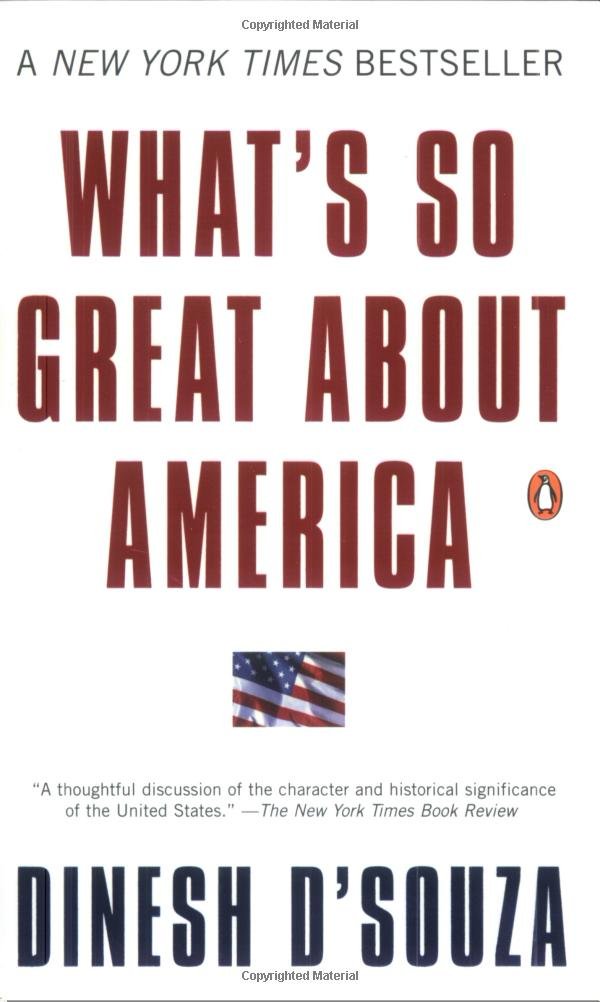



With What's So Great About America , Dinesh D'Souza is not asking a question, but making a statement. The former White House policy analyst and bestselling author argues that in the aftermath of September 11, 2001, American ideals and patriotism should not be things we shy away from. Instead he offers the grounds for a solid, well-considered pride in the Western pillars of "science, democracy and capitalism," while deconstructing arguments from both the political Left and political Right. As an "outsider" from India who has had amazing success in the United States, D'Souza defends not an idealized America, but America as it really is, and measures America not against an utopian ideal, but against the rest of the world in a provocative, challenging, and personal book. “D’Souza offers sharp and poignant observations on…freedom and opportunity.” The Wall Street Journal “A fast-paced, well-thought, and quietly deep assessment of America’s place in the world.” Daniel Pipes , director of the Middle East Forum “The best discussion I’ve seen on the nature of the Islamic threat, and the best argument against racial reparations.” Shelby Steele , author of the Content of Our Character Dinesh D'Souza, a former White House domestic policy analyst, is currently the Rishwain Research Scholar at the Hoover Institution at Stanford University. He is the bestselling author of several acclaimed books. WHY THEY HATE US America and Its Enemies * * * The cry that comes from the heart of the believer overcomes everything, even the White House. —Ayatollah Khomeini Before the terrorists destroyed the World Trade Center, crashed a plane into the Pentagon, and began their campaign to bring to America the horrors of the war-ravaged Middle East, life in the United States was placid and even a little boring. The dominant issue in politics was the Social Security lockbox, an especially curious subject of dispute since no such lockbox exists or has ever existed. For diversion and entertainment, Americans could follow the Gary Condit sex scandal or watch "reality TV" shows like Survivor . Newspapers devoted front-page reports to such issues as road rage, a man bitten by a shark, and the revelation that overage kids were playing Little League baseball. The biggest issue in the airline industry involved something called "economy class syndrome." Essentially this referred to rather obese people sitting in coach class and fretting that during long flights their legs became stiff. All this triviality and absurdity was swept aside by the hijackers. In an act of supreme chutzpah, coordination, and technical skill, nineteen men seized control of four commercial jet planes, crashed two into the Twin Towers of the World Trade Center, and rammed one into the shoulder of the Pentagon. The fourth plane did not find its target—possibly the White House or CampDavid—but crashed into the woods of Pennsylvania. In a single day of infamy—September 11, 2001—the terrorists had killed more than three thousand people. Not since Pearl Harbor, which provoked American entry into World War II, had America been directly attacked in this way by a foreign power. But even that was different. Pearl Harbor is in Hawaii, not on the American mainland. Moreover, the attack on Pearl Harbor was a military operation directed against the U.S. Navy. By contrast, the terrorists struck New York City, and most of the people they killed were civilians. One would have to go back more than a century, to the Civil War, to count such large numbers of American casualties on a single day. As for civilian casualties, the citizens of the United States had never endured such mayhem. Historian David McCullough called September 11, 2001, the worst day in America's history. Now, amidst our grief and sad memories, we find ourselves at war against the forces of terrorism. It is an overt war, such as we saw in the overthrow of the Taliban regime, as well as a covert war, with secret campaigns to identify and destroy enemy networks and cells. It is a war that has come home to America, as people cope with fears of further attacks, including those involving biological, chemical, and—God forbid—nuclear weapons. Moreover, this is a new kind of war against an enemy that refuses to identify himself. Our enemy is a terrorist regime that inhabits many countries, including the United States. It is made up of very strange people most of whose names we do not yet know and whose motives and inspiration remain unclear to us. And the enemy conducts its operations in the name of Islam, one of the world's great religions and a very old civilization that has somehow now become an incubator of fanaticism and terrorism. * * * Know your enemy, Clausewitz instructs us, and then you will be able to fight him. Despite our early success in Afghanistan, it is not clear that we understand our enemy very well. Indeed, America's incomprehension of the enemy became apparent in the days immediately