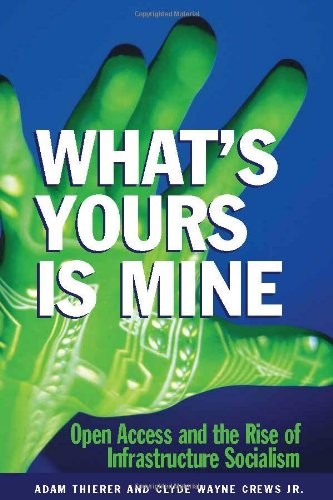
What's Yours is Mine: Open Access and the Rise of Infrastructure Socialism
$12.95
by Adam Theirer



This book explores how regimes that respect property rights including the right to exclude rivals better serve consumers and innovation. Adam Thierer is the director of telecommunications studies at the Cato Institute. WHAT'S YOURS IS MINE Open Access and the Rise of Infrastructure Socialism By ADAM THIERER CLYDE WAYNE CREWS JR. CATO INSTITUTE Copyright © 2003 Cato Institute All right reserved. ISBN: 978-1-930865-42-6 Contents Introduction.........................................................................................................1Part I: Open Access: Theory and Reality1. The Case against Forced Access....................................................................................92. Debunking "Natural Monopoly" and "Essential Facility" Rationales for Forced-Access Regulation.....................233. Why Network Proliferation Spells the End of the Essential Facilities Doctrine.....................................37Part II: Case Studies: How Forced Access Harms Specific Industries4. Case Study 1: Open Access to the Electricity Grid.................................................................475. Case Study 2: Open Access to Local Telephone Networks.............................................................556. Case Study 3: Open Access to Broadband Services...................................................................657. Case Study 4: Must-Carry Mandates on Cable and Satellite Networks.................................................918. Case Study 5: Open Access to Software.............................................................................99Part III: Conclusion9. What Really Protects Consumers and Network Reliability-Markets or Mandates?.......................................105Notes................................................................................................................109Index................................................................................................................125 Chapter One The Case against Forced Access Despite its advocacy by regulators, misguided consumer advocates, and opportunistic businesspeople, forced-access regulation has many problems. Problem 1: Forced Access Is a Taking of Private Property Forced-access regulation is essentially at war with private property rights. In one sense, forced-access regulation is really nothing more than a variant of socialism since it demands that private companies surrender control of their systems or technologies to a governmental vision of efficient and proper distribution of resources. Forced-access crusades are always undertaken in the name of advancing consumer choice, competition, and "openness." But even if forced access helped advance these ends, the ends do not justify the means. Free market competition means that private property owners-even owners of network properties-are at liberty to use their property as they see fit, and citizens are free to shop around for better arrangements when they feel they are not getting the best deal possible. The alternative is that of government bureaucrats demanding that control over private property be surrendered. Commenting on open-access conditions imposed on the AOL Time Warner merger, American Enterprise Institute scholar James K. Glassman noted that regulators "have served notice to high-tech firms that if they make big investments in new products like cable modems and instant messaging services, their property rights to those innovations may be stripped from them at will for political reasons." Moreover, because forced-access regulation forces private property owners to surrender the ownership or control of their property to regulators, there remains a legitimate question of whether it represents an unconstitutional taking under the Fifth Amendment to the Constitution. Some scholars, such as J. Gregory Sidak of the American Enterprise Institute and Daniel F. Spulber of the Northwestern University Graduate School of Management, argue that this is the case even for industries that were formerly treated as regulated monopolies, such as electricity and local telecommunications. They argue that these entities deserve compensation for the past investments or "stranded costs" they have incurred in the past. The facilities of the regulated network industries did not fall like manna from heaven, but rather were established by incumbent utilities through the expenditures of their investors. Utilities made past expenditures to perform obligations to serve in expectation of the reasonable opportunity to recover the costs of investment plus a competitive rate of return. Investors must be compensated for those past costs; it follows a fortiori that investors must be offered additional compensation if existing responsibilities are perpetuated or new burdens imposed. Stranded cost recovery remains a controversial proposition given that these entities enjoyed geographic service monopolies and guara