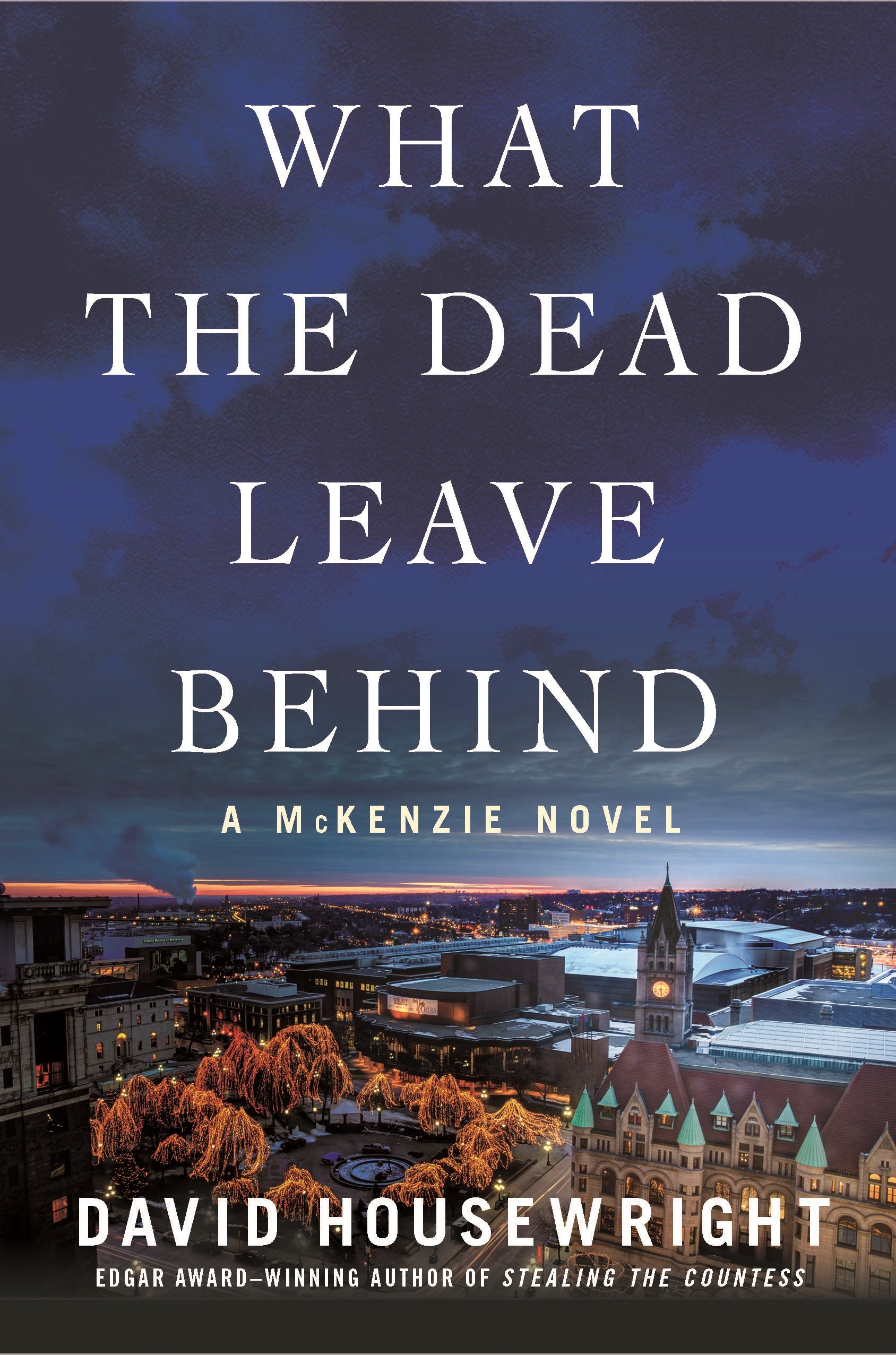
What the Dead Leave Behind: A McKenzie Novel (Twin Cities P.I. Mac McKenzie Novels, 14)
$34.93
by David Housewright



Looking into an unsolved murder as a favor, McKenzie soon uncovers either the strangest set of coincidences or the sites of a very real, very deadly conspiracy. Once a police detective in St. Paul, Minnesota, Rushmore McKenzie has become not only an unlikely millionaire, but an occasional unlicensed private investigator, doing favors for friends and people in need. When his stepdaughter Erica asks him for just such a favor, McKenzie doesn’t have it in him to refuse. Even though it sounds like a very bad idea right from the start. The father of Malcolm Harris, a college friend of Erica’s, was found murdered a year ago in a park in New Brighton, a town just outside the Twin Cities. With no real clues and all the obvious suspects with concrete alibis, the case has long since gone cold. As McKenzie begins poking around, he soon discovers another unsolved murder that’s tangentially related to this one. And all connections seem to lead back to a group of friends the victim was close with. But all McKenzie has is a series of odd, even suspicious, coincidences―until someone decides to make it all that more serious and personal. “Nearly impossible to put down.” ― Publishers Weekly “…it’s a distinct pleasure to follow McKenzie as he uncovers layer upon layer of corporate corruption, from sexual harassment to industrial espionage, while every second woman in the cast comes on to him.” ― Kirkus Reviews DAVID HOUSEWRIGHT has won the Edgar Award and is the three-time winner of the Minnesota Book Award for his crime fiction, which includes the modern noir Twin Cities P.I. Mac McKenzie series (starting with A Hard Ticket Home ). He is a past president of the Private Eye Writers of America (PWA). He lives in St. Paul, Minnesota. What the Dead Leave Behind By David Housewright St. Martin's Press Copyright © 2017 David Housewright All rights reserved. ISBN: 978-1-250-09451-3 CHAPTER 1 The way he paced recklessly in front of me, bouncing off furniture, tripping on the throw rug; the way he looked at me with unblinking eyes — I decided the kid was messed up. My only question: Was it a temporary condition possibly brought on by pharmaceuticals or permanent? "It's been a year," he said. "A year. And no one's done anything." I was sitting in a chair. He halted in front of me and waved his fist. The effort caused his body to sway uncertainly. "Anything," he repeated. "Malcolm," Erica said. She patted the cushion next to her. "Please." He turned reluctantly and moved to the sofa. He didn't sit so much as collapse as if all the weight of the world was forcing him down. Erica took his hand in hers, and I noticed for the first time that his knuckles were scraped and a couple of drops of blood had dried in the creases between his fingers. "It'll be all right," she told him. "No it won't," he said. Erica squeezed his hand, and he sighed. His eyes closed with the sigh, and she gazed at him with such affection that for a moment I felt anxious. What the hell was this kid to her, I wondered — besides being a good-looking boy who was in trouble that a strong woman like her might be able to help him with? I had known Erica since I had become involved with her mother — has it really been over six years now? I watched her evolve from an awkward, nerdy teen into a beautiful, smart-as-hell young woman who was a year away from earning both a bachelor of arts and a bachelor of science degree from Tulane University. I had never known her to look at anyone like she looked at Malcolm. "McKenzie will help," she said. You will? my inner voice asked. "Won't you?" Erica said. Yeah, probably. "What do you need?" I asked. "Be specific." Malcolm's eyes snapped open, and he practically leapt from the sofa. He was taller than I was but thin and pale, and I wondered — how could anyone going to school in New Orleans be pale? He began pacing again. I Came this close to telling him to sit his ass back down, but resisted. I knew Erica wouldn't like it. "You're a detective," he said. "Rickie said you're a detective." Rickie? "In a manner of speaking," I said. "Well, are you or aren't you?" "I don't have a license, if that's what you're asking." "Then how can you help?" Malcolm's voice was suddenly high and out of control. "I never said I could." "Rickie told me ..." He made a noise in his throat that might have been a sob. He stopped pacing and gazed at his damaged hand as if seeing it for the first time. "How did that happen?" I asked. "What?" "Your hand." Malcolm hid it behind his back. "None of your business," he told me. "Okay." I watched him. He watched me. "What?" he asked again. "Just waiting." "For what?" "For you to tell me the reason why you're here. While we wait, would you like something to drink? Coffee? Dr Pepper? We got milk." "I'm twenty-one." "You say that like you're old." "Old enough to drink." "Have you been drinking?" "No. I — I guess I'm not making a very good impression, am I? Something my mother said earlier kind of