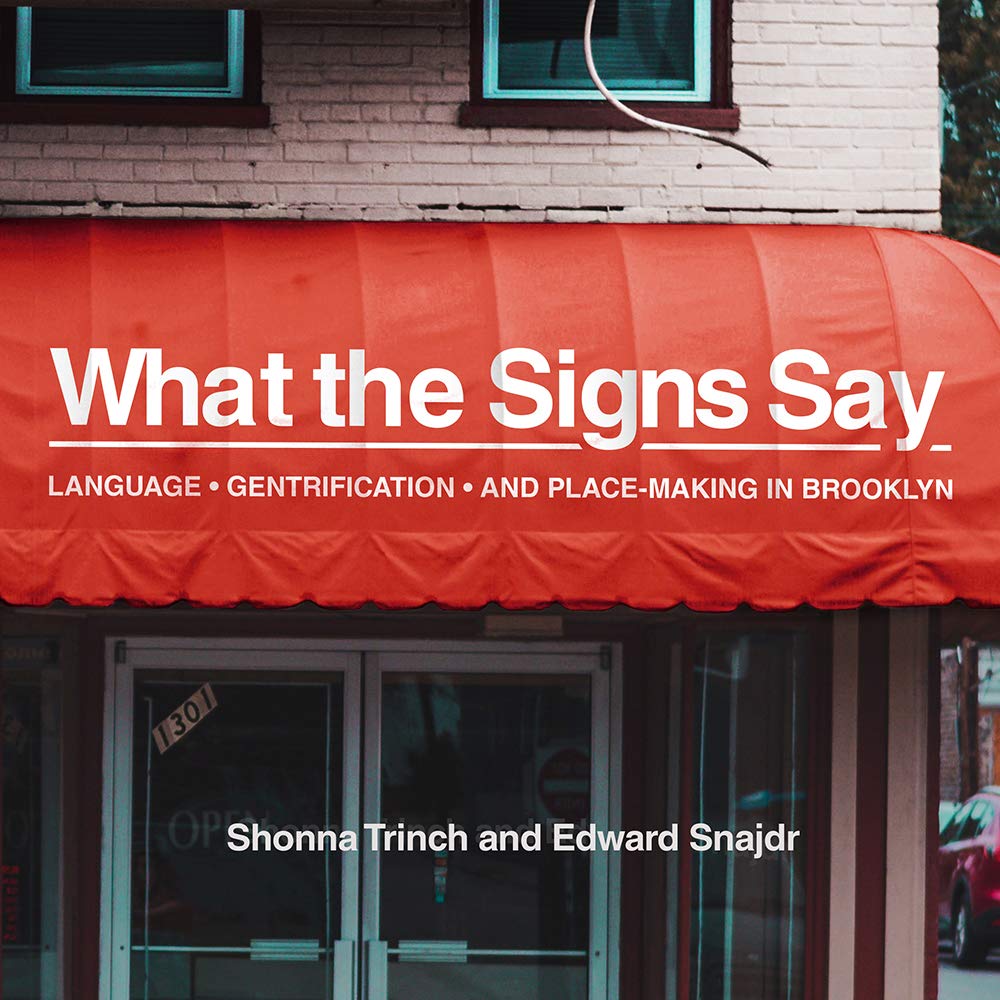
What the Signs Say: Language, Gentrification, and Place-Making in Brooklyn
$39.95
by Shonna Trinch



Although we may not think we notice them, storefronts and their signage are meaningful, and the impact they have on people is significant. What the Signs Say argues that the public language of storefronts is a key component to the creation of the place known as Brooklyn, New York. Using a sample of more than two thousand storefronts and over a decade of ethnographic observation and interviews, the study charts two very different types of local Brooklyn retail signage. The unique and consistent features of many words, large lettering, and repetition that make up Old School signage both mark and produce an inclusive and open place. In contrast, the linguistic elements of New School signage, such as brevity and wordplay, signal not only the arrival of gentrification, but also the remaking of Brooklyn as distinctive and exclusive. Shonna Trinch and Edward Snajdr, a sociolinguist and an anthropologist respectively, show how the beliefs and ideas that people take as truths about language and its speakers are deployed in these different sign types. They also present in-depth ethnographic case studies that reveal how gentrification and corporate redevelopment in Brooklyn are intimately connected to public communication, literacy practices, the transformation of motherhood and gender roles, notions of historical preservation, urban planning, and systems of privilege. Far from peripheral or irrelevant, shop signs say loud and clear that language displayed in public always matters. This book is the recipient of the 2021 Norman L. and Roselea J. Goldberg Prize from Vanderbilt University Press for the best book in the area of art or medicine. “This analysis of Brooklynites’ sense of place is strikingly innovative and the ethnography utterly engaging. We see signage changing with the influx of gentrification, contrasting assumptions about whose Brooklyn it really is, and both older and newer residents invested in a sense of place as incoming chain businesses assuredly are not.” — Bonnie Urciuoli , author of Exposing Prejudice: Puerto Rican Experiences of Language, Race, and Class " What the Signs Say charts emerging terrains of gentrification through an acute, open-eyed, and deeply contextualized reading of Brooklyn streetscapes and the signs that shape them. This is a fascinating and textured case study in itself. It also models generative new ways of approaching the complex intersections of language, landscape, and social experience." — Donald Brenneis , coeditor of the Annual Review of Anthropology -- Donald Brenneis "This analysis of Brooklynites' sense of place is strikingly innovative and the ethnography utterly engaging. We see signage changing with the influx of gentrification, contrasting assumptions about whose Brooklyn it really is, and both older and newer residents invested in a sense of place as incoming chain businesses assuredly are not." — Bonnie Urciuoli , author of Exposing Prejudice: Puerto Rican Experiences of Language, Race, and Class -- Bonnie Urciuoli "A compelling study of how business signs in Brooklyn neighborhoods serve as 'place-making technologies' that both signal and work in the interests of gentrification. The central argument—that 'new school' signs, while directly indexing playfulness and cleverness, indirectly index exclusivity—drives home the often subtle but profound ways that language is implicated in gentrification and exclusion, regardless of a sign author's expressed intent." — Gabriella Gahlia Modan , author of Turf Wars: Discourse, Diversity, and the Politics of Place -- Gabriella Gahlia Modan Cover designer: Derek Thornton, Notch Design Shonna Trinch is a sociolinguist and faculty member in the Department of Anthropology at John Jay College, CUNY. Edward Snajdr is a cultural anthropologist and faculty member in the Department of Anthropology at John Jay College, CUNY. Introduction Discovering a Field Site Have you ever noticed which of the street signs, over the shop doors, are the most attractive of attention? . . . the over-largely lettered signs and placards of the street, escape observation by dint of being excessively obvious. Edgar Allen Poe, “The Purloined Letter,” 1845 In the spring of 2007, a Brooklyn bagel-maker put up a sign for his new store on 5th Avenue near St. Marks Avenue in Park Slope. It read ARENA in five large capital letters, above the words BAGELS & BIALYS. The owner said he hoped to link his new shop to the coming sports arena, what would become the Barclays Center, the centerpiece of Atlantic Yards, New York City’s largest urban redevelopment project in the past fifty years. The multibillion-dollar plan included the basketball arena and sixteen high-rise office and residential towers in the middle of Brooklyn. The bagel seller soon learned that local residents planned to protest his store’s name. They read the name ARENA as an open endorsement of Atlantic Yards, which they were publicly and legally contesting. Local resident