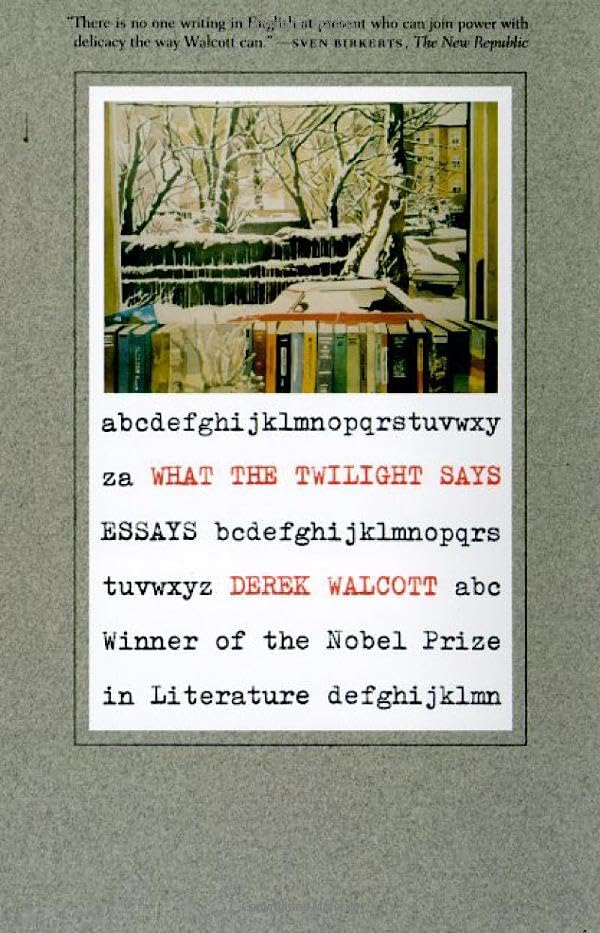



A collection of essays gathers pieces written over more than twenty years, including examinations of Caribbean culture and commentary on some of the world's great writers Derek Walcott's identity as a poet is evident even in his literary criticism. Who else would produce a sentence such as "Let the shaggy, long horde of spiky letters and the dark rumbling of hexametrical phalanxes rise over the outback towards the capital of the English language" to describe the work of a fellow poet--in this case, Australian Les Murray? Indeed, each of the essays in What the Twilight Says is at least as rich in language as it is in ideas; so much so, in fact, that at times the view is obscured by the verbiage. Nevertheless, beneath the loco rococo turns of phrase Walcott has some serious points to make. In his discussion of V.S. Naipaul, for example, he offers some telling insights into the effects of colonialism on his subject's psyche: "What is the cost to his Indianness of loving England?" Walcott asks; "To whom does he owe any fealty? Ancestors? The surroundings that history placed them in, the cane fields of Trinidad, were contemptible, as they themselves would have to be, having lost both shame and pride. Therefore, the only dignity is to be neither master nor servant, to choose a nobler servitude: writing. The punishment for the choice is the astonishment of gratitude; to be grateful to the vegetation of an English shire. Not to India or the West Indies, but to the sweet itch of an old wound." Walcott praises Naipaul's genius while calling him on his racism, selfishness, and disdain for his roots--in effect loving the sinner while hating the sin. His essay on Joseph Brodsky is an intelligent meditation on the art of translation while "The Muse of History" looks at the influence of history in New World literature. From a discussion of the poetry of Ted Hughes to an open love letter to Martiniquan writer Patrick Chamoiseau, Derek Walcott provides plenty of provocative food for thought wrapped in poetical prose. --Alix Wilber Twilight--that dramatic and melancholy transition--is the perfect trope for Nobel laureate Walcott, a West Indian born of forces as opposite as day and night--of light skin and dark, of conquerors and the enslaved, of the old and the new. The first set of essays in this collection of powerful meditations focuses on the confounding confluence of cultures found in the Caribbean. In the title essay, Walcott reveals how the conflict between his deep love of the English language and his anguish over the horrors and injustices of racism and colonialism made finding his voice as a poet and playwright excruciatingly difficult. "The truest writers are those who see language not as linguistic process but as a living element," he writes, and, indeed, he himself makes no distinction between life and literature, whether he's writing poetry or brilliant assessments of the work of his peers, Joseph Brodsky, Robert Frost, V. S. Naipaul, and Les Murray. Walcott's vision is global, his candor electrifying, his piercing insights and oceanic eloquence transcendent. Donna Seaman A poet's (poetical) prose about poetry. Walcott's (The Bounty, etc.) humid rhetoric can overwhelm a subject, as when ``I try to divert my concentration from that mesmeric gritted oyster of sputum on the concrete floor.'' And so, a reader wandering through the periodically flowery byways and orotund arabesques of these 14 essays may long, instead, at times, for a more plainspoken, adamantine critical voicelike that, say, of poet-critic Mary Karr. Yet entwined here with the tricky verbal vines and orchids are also insights of an unusual provenance. West Indianborn Walcott's views of current poetry and postcolonial culture are admirably independent and syncretic. He is able to take the measure of such stylistically distinct avatars as the relentlessly, redemptively flinty British poet Philip Larkin and American confessionalist Robert Lowell. Walcott spikes his intermittently languid reveries with comments that crackle: ``Modern American poetics is as full of its sidewalk hawkers as a modern American city: this is the only meter, this is the American way to breathe, this is the variable foot,'' he complains. That error isn't his. Rather, the 1992 Nobel laureate explores, in the emphatic plural, poetry's various islands, while diverging now and then to authors of prose. He claims Hemingway as ``a West Indian writer'' and salutes the Trinidadian C.L.R. James for Beyond a Boundary, termed by Walcott a cricketer's Iliad.'' Still, our critic's lens isn't flawless. As an apologist for Ted Hughes, Walcott proves laughably sentimental: ``Poets come to look like their poetry . . . Hughes's face emerges through the pane of paper in its weathered openness as both friendly and honest. It speaks trust.'' Rather conspicuously in an era of major contemporary women poets, the book omits positive mention of women (save for Dickinson) as anything more than muse