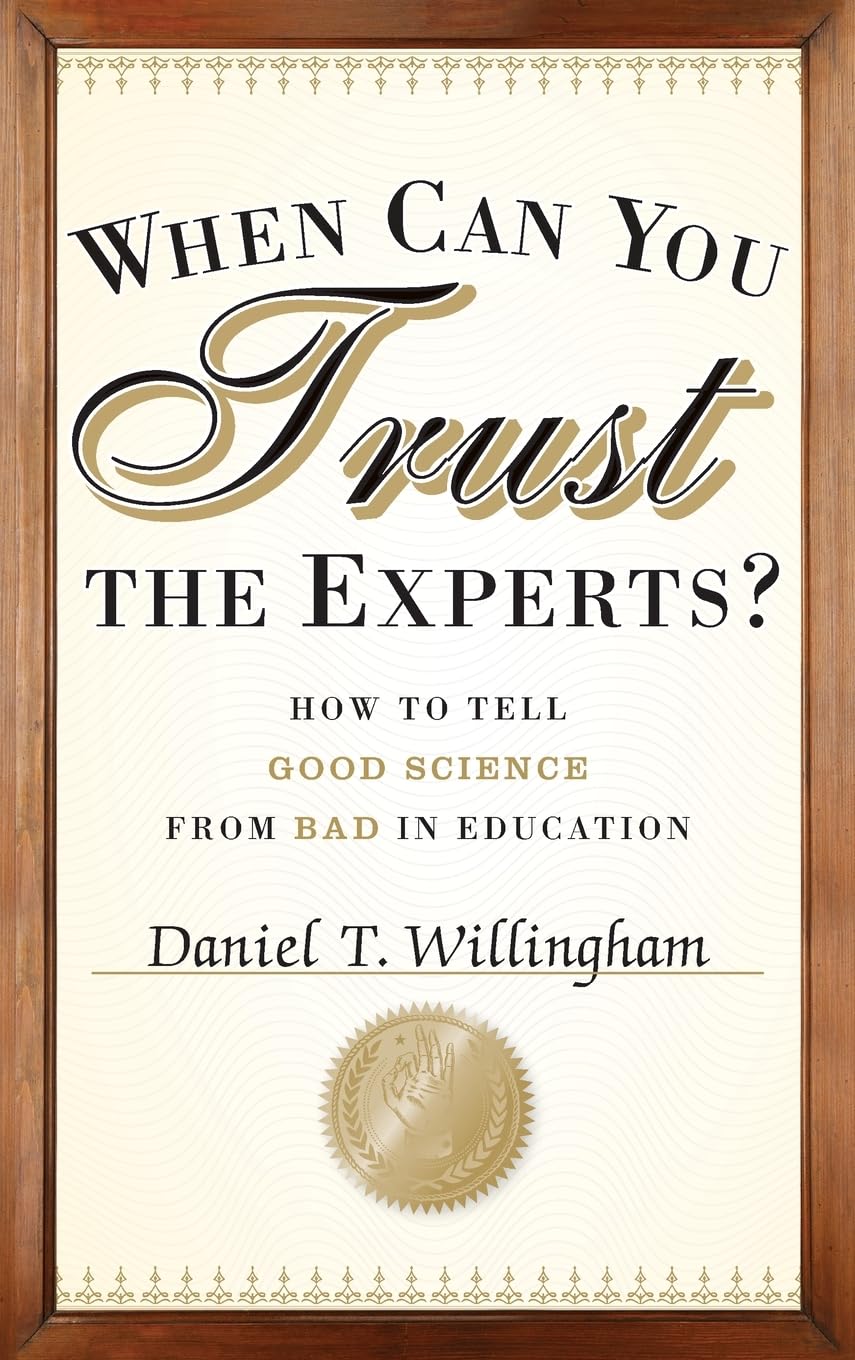
When Can You Trust the Experts?: How to Tell Good Science from Bad in Education
$15.49
by Daniel T. Willingham



Clear, easy principles to spot what's nonsense and what's reliable Each year, teachers, administrators, and parents face a barrage of new education software, games, workbooks, and professional development programs purporting to be "based on the latest research." While some of these products are rooted in solid science, the research behind many others is grossly exaggerated. This new book, written by a top thought leader, helps everyday teachers, administrators, and family members―who don't have years of statistics courses under their belts―separate the wheat from the chaff and determine which new educational approaches are scientifically supported and worth adopting. Author's first book, Why Don't Students Like School?, catapulted him to superstar status in the field of education - Willingham's work has been hailed as "brilliant analysis" by The Wall Street Journal and "a triumph" by The Washington Post - Author blogs for The Washington Post and Brittanica.com, and writes a column for American Educator In this insightful book, thought leader and bestselling author Dan Willingham offers an easy, reliable way to discern which programs are scientifically supported and which are the equivalent of "educational snake oil." "Parents increasingly come face-to-face with important educational decisions that they feel ill prepared to make. Whether they are choosing among schools, math programs or early interventions for a learning disability, this book will help them figure out which options are backed by the best science. (Recommended)"― Scientific American "By my bedtable is Dan Willingham's new book, When Can You Trust the Experts? ... This is help we all can use, from one of the most sensible guys around."―John Merrow, The Huffington Post "A brilliant new book... Willingham presents a 'short cut' to assessing the value of a given idea―a set of four steps that will be useful to anyone sizing up an unfamiliar concept. I’ve read Willingham’s book and I recommend it highly!"―Annie Murphy Paul Along with some potentially worthy ideas, the last fifty years have encapsulated a flood of educational quackery and nostrums. The innovation and implementation continues, while teachers, administrators, and policymakers have a hard time separating the wheat from the chaff. What makes this so difficult for individuals in the American educational system? They're on their own. There is no research team to evaluate every new idea. But there is pressure to effect change through these innovations. In When Can You Trust the Experts? Daniel Willingham offers a solution for those who must sift through the information overload and discern which of the latest educational models, programs, and approaches are worthy of their attention. Willingham provides a reliable shortcut comprising four steps. For each step he offers an explanation of why the principle works by referring back to the rules for what constitutes good science. Willingham's easy-to-apply process consists of: Strip it. Clear away the verbiage and look at the actual claim. What exactly is the claim suggesting a teacher should do, and what outcome is promised? Trace it. Who created this idea, and what have others said about it? It's common to believe something because an authority confirms it, and this is often a reasonable thing to do. In education research, however, this can be a weak indicator of truth. Analyze it. Why are you being asked to believe the claim is true? What evidence is offered, and how does the claim square with your own experience? Should I do it? You're not going to adopt every educational program that is scientifically backed, and it may make sense to adopt one that has not been scientifically evaluated. When Can You Trust the Experts? offers parents, teachers, administrators, and policymakers the tools they need to ask tougher questions, think more logically about why an intervention might or might not work, and ultimately make more informed decisions. Praise for When Can You Trust the Experts? "For decades our nation's debates on education have obsessed over a small number of politicized hot buttons charter schools, vouchers, class size, teachers' unions while chasing expensive fads of dubious value. What's missing is evidence on what works and what doesn't. At last we have a place to go: Dan Willingham's indispensable guide to fact and fiction in educational methods. Read it and buy copies for your children's teachers, principals, and school board members." STEVEN PINKER, Harvard College Professor of Psychology, Harvard University, and author, The Language Instinct and How the Mind Works "Daniel Willingham tackles one of the most difficult but least discussed problems for educators: how to sort through the barrage of programs for sale and figure out what really works. Unlike other experts who try to persuade teachers to simply adopt their views, Willingham gives nonscientists the tools and knowledge they need to wade into