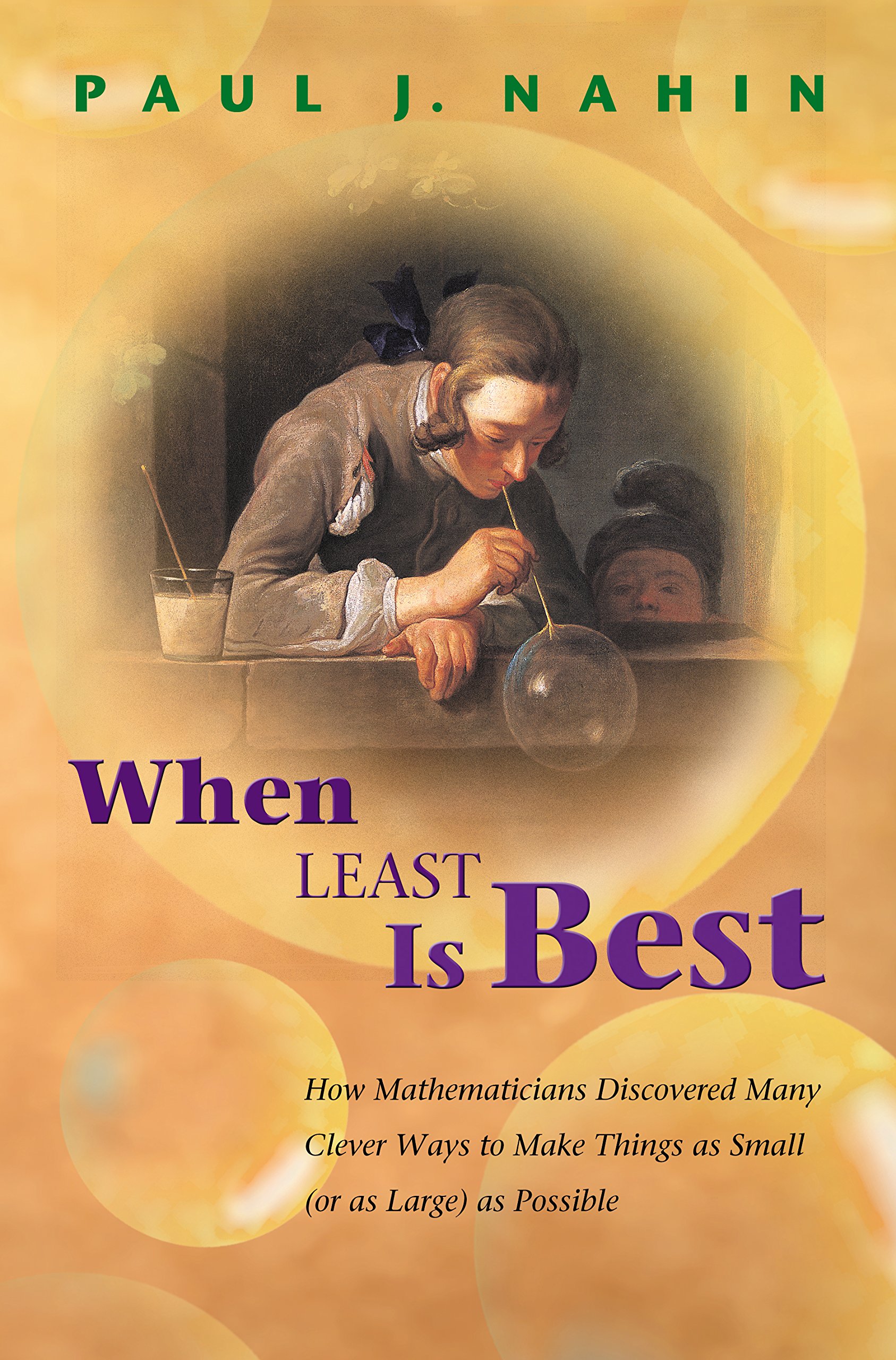
When Least Is Best: How Mathematicians Discovered Many Clever Ways to Make Things as Small (or as Large) as Possible
$26.98
by Paul J. Nahin



What is the best way to photograph a speeding bullet? Why does light move through glass in the least amount of time possible? How can lost hikers find their way out of a forest? What will rainbows look like in the future? Why do soap bubbles have a shape that gives them the least area? By combining the mathematical history of extrema with contemporary examples, Paul J. Nahin answers these intriguing questions and more in this engaging and witty volume. He shows how life often works at the extremes--with values becoming as small (or as large) as possible--and how mathematicians over the centuries have struggled to calculate these problems of minima and maxima. From medieval writings to the development of modern calculus to the current field of optimization, Nahin tells the story of Dido's problem, Fermat and Descartes, Torricelli, Bishop Berkeley, Goldschmidt, and more. Along the way, he explores how to build the shortest bridge possible between two towns, how to shop for garbage bags, how to vary speed during a race, and how to make the perfect basketball shot. Written in a conversational tone and requiring only an early undergraduate level of mathematical knowledge, When Least Is Best is full of fascinating examples and ready-to-try-at-home experiments. This is the first book on optimization written for a wide audience, and math enthusiasts of all backgrounds will delight in its lively topics. How can a factory manager minimize breakdowns? How can a disoriented hiker reach her car in the least possible time? In answering questions such as these, engineer Nahin delivers maximal mathematical enjoyment with minimal perplexity and boredom. Classical minimization problems allow Nahin to showcase the ingenuity of ancient mathematicians--and to let general readers in on the thrill of riding high-school geometry and algebra to breakthrough insights. Knowledgeable readers will probably anticipate the eventual transition from subtle geometry to complex calculus. But even specialists may learn from Nahin's chronicle of how the often-forgotten tangents of Pierre de Fermat paved the way to the calculus of Newton and Leibniz. In addition, Nahin deftly interweaves episodes from the lives of its discoverers: a rash Belgian theorist loses his sight staring at the sun; a jealous Swiss mathematician denies his own son credit for groundbreaking work. A refreshingly lucid and humanizing approach to mathematics. Bryce Christensen Copyright © American Library Association. All rights reserved "This book was terrific fun to read! I thought I would skim the chapters to write my review, but I was hooked by the preface, and read through the first 100 pages in one sitting. . . . [Nahin shows] obvious delight and enjoyment--he is having fun and it is contagious." ---Bonnie Shulman, MAA Online " When Least is Best is clearly the result of immense effort. . . . [Nahin] just seems to get better and better. . . . The book is really a popular book of mathematics that touches on a broad range of problems associated with optimization." ---Dennis S. Bernstein, IEEE Control Systems Magazine "[ When Least is Best is] a wonderful sourcebook from projects and is just plain fun to read." ― Choice "This book is highly recommended." ---Clark Kimberling, Mathematical Intelligener "A valuable and stimulating introduction to problems that have fascinated mathematicians and physicists for millennia." ---D.R. Wilkins, Contemporary Physics "Nahin delivers maximal mathematical enjoyment with minimal perplexity and boredom. . . . [He lets] general readers in on the thrill of riding high-school geometry and algebra to breakthrough insights. . . . A refreshingly lucid and humanizing approach to mathematics." ― Booklist "Anyone with a modest command of calculus, a curiosity about how mathematics developed, and a pad of paper for calculations will enjoy Nahin's lively book. His enthusiasm is infectious, his writing style is active and fluid, and his examples always have a point. . . . [H]e loves to tell stories, so even the familiar is enjoyably refreshed." ---Donald R. Sherbert, SIAM Review "This is a delightful account of how the concepts of maxima, minima, and differentiation evolved with time. The level of mathematical sophistication is neither abstract nor superficial and it should appeal to a wide audience." ―Ali H. Sayed, University of California, Los Angeles " When Least Is Best is an illustrative historical walk through optimization problems as solved by mathematicians and scientists. Although many of us associate solving optimization with calculus, Paul J. Nahin shows here that many key problems were posed and solved long before calculus was developed." ―Mary Ann B. Freeman, Math Team Development Manager, Mathworks "This is a delightful account of how the concepts of maxima, minima, and differentiation evolved with time. The level of mathematical sophistication is neither abstract nor superficial and it should appeal