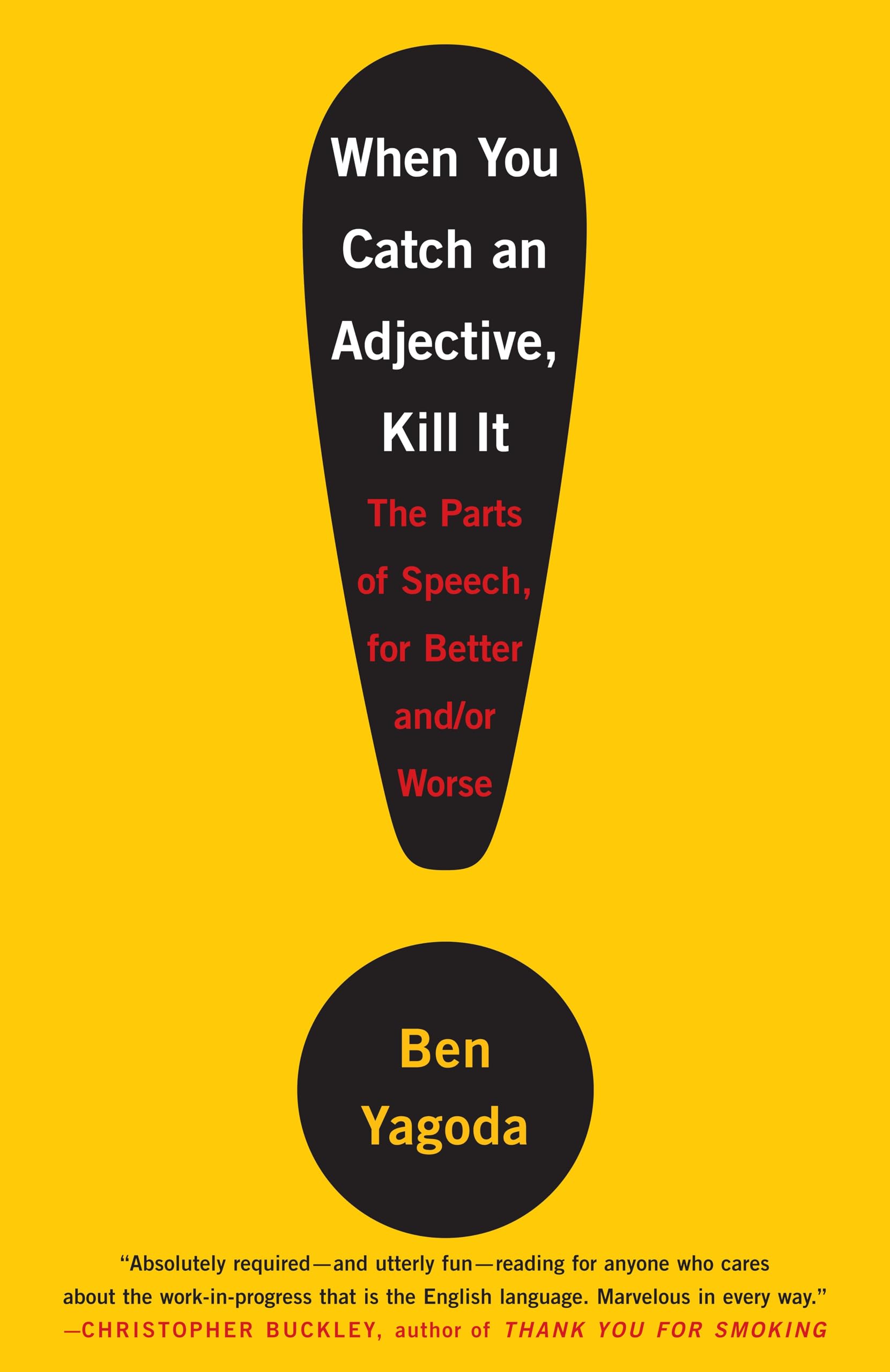
When You Catch an Adjective, Kill It: The Parts of Speech, for Better and/or Worse
$11.08
by Ben Yagoda



What do you get when you mix nine parts of speech, one great writer, and generous dashes of insight, humor, and irreverence? One phenomenally entertaining language book . In his waggish yet authoritative book, Ben Yagoda has managed to undo the dark work of legions of English teachers and libraries of dusty grammar texts. Not since School House Rock have adjectives, adverbs, articles, conjunctions, interjections, nouns, prepositions, pronouns, and verbs been explored with such infectious exuberance. Read If You Catch an Adjective, Kill It and: Learn how to write better with classic advice from writers such as Mark Twain (“If you catch an adjective, kill it”), Stephen King (“I believe the road to hell is paved with adverbs”), and Gertrude Stein (“Nouns . . . are completely not interesting”). Marvel at how a single word can shift from adverb (“I did okay”), to adjective (“It was an okay movie”), to interjection (“Okay!”), to noun (“I gave my okay”), to verb (“Who okayed this?”), depending on its use. Avoid the pretentious preposition at , a favorite of real estate developers (e.g., “The Shoppes at White Plains”). Laugh when Yagoda says he “shall call anyone a dork to the end of his days” who insists on maintaining the distinction between shall and will . Read, and discover a book whose pop culture references, humorous asides, and bracing doses of discernment and common sense convey Yagoda’s unique sense of the “beauty, the joy, the artistry, and the fun of language.” Advance praise for If You Catch an Adjective, Kill It : “Absolutely required—and utterly fun—reading for anyone who cares about the work-in-progress that is the English language. Marvelous in every way.” —Christopher Buckley “All hail to Ben Yagoda! Not only has he publicly rescued mother from the ubiquitous debasement of mom , and consigned shall to the schoolmarm’s dead-rules inferno, but—ebulliently—he dresses Fowler, his eminent usage-predecessor, in relaxed American shoes. Yagoda’s invigorating interrogation of our language will excite every syntax-obsessed reader and writer. (And there are more of us than you might think.)” —Cynthia Ozick BEN YAGODA teaches English at the University of Delaware, and is the author of four books, including The Sound on the Page and About Town: The New Yorker and the World It Made. He has contributed to Slate.com, the New York Times Book Review , the American Scholar, Rolling Stone and Esquire , and writes an occasional column on language for the Chronicle of Higher Education . He lives in Swarthmore, Pennsylvania. CHAPTER I ADJ. Look to the adjectives. — Virgil Thomson Kicking things off with adjectives is a little like starting a kids’ birthday party with the broccoli course. Because as far as not getting respect goes, adjectives leave Rodney Dangerfield in the dust. They rank right up there with Osama bin Laden, Geraldo Rivera, and the customer–service policies of cable TV companies. That it is good to avoid them is one of the few points on which the sages of writing agree. Thus Voltaire: “The adjective is the enemy of the noun.” Thus William Zinsser: “Most adjectives are…unnecessary. Like adverbs, they are sprinkled into sentences by writers who don’t stop to think that the concept is already in the noun.” And thus the title of this book, a piece of advice traditionally attributed to Mark Twain. Even the ancient Greeks seem to have been dismissive of the adjective; their term for it was epitheto , meaning “something thrown on.” In Latin, as previously noted, there are no adjectives, and such was the influence of that ancient language that the earlier English grammarians categorized these words as a subset of nouns. In 1735, John Collyer sensibly objected: Words that signify the Quality of the Thing, cannot come under the same Denomination with those that signify the Name of the Thing; And seeing the Adverb, which signifies the Manner of the Verb is made a distinct Part of Speech, why should not the Adjective be so too, since it bears at least the same relation to the Noun, as that doth the Verb? His reasoning could not really be disputed, and not long afterward the adjective became a full-fledged part of speech. The situation is not quite as simple as Collyer made it out, however. For one thing, “words that signify the Quality of the Thing,” as he puts it, come from a lot of different sources. There are not only the run–of–the–mill adjectives like good, bad , and ugly , but also various verb forms (a driving rain, a decorated cake); words created from suffixes like – ific, – ive, – ous, – ful, – less , and – ic ; words that do double duty as nouns and adjectives ( green ); both cardinal ( two ) and ordinal ( second ) numbers; determiners or possessive pronouns like the, those , and my ; hyphenated adjective phrases such as high – quality ; and so–called attributive nouns, such as the first word in the phrases company man, wedding cake