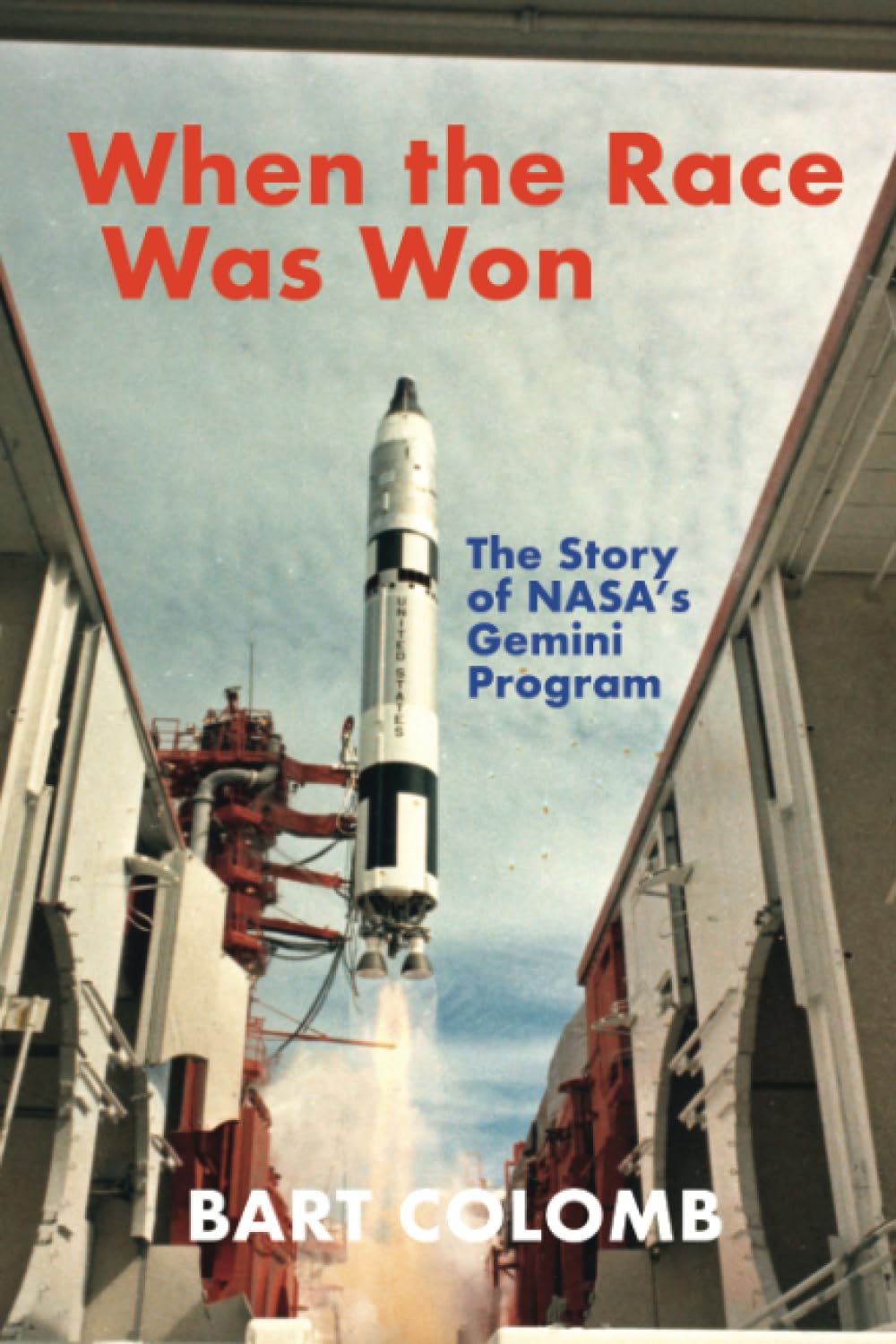



Published in Ad Astra , quarterly of the National Space Society (Issue 2023-1), reviewed by Rod Pyle, Editor-In-Chief: The Gemini program was a pivotal chapter in the Space Race. Consisting of 10 crewed flights following the simple, one-man up, around, and down missions of Project Mercury, the two-man Gemini missions were the proving ground for orbital rendezvous and docking, both deemed necessary steps to proceed with the Apollo lunar landing program. The Gemini program is also the least well-known of the era and has been lamentably overlooked in popular literature on the Space Race. A few recent books have addressed this oversight, and Bart Colomb’s When the Race Was Won tells the story with skill, humor, and verve. Writing space histories is an arduous undertaking and not for the timid. In the 1960s, the American space program was jamming ahead at warp speed, and records were not as carefully filed away as we might like in retrospect. After all, who would have thought that writers and historians would be examining the events under a microscope a half-century later? In fact, it’s not uncommon to find primary references from the era-pulled straight from NASA archives—that differ in sometimes critical ways. It is a tribute to authors like Colomb that books like this reach our hands. Colomb begins by strolling through the critical events of the Mercury program and introducing us to the personalities that were critical to NASA’s early days and the first human spaceflight achievements, both those of the U.S. and the Soviet Union. His writing is excellent and on-point, while remaining breezy enough to entertain and engage throughout. Eagle-eyed space buffs will find an error or two-Explorer 1, the U.S.’s first successful satellite-was launched on a Juno booster, not a Vanguard rocket as recorded, for example, but this does not detract in the slightest from the volume. In fact, as a writer of over a dozen popular space histories, I can confidently state that errors creep into just about every book. Mea culpa. As the story picks up steam with the first crewed flight of the titular program, Gemini 3, the personalities of the astronaut pairs who flew on Gemini emerge in delightful ways. Not unlike Andrew Chaikin’s A Man on the Moon, When the Race Was Won alternately thrills us and puts smiles on our faces as we read about not just the achievements of the astronauts, but also their (usually) small indiscretions and (always) colorful personalities. ... It’s important to remember that at the time Gemini was getting into gear in 1965, much of the necessary technology was being invented “on the fly, as Chris Kraft, the seemingly omnipotent flight director, put it. Computers were in their infancy and not portable; rockets were still blowing up far too often, and command and control was a new concept still being developed, with multiple stations around the world (and some located on ships at sea). No Gemini mission was in contact with Mission Control at all times. This was also the period in which Mission Control was growing up and would be defined in the form that got American astronauts to the lunar surface. Gradually, the roles of flight controllers emerged, and the design of Mission Control and its layout were perfected. This was all new territory, and in many ways was as great an accomplishment as the flights themselves. ... If there’s a letdown to the book, it’s that we can’t spend more time with these remarkable people as the highlights of their careers are wrapped up .... When the Race Was Won is a solid retelling of the oft-overlooked Gemini program and will be an enjoyable read by both space enthusiasts who already know the program but are not necessarily aware of some of the smaller dynamics at work, and readers who are new to the history of human spaceflight. Enjoy.