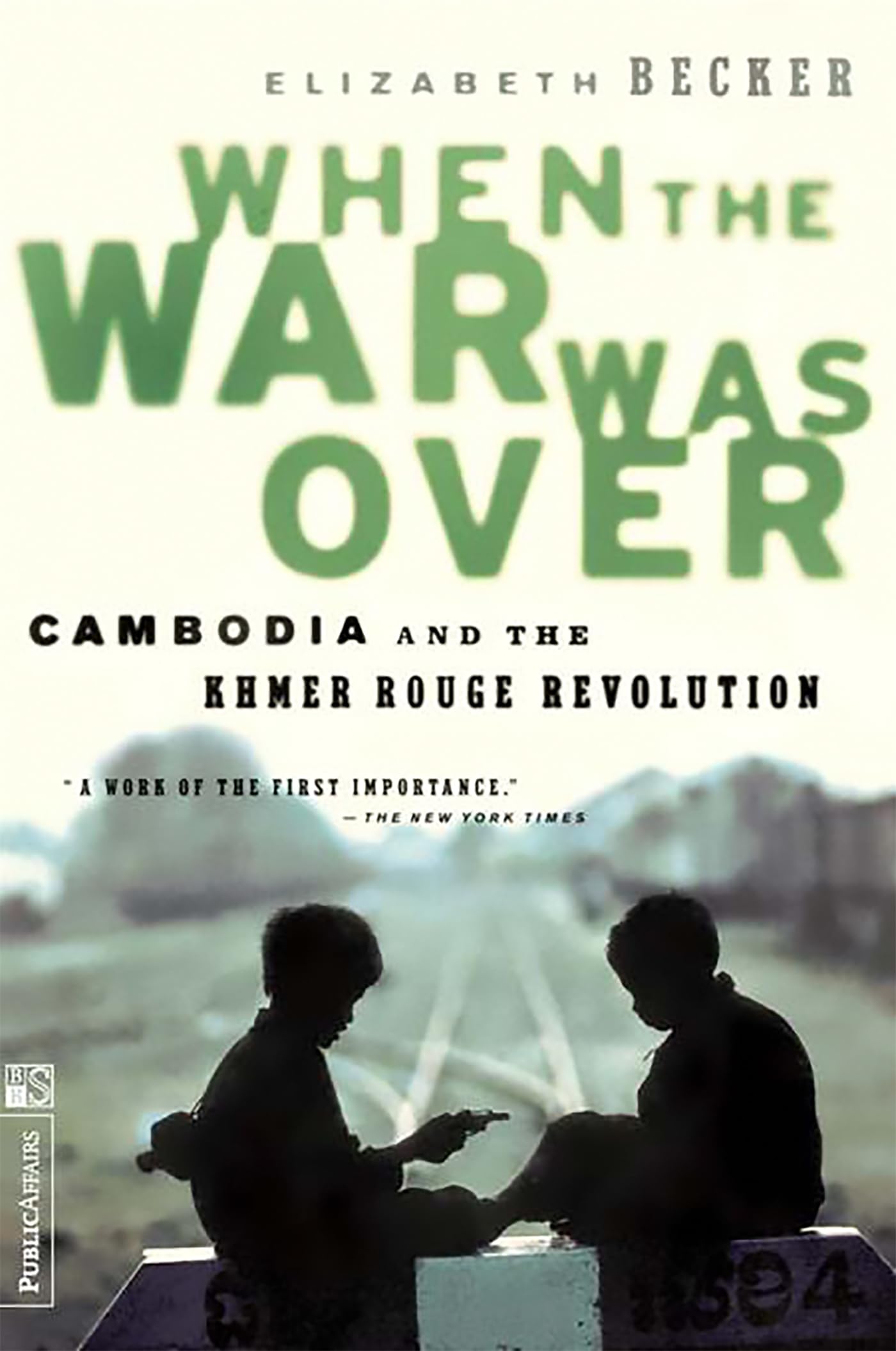
When the War Was Over: Cambodia and the Khmer Rouge Revolution, Revised Edition
$19.95
by Elizabeth Becker



The "definitive" ( Los Angeles Times ), award-winning history of Cambodia and Pol Pot's rise to power, tracing the country's modern origins to the human rights abuses that reshaped it forever Award-winning journalist Elizabeth Becker started covering Cambodia in 1973 for The Washington Post , when the country was perceived as little more than a footnote to the Vietnam War. Then, with the rise of the Khmer Rouge in 1975 came the closing of the border and a systematic reorganization of Cambodian society. Everyone was sent from the towns and cities to the countryside, where they were forced to labor endlessly in the fields. The intelligentsia were brutally exterminated, and torture, terror, and death became routine. Ultimately, almost two million people—nearly a quarter of the population—were killed in what was one of this century's worst crimes against humanity. When the War Was Over is Elizabeth Becker's masterful account of the Cambodian nightmare. Encompassing the era of French colonialism and the revival of Cambodian nationalism; 1950s Paris, where Khmer Rouge leader Pol Pot received his political education; the killing fields of Cambodia; government chambers in Washington, Paris, Moscow, Beijing, Hanoi, and Phnom Penh; and the death of Pol Pot in 1998; this is a book of epic vision and staggering power. Merging original historical research with the many voices of those who lived through the times and exclusive interviews with every Cambodian leader of the past quarter century, When the War Was Over illuminates the darkness of Cambodia with the intensity of a bolt of lightning. Elizabeth Becker's When the War Was Over: Cambodia and the Khmer Rouge Revolution is a heart-rending history of modern Cambodia--a state whose people have, in the last 30 years, endured war, political upheaval, international betrayal, and genocide. Beginning with the Khmer Rouge overthrow of the U.S.-backed Lon Nol regime in 1975, Becker examines the historical patterns of violence and authority within Cambodian culture that made the Khmer Rouge's slaughter of close to 2 million people possible. Becker integrates interviews with Cambodian leaders and ordinary citizens with a penetrating analysis of the politics of the cold war and humanitarianism. For example, she follows the story of Mey Komphot, a banker, who, like millions of others, was displaced from his life in Phnom Penh and marched to a labor camp. She also explores how the United States, as well as many states within the United Nations, refused to acknowledge the forced departures and the killing in order to appease China's hunger for punishing Vietnam's 1978 invasion of Cambodia. By contrasting the concerns of states with those of people, Becker shows how the international order has repeatedly betrayed the people of Cambodia. When the War Was Over is more than just an authoritative account of the Cambodian Revolution; Becker's trenchant portrait of the dynamics of power and human suffering serves as a warning about how diplomatic imperatives can blunt the United Nations' ability to preserve human rights and life. --James Highfill "The definitive book on the Cambodian Revolution"― Los Angeles Times Book Review "Burns with its own fire, the fire of a dedicated writer who witnessed the incomprehensible and worked long and hard to comprehend it...An impressive feat of scholarship and reporting: intelligent, measured, resourceful." ― Washington Post "Becker writes history as history should be written."― Financial Times "A work of the first importance."― New York Times "Burns with its own fire, the fire of a dedicated writer who witnessed the incomprehensible and worked long and hard to comprehend it. It is indispensible for understanding our times and the noble and terrible sides of modern man. It is a powerful and important book." (William Broyles, Jr., The Washington Post Book World) "When the War Was Over is an extraordinary synthesis of journalism and scholarship. There's a reportial immediacy to much of the book while at the same time it has the virtue of historical perspective. . . . This is an important, compelling, often touching book." (Strobe Talbott, author of Deadly Gambits) "Becker writes history as history should be written." (Financial Times) "The current crisis in Cambodia cannot be understood without a thorough understanding of the Khmer Rouge revolution, which is why I am updating and revising When the War Was Over. By bringing the history up to date through the Hun Sen regime, I revisit the many questions still plaguing development and justice in Asia." Elizabeth Becker is an award-winning journalist and author who began her career as a war correspondent for the Washington Post in Cambodia. The French movie Meeting with Pol Pot is based on her life. She is the author of four books, including You Don't Belong Here and Overbooked. She lives in Washington, D.C. From Chapter 11: I cleared the table and was asleep by 11:00 p.m. My bags