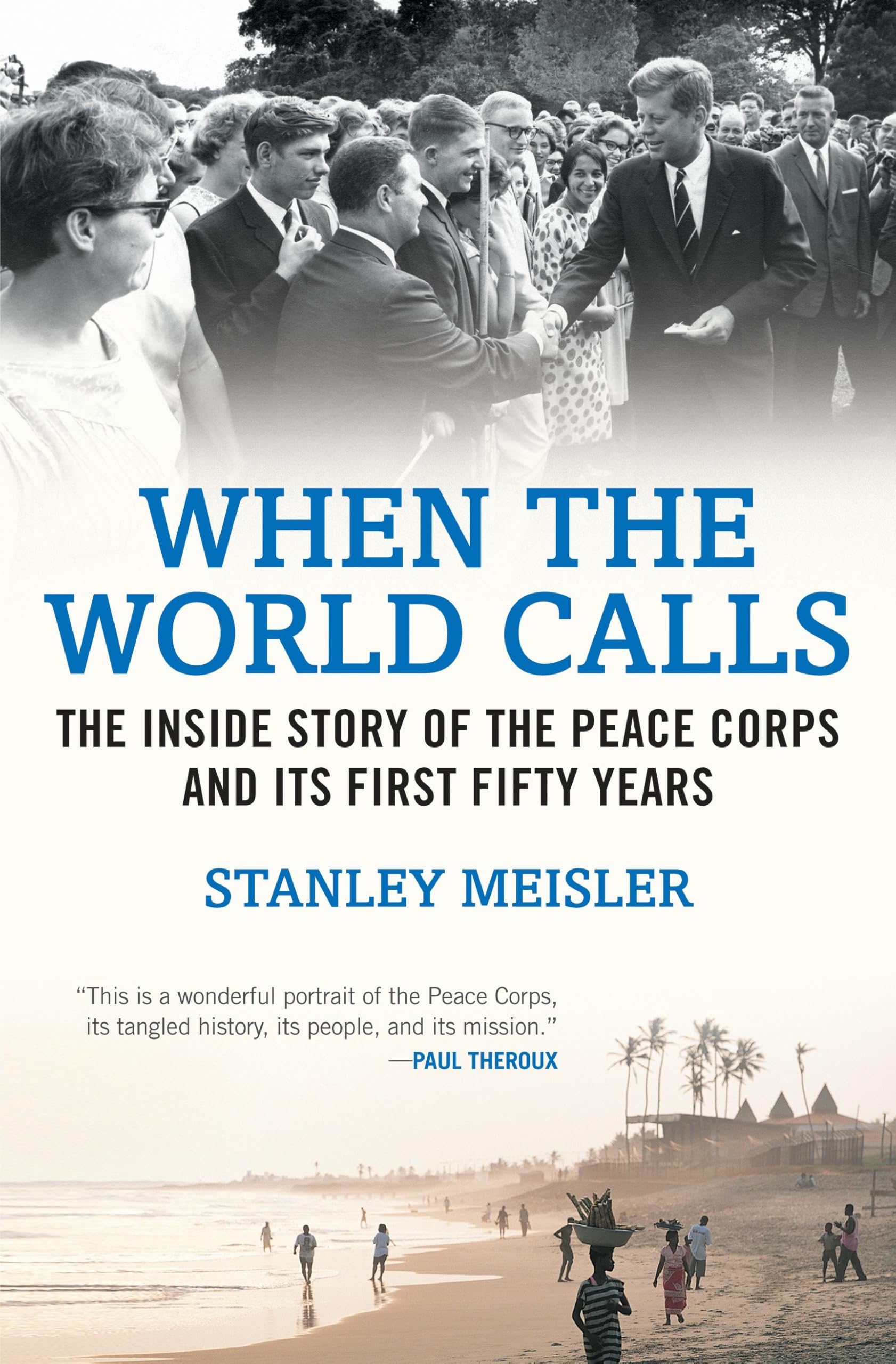
When the World Calls: The Inside Story of the Peace COrps and Its First Fifty Years
$12.81
by Stanley Meisler



When the World Calls is the first complete and balanced look at the Peace Corps’s first fifty years. Revelatory and candid, journalist Stanley Meisler’s engaging narrative exposes Washington infighting, presidential influence, and the Volunteers’ unique struggles abroad. He deftly unpacks the complicated history with sharp analysis and memorable anecdotes, taking readers on a global trek starting with the historic first contingent of Volunteers to Ghana on August 30, 1961. In the years since, in spite of setbacks, the ethos of the Peace Corps has endured, largely due to the perseverance of the 200,000 Volunteers themselves, whose shared commitment to effect positive global change has been a constant in one of our most complex—and valued—institutions. "The Peace Corps has always been poorly understood by Americans, and even its Volunteers rarely know much about the agency's founding and development....[A]n instructive, thorough, and fascinating history." —Peter Hessler, New Yorker staff writer, journalist, and author of River Town: Two Years on the Yangtze "In his new and engaging history...Meisler takes us through a concise and affectionate look at its birth, and its various political battles." —Scott Martelle, Los Angeles Times "Meisler's affection for the agency permeates every chapter. But he does not ignore criticisms and failures, making for a balanced, satisfying institutional history." —Steve Weinberg, San Francisco Chronicle "A thoughtful, balanced story of a program that captured the spirit of America. My Peace Corps service defined me and thousands of others who had the privilege of serving." —Donna Shalala, president, University of Miami, and former secretary of health and human services "Stanley Meisler delivers an enlightened and engaging narrative of President Kennedy's 'most enduring legacy'--the Peace Corps. With humor and a historian's eye for telling detail, he carries us through this remarkable organization's fifty years of history and leaves us convinced that 200,000 Volunteers really did make a difference in the world." —David Lamb, long-time Los Angeles Times foreign correspondent and author of Vietnam Now: A Reporter Returns "Stanley Meisler is a gifted writer....This book is full of insights and great anecdotes. It is wonderful history, wonderfully told."—James Mann, author-in-residence, Johns Hopkins University School of Advanced International Studies, and author of Rise of the Vulcans: The History of Bush's War Cabinet “This is a wonderful portrait of the Peace Corps, its tangled history, its people, and its mission. It is a timely reminder of how it is possible to bring hope and change to the world. Stanley Meisler—a distinguished foreign correspondent—is just the man to tell this story.”—Paul Theroux Stanley Meisler , the author of two other books, was a foreign and diplomatic correspondent for the Los Angeles Times for three decades. He was also deputy director of the Peace Corps’s Office of Evaluation and Research in the mid-1960s. Meisler, who lives in Washington, D.C., has written for Foreign Affairs, Foreign Policy, the Atlantic, the Nation, and Smithsonian, and periodically posts news commentaries on his Web site. From Chapter Eight, “The Specter of Vietnam” On January 6, 1966, two Peace Corps officials embarked on a secret, reckless trip to Vietnam. The goal of their mission was to find out whether Vietnam might be a suitable country for a Peace Corps program. That goal was foolish and fanciful. President Lyndon Johnson had already dispatched thousands of combat troops to South Vietnam and ordered the continual bombing of North Vietnam. Antiwar rallies were already dominating campus life on universities throughout the United States. Peace Corps Volunteers were joining protests. Any attempt to place Volunteers in Vietnam would have crippled the Peace Corps. Even news of the exploratory trip would have damaged the Peace Corps badly. The two officials were Warren Wiggins, deputy director of the Peace Corps, and Ross J. Pritchard, director of Far East regional operations. Within the Peace Corps, Wiggins and Pritchard were known as the most fervent players of the numbers game—they relentlessly promoted massive new programs without worrying about meticulous planning. But it was not their idea to go to Vietnam. Wiggins, who died in 2007, never discussed the Vietnam adventure publicly. But Pritchard, retired in Tennessee, says they flew to Vietnam because Johnson ordered them to go. Pritchard says he and Wiggins knew that a program in Vietnam “would ruin the Peace Corps, absolutely wreck it. Because of the mood on campuses, it would cut us off at the knees.” But Bill Moyers, the former Peace Corps deputy director who was now White House press secretary, told them that Johnson insisted they go. According to Pritchard, “We went with great, great reluctance.” They should have resisted. But Johnson’s insistence came at a time would n