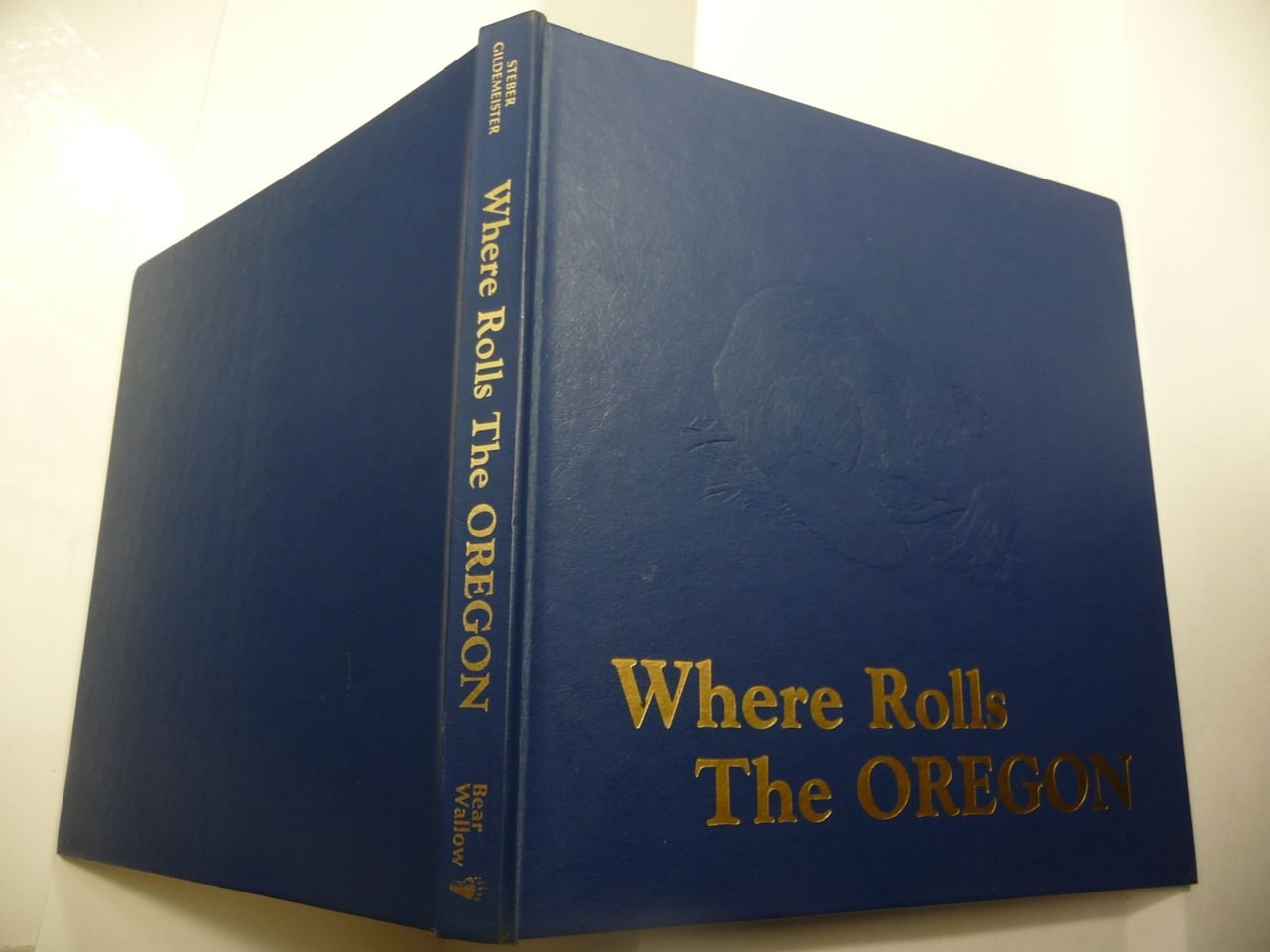



Printed and offered as a collector's limited edition, Where Rolls the Oregon is bound in rich Imperial bonded leather, 11"x11" in size, and signed by the authors. The book is lavishly illustrated with over 100 color photographs, historic works of art, and detailed maps. The first European to sail the waters of the North Pacific was pirate Sir Francis Drake. He plundered the gold of South America then escaped up the coast in search of a northwest passage which would take his ship, the "Golden Hind," back to the Atlantic Ocean. Russian, Spanish, and English sailors came in later years to explore the Pacific coast, and It was Captain Cook's crew that took a few sea otter pelts to China, discovering the fabulous riches awaiting the adventurous sea trader. This caused rumors to circulate among fur trading sea captains that a great river emptied from the North American interior into the Ocean near the 46th parallel. Their name for this fabled river was the "Oregon." On May 11,1792, American Robert Gray penned in his log: "At 8 A.M., being a little to windward of the entrance to the harbor, bore away and run in east-northeast, between the breakers, having from five to seven fathoms of water. When we were over the bar we found this to be a large river of fresh water, up which we steered. . . . .Vast numbers of natives came alongside." The "Great River of the West" had been discovered, and Captain Robert Gray named it the "Columbia" after his valiant ship. Exploration of the American continent was pushed westward by two British fur companies, the Hudson's Bay Company and the North West Company. The first to reach the Pacific coast overland was the North West's Alexander Mackenzie. At the water's edge he inscribed on the face of a rock, "Alexander Mackenzie from Canada by land, the 22nd day of July, 1793." The Louisiana Territory, including the Pacific Northwest, was purchased from Napoleon in 1803. The following year President Thomas Jefferson dispatched an expedition to explore the new country from the edge of civilization to the Pacific Ocean. Leading the expedition were Meriwether Lewis and William Clark. Along with a party of 45 adventurers, they traveled from St. Louis , up the Missouri, and over the Rocky Mountains to the vast wilderness drained by the mighty Columbia. Following the expedition's success, New York fur dealer John Jacob Astor founded the Pacific Fur Company with a plan to send two groups of men, one by sea and the other overland, thereby assuring he would gain control of the mouth of the Columbia and all the interior drained by it. Astor sent the ship "Tonquin" around the Horn to establish Fort Astoria in March of 1811. That summer the ship's crew was attacked and all hands murdered by Indians as the "Tonquin" laid at anchor off Vancouver Island. Disaster also plagued the overland expedition. After crossing the Rocky Mountains the hunters were not able to find enough wild game to sustain the men. They were forced to kill and eat their horses. Continuing on foot, and in the dead of winter they crossed the Blue Mountains and would have perished except for the generosity of Indians who provided horse and dog meat to ward off starvation. Singly or in small groups, other trappers came to the country. In the long shadows of evening they poked along the shore looking for sign and setting traps. Surrounded by the silence of early morning they returned to collect the beaver. No matter the caution, smoke from a campfire was sometimes spotted curling from a secret valley. A war hoop would split the stillness, an arrow would find its mark and there in the vast wilderness, beside a nameless stream, the body of a trapper would lie. In time the sun would bleach the bones to fine white powder. Where Rolls the Oregon depicts the rich history of the Pacific Northwest from discovery to settlement. The explorers, traders, and trappers who opened the country live again in the writings of Rick Steber and photographic illustrations of Jerry Gildemeister. Steber introduces the characters and allows them to speak in their own words, taken from original logs and journals: whereas, Gildemeister, with mood-setting photography, visually represents the country with the same wonderment of the discoverers and explorers. Through their combined talents, they guide the reader through the vast untamed wilderness that was the magnificent Oregon Country. ... the kind of book you'll hand down to your grandchildren ... [they'll] smell its rich binding and ... think of you. -- Johnathan Nicholas - The Oregonian - 5-26-86 Books from The Bear Wallow Publishing Co. ... have a comfortable quality about them, like worn leather [or] a well-oiled rifle ... -- Paul Pintarich -- The Oregonian -- 11-6-85 Its ... lavish use of color photographs, maps, and ... illustrations ... identify it as a gift book or collector's item. -- Nathan Douthit - Publishing NW - May/June 1986 The state's interesting history and vast beauty are a