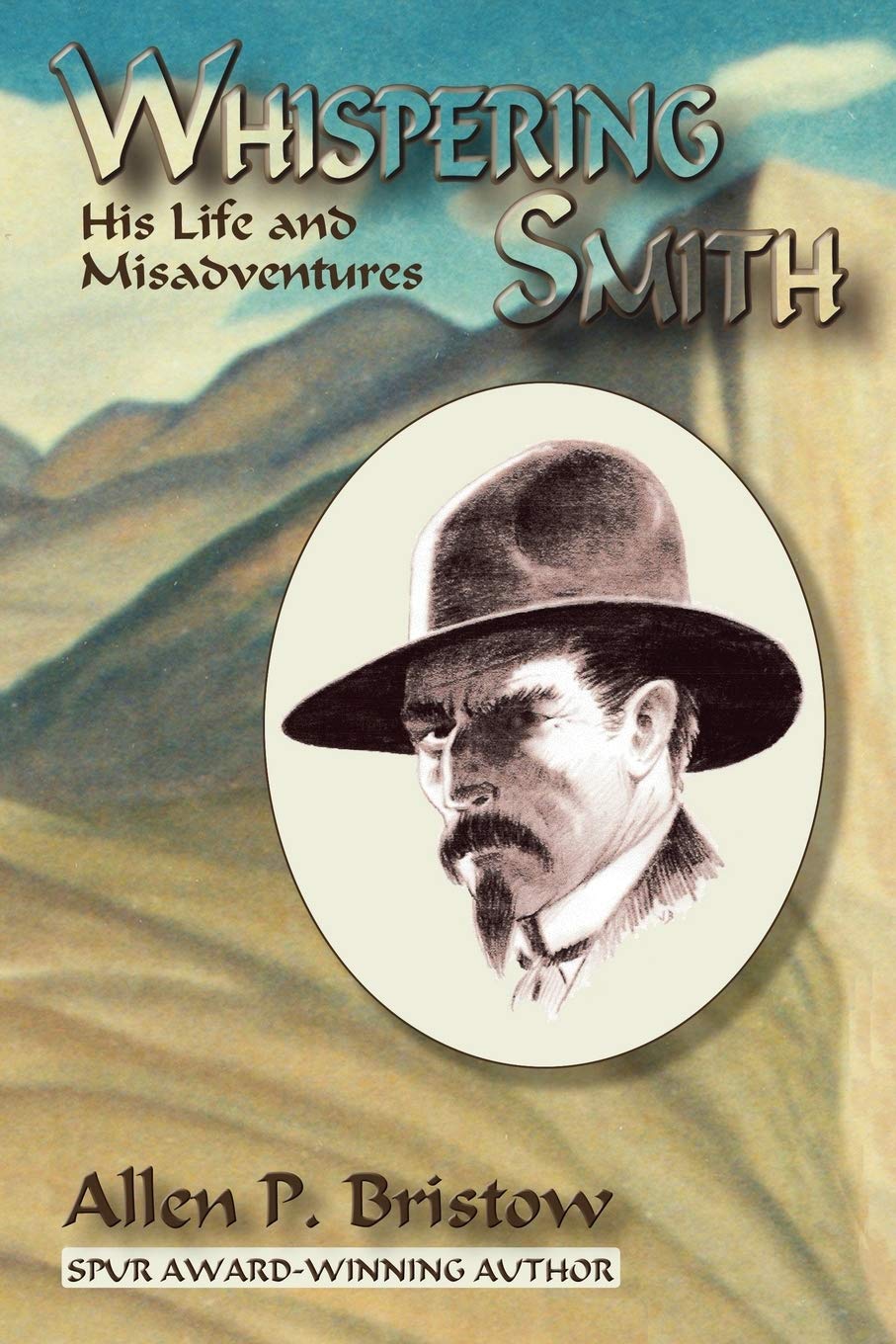



The fictional adventures of the heroic railroad detective called Whispering Smith have entertained readers, motion picture enthusiasts and television viewers for many years. The colorful name of this character had such appeal that it has been adopted by musical bands, apparel manufacturers and emblazoned on the nose of World War Two bombers. But was there a real Whispering Smith? Was he the heroic champion of justice on the western plains as depicted by Hollywood or was he instead a sinister and tragic recluse? Traces of his confrontations with western outlaws are found throughout Colorado, Nebraska, New Mexico, Utah and Wyoming. Yet in his search for justice did he become a centurion that confronted frontier lawlessness with a hangman's rope? Was the real Whispering Smith actually a cold-blooded killer, frustrated duelist, devious plotter and pugnacious braggart? These questions can best be answered by an examination of his life in this book. ''A book of 173 pages might not sound very long, but it's quite an accomplishment when the subject matter is a man named Smith who whispered (or didn't say anything) a lot, tended to be secretive and had few friends and no family. Furthermore, the name Whispering Smith is usually associated with fictional adventures portrayed in books or seen on the big or little screens. It all began with Frank H. Spearman's best-selling novel of 1906 with the catchy name Whispering Smith . The railroad detective of that book has appeared (usually more dramatically and heroically) in at least half a dozen motion pictures (including a 1948 version starring Alan 'Shane' Ladd) and in a 1961 television series. But there was a real Union Pacific Railway detective who came to be known as Whispering Smith; his true name was James L. Smith. Apparently the real Smith never personally used the nickname 'Whispering,' and one estimation that he killed 30 men is no doubt way too high (though he was definitely involved in several killings and probably in at least one lynching). Allen Bristow, who had a career in law enforcement and has written many articles for Wild West magazine and other publications, deals with the 'Hollywood Versus History' issue in his first chapter. The author's objective in exploring this subject was in fact to see if the mild-mannered, honest, moral, courageous Hollywood Smith matched the real-life Smith, who was credited with having been the only peace officer to ever penetrate the Hole-in-the-Wall (outlaw hangout in Wyoming) and with having once run Bat Masterson out of Denver. In the end, the real Whispering Smith, in part because of excessive drinking, was not the man he once was. But neither was the actor Alan Ladd. Bristow closes with some intriguing parallels between the two men.'' --Wild West Magazine, February 2008 ''If the moniker Whispering Smith rings a bell, one might recall a motion picture by the same name starring Alan Ladd or an even earlier novel by Frank Spearman. Few are aware of the historical roots for the celluloid soft spoken gunman. Allen Bristow, a WWA Silver Spur winner, is a retired law enforcement officer. He has put his considerable investigative skills to work and brought us the first book length on this fascinating frontier character, James L. Smith. Bristow brings forth a lot of new information including Smith's Civil War career as a union naval officer patrolling the Mississippi and antebellum investigator with the Freedman's Bureau. He sheds even more light on Whispering's New Orleans Metropolitan Police activities, including what may well be his first shooting and the reason why he surfaced in Cheyenne, Wyoming Territory, as an enforcer with the Union Pacific Railroad. Detailing a couple more killings, Bristow takes us with Smith to New Mexico Territory and back to the Great Plains. Smith took up his guns for the Wyoming Stock Growers' Association and eventually to Utah investigating the Castle Gate Payroll robbery. He does an excellent job weaving in Pat Garrett and Bat Masterson and a cast of lesser known but just as formidable characters. Author Bristow illuminates the historical process particularly when researching a relative unknown and with the hardly unique name of Smith. That process belies the contention that history is a reconstruction of the past. More accurately it is a construction based upon available facts and evidence seasoned with deduction and sense. There is much more work to be done trailing Whispering Smith. If you want to catch the bug, read Allen Bristow's book.'' --Quarterly of the National Association for Outlaw and Lawman History, July-December 2007 ''Allen P. Bristow's account of the life of James L. Smith (1838-1914) is a work of admirable research. A shadowy, intemperate figure who worked in a string of quasi-law enforcement and security jobs, Smith left a trail of belligerent encounters and a few dead men during his forty years in the West. A central issue the author does not adequately answer is the c