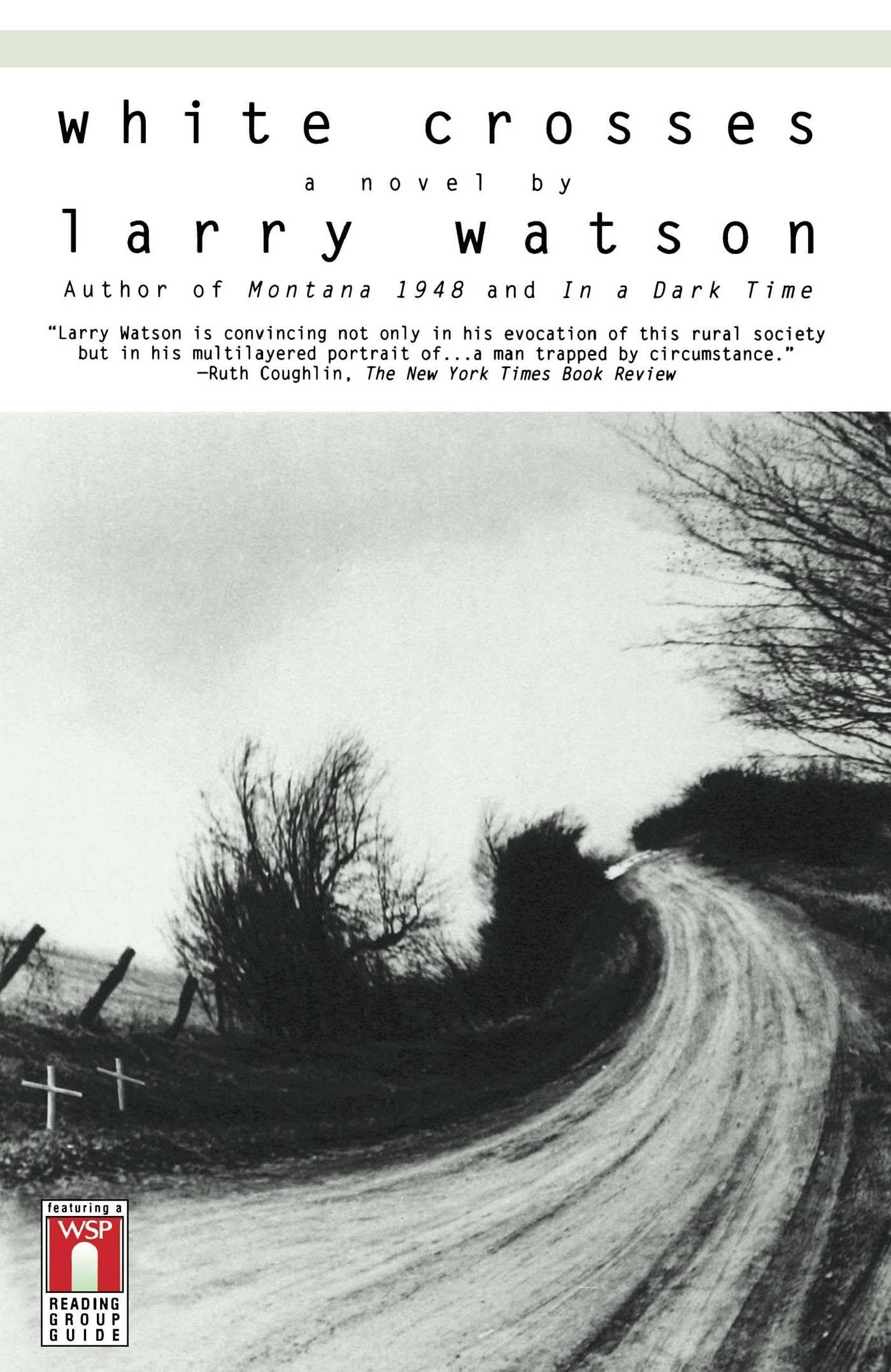



Larry Watson's previous fiction evoking contemporary Western small-town life has won him awards, a dedicated readership, and unqualified critical praise. Now he has written a novel that envelops the rich emotional terrain of his beloved Montana in a mystery that is both unexpected and unforgettable. After a nighttime accident at the bottom of Sprull Hill in Bentrock, Sheriff Jack Nevelsen is compelled to try and protect a part of his hometown that even a hero would have trouble saving -- its innocence. For most everyone in the community would agree that June Moss, the quiet girl who had just graduated from high school, and Leo Bauer, the principal of Bentrock Elementary and a married man like Jack, had no business heading out of town together. As Jack sets out to unravel the mystery of their deaths, he begins to create a story to shield his town, a lie that will reverberate throughout an entire community, and into the shadows of his own heart. Nancy Pate Chicago Tribune Morally and emotionally complex, the writing assured....Readers of Montana 1948 will find themselves on familiar ground. Chris Faatz The Nation There's something eminently universal in Watson's ponderings on the human condition, and it's refracted through a nearly perfect eye for character, place, and the rhythms of language. Margaret Cannon The Globe and Mail (Toronto) Haunting....One of the most irresistible novels of the year. Larry Watson was born in Rugby, North Dakota and raised in Bismarck. He is the recipient of the Milkweed National Fiction Prize, a National Endowment of the Arts award, and the Mountains and Plains Booksellers Association Regional Book Award. Watson teachers English at the University of Wisconsin at Stevens Points. Chapter 1 When Sheriff Jack Nevelsen got the call from the dispatcher about the accident out on Highway 284 -- single car, two fatalities -- his first thought was, kids. Teenagers. Oh, sweet Jesus, somebody's babies. It was ten o'clock Sunday night, May 28, 1957, and Bentrock High School's senior class had graduated that afternoon. Mercer County's roads and highways were going to be traveled that night by kids going from party to party. And they were going to be drinking. This was Jack's fear every year at graduation, that a kid -- or worse, kids, a whole car full of them -- would get drunk and try to beat a train to a crossing, or weave across the center line, and some parents' proudest day would turn into their worst. On graduation night kids drank; the ones who never drank would probably pick that night to start, and the ones who drank regularly would try to do it up bigger than ever. So far Mercer County had been lucky. No graduation-night tragedy for them. But three years ago they came close, damn close. The kids held a big party at an area north of town known as The Haystacks, and in all the driving back and forth, a young woman missed a bridge and landed her car in a creek bed. Jack could never figure out if it was good or bad that the creek was dry. At any rate, the drop from the bridge was not far, less than fifteen feet, and everyone got out of the car unhurt. Only minutes later, another carload of kids -- speeding around the same curve -- missed the same bridge. They didn't fall as far as the first car because they landed right on top of it. A giant hand couldn't have balanced the second car more precisely on the first. The next morning when the tow truck winched the cars up the slope, and when Jack saw the crushed roof of the first car, Kathy Hessup's white Ford, he wondered how much luck Mercer County had used up the previous night. So every year, come graduation time, Jack, along with Chief of Police Bagwell, tried to put the word out: Stay put and we'll leave you alone, but if you drive drunk, we're going to be on your ass. Now it sounded as though someone hadn't gotten the word, or hadn't heeded it, and Mercer County's luck had run out. Jack took the call on the phone in the kitchen, and before he went out to his truck, he stuck his head into the living room where his wife, Nora, was sewing and watching television. "I've got to go out," he said. "Accident out on two-eighty-four west of town." She didn't ask how bad the accident was, or if he knew who was involved. But that was Nora. She would know soon enough; everyone in town would. She was not in any hurry to hear bad news, and the fact that his job kept bringing it to their doorstep, like a stray dog or cat that, once fed, won't stay away, put some strain on their marriage. It was nothing serious. But often Jack could not talk with Nora about his work. If it was in the least sordid, ugly, brutal, or even unpleasant, Nora did not want to hear about it. Starting at midnight on Friday nights, the television station in Williston broadcast Shockerama, a double feature of old horror movies, and Nora would not even stay in the room when those movies played. Jack loved them, especially the werewolf features, and if he was