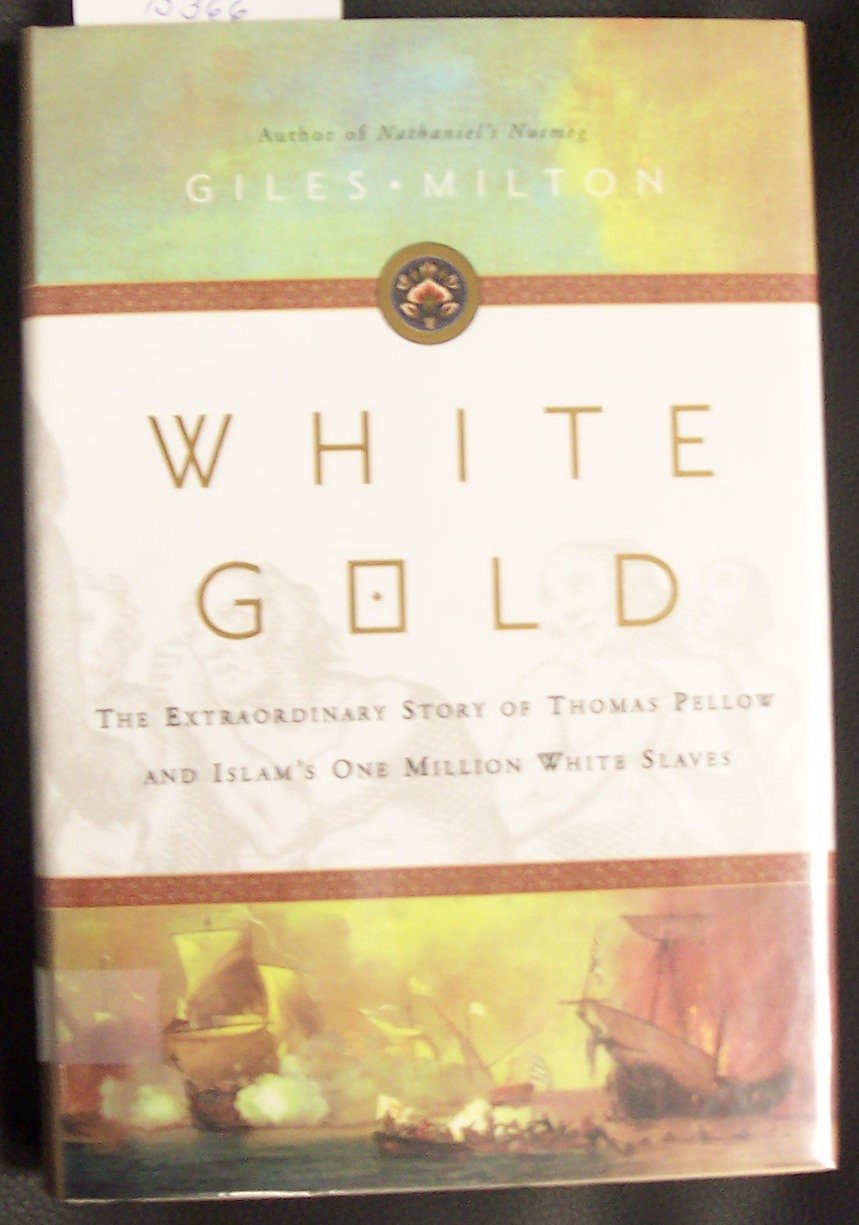
White Gold: The Extraordinary Story of Thomas Pellow and Islam's One Million White Slaves
$43.98
by Giles Milton



The true story of white European slaves in eighteenth century Algiers, Tunis, and Morocco In the summer of 1716, a Cornish cabin boy named Thomas Pellow and fifty-one of his comrades were captured at sea by the Barbary corsairs. Their captors--Ali Hakem and his network of Islamic slave traders--had declared war on the whole of Christendom. France, Spain, England and Italy had suffered a series of devastating attacks. Thousands of Europeans had been snatched from their homes and taken in chains to the great slave markets of Algiers, Tunis and Salé in Morocco. Pellow and his shipmates were bought by the tyrannical sultan of Morocco, Moulay Ismail, who was constructing an imperial palace of such scale and grandeur that it would surpass every other building in the world, a palace built entirely by Christian slave labor. Resourceful, resilient, and quick-thinking, Pellow was selected by Moulay Ismail for special treatment, and was one of the fortunate few who survived to tell his tale. An extraordinary and shocking story, drawn from unpublished letters and manuscripts written by slaves and by the padres and ambassadors sent to free them, White Gold reveals a disturbing and long forgotten chapter of history. The horrors of the transatlantic slave trade have been extensively documented in print and eloquently portrayed on film and television. But chattel slavery was a well-established African as well as European institution, and its victims were not exclusively people of color. In the seventeenth, eighteenth, and early nineteenth centuries, the Barbary states of North Africa used Islamic pirates, or corsairs, to conduct slave raids, which fed the flourishing slave markets of Algiers, Tunis, and Tripoli. Many of the enslaved were white Europeans or North Americans captured at sea. Among them was Thomas Pellow, an 11-year-old English child who was seized in 1716 and served for 23 years as a personal servant to Sultan Moulay Ismail of Morocco. Milton relates Pellow's compelling story as a triumph of wile, pluck, and endurance; but this is also a tale of great brutality and suffering, as Milton eloquently shows that all of the indignities one associates with European and American slavery were visited upon those held in North Africa. A riveting account. Jay Freeman Copyright © American Library Association. All rights reserved Praise from Britain for White Gold : "White Gold is lively, and diligently researched, a chronicle of cruelty on a grand scale. An unfailingly entertaining piece of popular history." -- Sunday Telegraph "[Giles Milton] is a popular, non-academic historian drawn to dramatic, even bizarre subjects, researched in highly enterprising ways, and told in a vividly swashbuckling style. An exciting and sensational account of a really swashbuckling historical episode, White Gold will do very well for this summer's beach read." -- The Spectator "White Gold delivers on its promise of exotic thrills." --Rhoda Koenig, The Evening Standard Giles Milton is the author of Samurai William (FSG, 2003), The Riddle and the Knight (FSG, 2001), Big Chief Elizabeth (FSG, 2000) and Nathaniel's Nutmeg (FSG, 1999). He lives in London. Giles Milton's new book is a fascinating account of a long-forgotten era when an awful menace terrorized the coastal waters of North Africa. In the 17th and 18th centuries, countless vessels leaving the coasts of Europe and colonial North America were seized at sea by bands of Barbary corsairs, who confiscated their cargo and dragged their hapless crews to the shores of Morocco, Algiers, Tunis and Tripoli to be sold into slavery. Based primarily on narratives published by freed or escaped slaves, White Gold recounts the story of Thomas Pellow, who at age 11 joined the crew of an English trading vessel, the Francis, as a cabin boy and merchant's apprentice. Pellow's ship left Cornwall in 1715, carrying a cargo of salted pilchards to trade in Genoa. Upon setting sail for home, the Francis was overtaken by a band of "fanatical corsairs of Barbary" who, in a "deranged fury," boarded the ship, overpowered its unarmed crew and seized its precious cargo of Italian wares meant for sale in England. But the merchandise was a mere pittance compared to the real prize of the ship: its crew. In the early 1700s, the trade in European slaves was a booming business throughout North Africa, even though, in size and scope, it did not compare to Europe's own immensely profitable African slave trade. According to Milton, nearly 1 million Europeans passed through the markets of coastal towns like Salé, on the north coast of Morocco, where they were auctioned off to the highest bidder. For better or worse, Pellow's crew was spared such humiliation and instead marched directly to the imperial city of Meknes, where they were ceremonially presented as gifts to the cruel and capricious sultan of Morocco, Moulay Ismail. Being a strong and hearty young boy, Pellow immediately caught the at