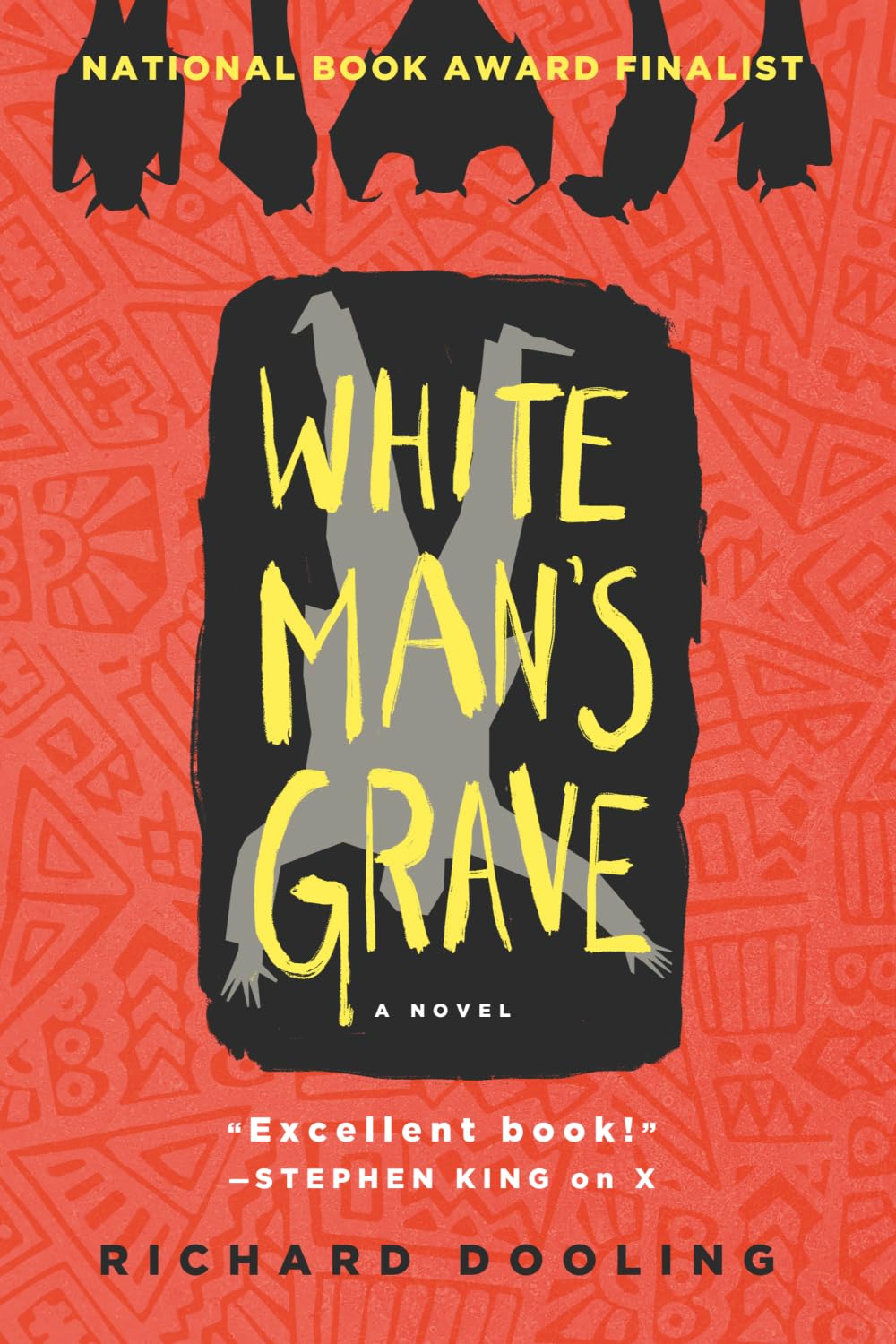



National Book Award Finalist • New York Times Notable Book of the Year "Excellent book!" Stephen King on Twitter (X) "White Man's Grave takes the reader on a wild journey to West Africa and conforms to no known format for fiction." — Janet Maslin, New York Times When Peace Corps volunteer Michael Killigan vanishes in West Africa, two men go looking for him. His father Randall, a bankruptcy lawyer, is the warlord of his world — a shark in a fishbowl who exercises power with mad, relentless, hilarious glee. His best friend Boone Westfall, an American innocent abroad, journeys into the African bush armed with nothing but a passport and the almighty dollar. Both men find far more than they bargained for. Witches and witch-finders, bush devils, shape-shifters, village chiefs, judges, and medicine men from two continents populate this ferociously funny novel — one that makes litigation, modern medicine, and the insurance business look indistinguishable from primitive magic. "Excellent book!" Stephen King on Twitter (X) "A bravura display of satire . . . Dooling evokes the humane checks and balances of a deep world: the logic, you might say, of its magic."--Richard Eder, Los Angeles Times Book Review "The book is absolutely astonishing; I am a Richard Dooling fan for life."--Phillip M. Margolin, author of Gone, But Not Forgotten "The author's fizz of comic energy is as wild and scornful as Richard Condon's."--Time From Publishers Weekly This is a galloping tale about a clash of worldviews, in this case between the insular West African Mende culture--complete with tribal politics and voodoo--and the pure red-blooded Caucasian American variety, with its highly rational citizens bent on ideological conquest, good deeds and the accumulation of cash. For all that heavy loading, Dooling ( Critical Care ) has constructed a deceptively simple story involving the disappearance in the African bush of Michael Killigan, a Peace Corps worker from Indianapolis whose father is a powerful wizard of the bankruptcy courts in the Seventh Circuit. A "black bundle of tightly wrapped rags the size of a football," which has arrived at Randall Killigan's law office, eventually oozes blood and might be the cause of his bizarre nocturnal hallucinations. Calling on his considerable and well-compensated powers of analysis and suasion, Randall discovers that he is the recipient of African "bad medicine." The State Department confirms that his son is missing. What follows is a journey far into the depths of African magic for the whereabouts of Michael Killigan. His boyhood friend, a not-always endearing naif named Boone Westfall, flies on a heroic rescue mission, only to further complicate the situation. Meanwhile, looking to buy answers, lawyer Killigan showers money and Land-Rovers into the African bush. Dooling's prose gifts are capacious: of a "huge shirtless blacksmith" working at a forge, he says "he lifted something and the muscles of his back bloomed like the hood of a cobra." The book's language similarly expands to accommodate the bizarre and mind-bending mysteries of witchcraft upon which the plot turns. In the end, the book's lush satire cleverly obscures its simple, unarguable premise: that unfathomable rituals are at the heart of any culture, even in Indiana. From The New Yorker First and Third Worlds collide in this dark comedy, in which Dooling explores one of their largest common denominators--absurdity . . . Dooling, alternating his narrrative between Sierra Leone's turmoil of witchcraft and poisoned politics and Indiana's air-conditioned and stress-managed landscape, reveals their surprising similaries with ease and wit. I visited my good friend, Michael O'Neill, in Sierra Leone in the fall of 1981. Mike was a Peace Corps Volunteer in Bo Province. The day I arrived in the village, I met my "father," a wise old Pa who would be my guardian during my visit. Pa Moussa told me the first day that I would never be same after my visit. We never step twice in the same river and all, but Pa Moussa knew the place would change me, and it did. Sierra Leone, or Salone, as its known to those who love her, stuck with me. And about ten years later, I published my first novel, Critical Care, which gave me the time and the funds to leave the practice of law and undertake White Man's Grave. I knew it would take me a year or so to research all the secret society and folklore I had heard about during my visit and another year or so to write it. I remember realizing, even while I was still in Salone, that villagers hire bad medicine men, or hale nymubla , to harm an enemy with witchcraft or bad medicine the same way an American would, say, hire a lawyer to sue somebody. And that's basically what the novel is about. Richard Dooling Richard Dooling's debut, Critical Care , was hailed as a masterpice, a "very funny first novel" (Beryl Benderly, The Washington Post ) which readers found "impossible to put down" (Harper Barnes, St