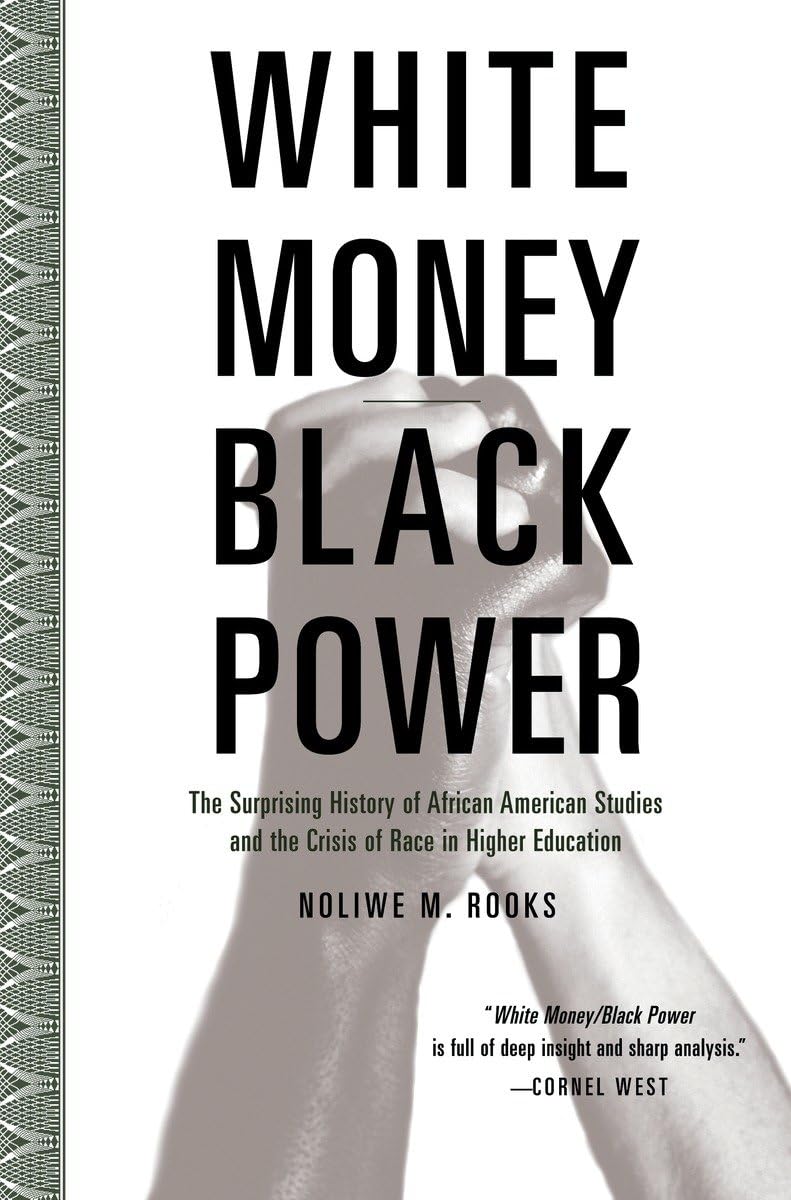
White Money/Black Power: The Surprising History of African American Studies and the Crisis of Race in Higher Education
$20.00
by Noliwe Rooks



The history of African American studies is often told as a heroic tale, with compelling images of black power and passionate African American students who refused to take no for an answer. Noliwe M. Rooks argues for the recognition of another story, which proves that many of the programs that survived actually began as a result of white philanthropy. With unflinching honesty, Rooks shows that the only way to create a stable future for African American studies is by confronting its complex past. In this concise, compelling volume, Rooks . . . recreates the social and political contexts of the discipline's history, paying particular attention to its past reliance on white philanthropy and involvement. . . A must for anyone working in the field. -Publishers Weekly "Rooks is a serious scholar and insider of African American studies, and this book is full of deep insight and sharp analysis."--Cornel West "A provocative and original history of the relationship between philanthropy, politics and the emergence of Black Studies. White Money/Black Power will become central to discussions and debates about the origins and future of this dynamic and transformative intellectual project."--Farah Jasmine Griffin, author of If You Can't Be Free, Be a Mystery: In Search of Billie Holiday Noliwe M. Rooks is associate director of African American studies at Princeton University. The author of Hair Raising: Beauty, Culture, and African American Women and Ladies' Pages: African American Women's Magazines and the Culture That Made Them, she lives in Princeton, New Jersey. White Money/Black Power The Surprising History of African American Studies and the Crisis of Race in Higher Education By Noliwe M. Rooks Beacon Press Copyright © 2007 Noliwe M. Rooks All right reserved. ISBN: 9780807032718 Chapter One WHITE MONEY/BLACK POWER The Ford Foundation and Black Studies In I968, while under the leadership of McGeorge Bundy, the former national security advisor in both the Kennedy and Johnson administrations, the Ford Foundation began to craft and then fund a strategy aimed at ensuring a complication-free birth and life for African American Studies on college campuses. It was an act that would be denounced by the United States Congress as an attempt at social engineering. In keeping with the late-1960s world-view, African American Studies (then termed Black Studies) was envisioned and proposed by the Ford Foundation as a means to desegregate and integrate the student bodies, faculties, and curricula of colleges and universities in ways that would mirror the public school systems that had been ordered by the Supreme Court to free themselves from "separate but equal" racial educational systems. Within that context, African American Studies programs were viewed as a positive response to the increasingly strident calls for social and political redress made by African American students, as well as a means of responding to the unprecedented increase in the numbers of African American students entering colleges and universities during that politically turbulent period. Those early strategies around institutionalizing Black Studies, funded by Bundy and the Ford Foundation, currently threaten the very viability of African American Studies and have implications for how we think about, discuss, and understand both affirmative action and racial integration within colleges and universities today. While African American Studies programs and departments are still a central means of ensuring broad-based discussions about race, as well as the presence of Black students and faculty in American higher education, there has been a truly ironic development: As "Black Studies" became "African American, Africana, and African Diaspora Studies," Black students and faculty on white college campuses were less frequently African American-a trend that has increased. Indeed, the very question of what we mean when we say "Black students" has become a contested issue in and of itself. In 2005, increasing numbers of Black students are the children or grandchildren of first- or second-generation immigrants from the Caribbean or Africa. These students compose between 40 to nearly 80 percent of Black students on elite college campuses. In short, Black no longer means African American. As a result, if Black Studies was originally a tool used by colleges and universities to foster integration of faculties and curricula, and to achieve social justice, by recruiting African American students and faculty, today such programs have begun to signal a compelling shift in what we mean when we speak of affirmative action in relation to Black students. This is a far cry from the circumstances surrounding Black Studies at its founding, and a very different set of concerns from those McGeorge Bundy and the Ford Foundation first sought to address. Much of this book is about student protest, the politics of racial integration on college campuses, and