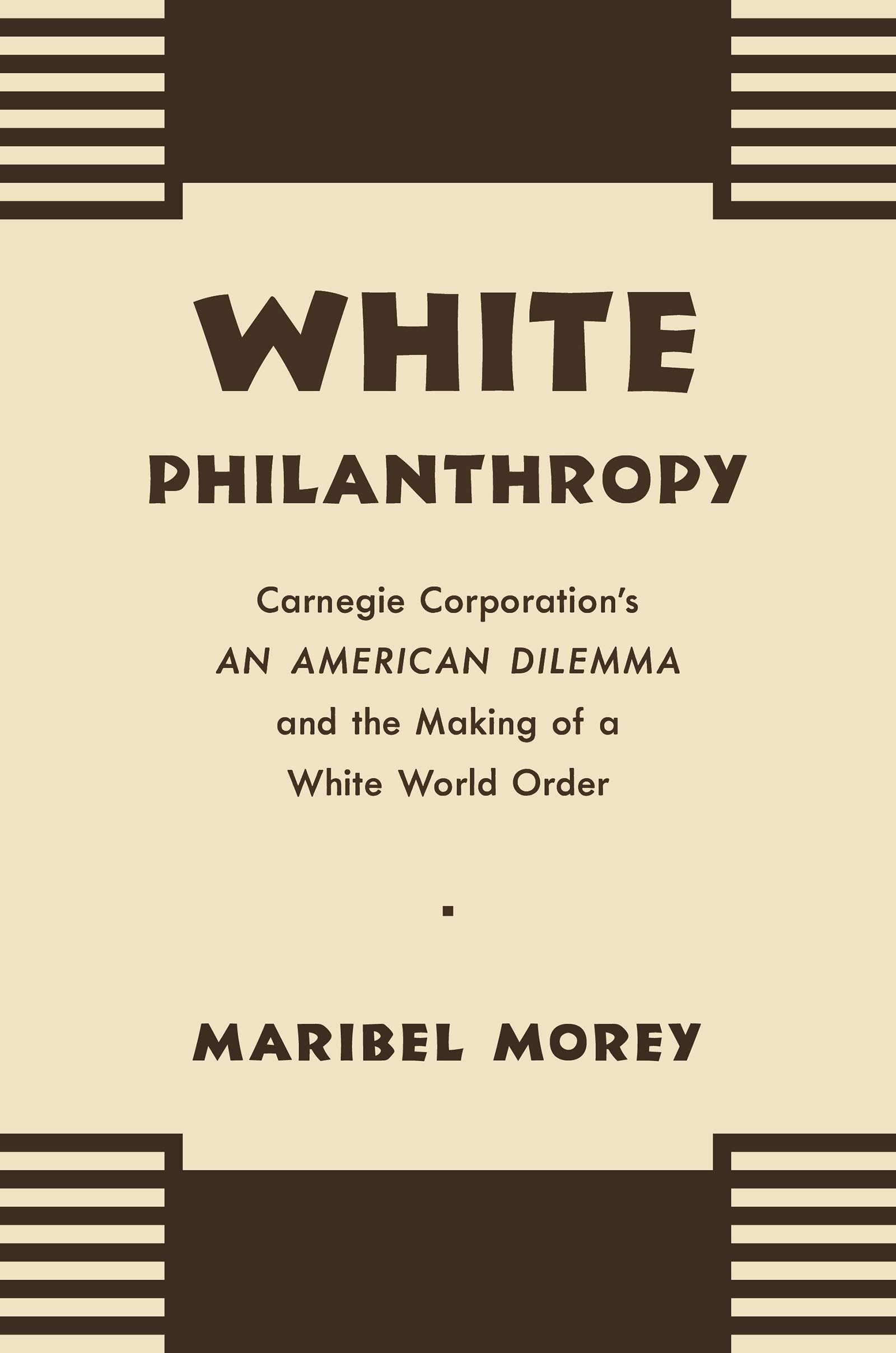
White Philanthropy: Carnegie Corporation's an American Dilemma and the Making of a White World Order
$39.95
by Maribel Morey



Since its publication in 1944, many Americans have described Gunnar Myrdal's An American Dilemma as a defining text on U.S. race relations. Here, Maribel Morey confirms with historical evidence what many critics of the book have suspected: An American Dilemma was not commissioned, funded, or written with the goal of challenging white supremacy. Instead, Morey reveals it was commissioned by Carnegie Corporation president Frederick Keppel, and researched and written by Myrdal, with the intent of solidifying white rule over Black people in the United States. Morey details the complex global origins of An American Dilemma , illustrating its links to Carnegie Corporation's funding of social science research meant to help white policymakers in the Anglo-American world address perceived problems in their governance of Black people. Morey also unpacks the text itself, arguing that Myrdal ultimately complemented his funder's intentions for the project by keeping white Americans as his principal audience and guiding them towards a national policy program on Black Americans that would keep intact white domination. Because for Myrdal and Carnegie Corporation alike, international order rested on white Anglo-Americans' continued ability to dominate effectively. " White Philanthropy is a vivid and thorough account of how a wealthy and powerful philanthropic organisation initiated, and eventually completed, a project to establish how white governance could improve the status of Black people. Morey's work draws close attention to the capacity of elite philanthropy to disseminate and uphold ideologies. More importantly, it carefully explains the tools and mechanisms that make this, and a white world order, viable."-- LSE Review of Books " White Philanthropy is an outstanding addition to the historiography on philanthropic foundations' support of social science."-- North Carolina Historical Review " White Philanthropy sets a new standard for critical philanthropy studies, exposing the historical underpinnings of how extreme wealth has perpetuated racial subordination in the United States and Africa. Morey's finely textured analysis of Andrew Carnegie, one of the most influential philanthropists in U.S. history, presents a bold, compelling, and provocative interpretation of how his foundation, the Carnegie Corporation, funded second-class education and social science research to effectively manage Black populations around the globe." -- Khalil Gibran Muhammad, Harvard University "Ground-breaking. . . . A major, original contribution to an understanding of the racialised basis of elite US institutions, networked into the American establishment; their huge impact on US life especially in this case on 'race relations' and understanding of racial power structures. . . . While there is no doubt that Morey's study is at heart a work of brilliant historical scholarship, it screams with relevance to current discussions of race and inequality, and White supremacy."-- The Wire "No work of intellectual history has offered more to think about when reconsidering An American Dilemma than Maribel Morey's White Philanthropy . . . . [A]n engaging work of institutional history of the Carnegie Corporation, and a trenchant analysis of the intellectual history of race in the twentieth century."-- Society for U.S. Intellectual History "Well-researched. . . . Carnegie, its president Keppel, and Myrdal framed An American Dilemma . Morey's White Philanthropy presents much evidence and an argument that they and the project were, well, white supremacist."-- Law & Liberty U.S. philanthropy?s white supremacist history Maribel Morey is founding executive director of the Miami Institute for the Social Sciences.