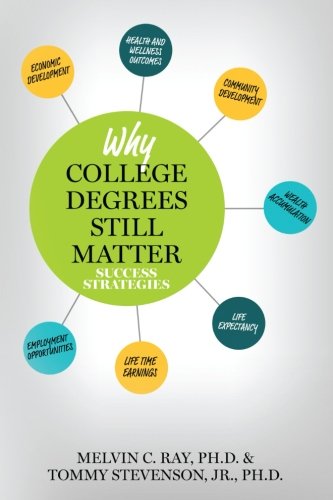



Why do college degrees still matter is a question often posed by students, parents/ guardians, family members, close friends, and even some religious leaders. Invariably, a follow-up question probes for advice or guidance regarding what it takes to earn a college degree. The authors drew from their personal experiences, interactions with college students and their parents/ guardians, colleagues, and empirical research to provide succinct, clear, and defensible answers to such inquiries. The book begins by laying out a strong and compelling case for linking postsecondary degree attainment at individual and community levels to all quality of life measures. Readers are shown the direct and indirect relationships between percent of postsecondary degree attainment and characteristics of local neighborhoods including availability of single-family homes, sidewalks, adequately funded public schools, properly maintained streets and security lighting, sufficient parks and recreation, access to fresh foods and vegetables, and proximity to quality healthcare. Readers quickly realize an undisputable fact. College degrees influence both quality of life and life expectancy along with where we live, work, and play. Moreover, readers are empowered with a message that transforms the act of earning a college degree from satisfying a personal goal to fulfilling a social obligation. It is not enough to increase awareness of relationships between college degree rates and quality of life in rural and poor communities. Stakeholders need access to empirical research findings and evidence-based best practices to increase academic achievement and attainment at the postsecondary level. The second half of the book shares the results of a survey of rural college students regarding the impacts of both social and behavior patterns on their success or setbacks while pursuing their degrees in 2013. The results of the survey showed that parental messaging, self-efficacy, study habits, employment, and daily routine activities matter. The authors discuss the results of the survey and offer recommendations for implementing common sense and cost effective initiatives to help increase retention and degree attainment among rural college students. There are two primary take-aways from this book. First, a critical mass of postsecondary degree holders increases social and economic capital in local communities that lead to higher quality of life indicators, even in poor and rural communities. Finally, according to the authors, controlling for medical and mental challenges, all students can learn and perform at or above national averages. Differences in rates of academic attainment can be explained by a combination of social and behavioral factors that are malleable.