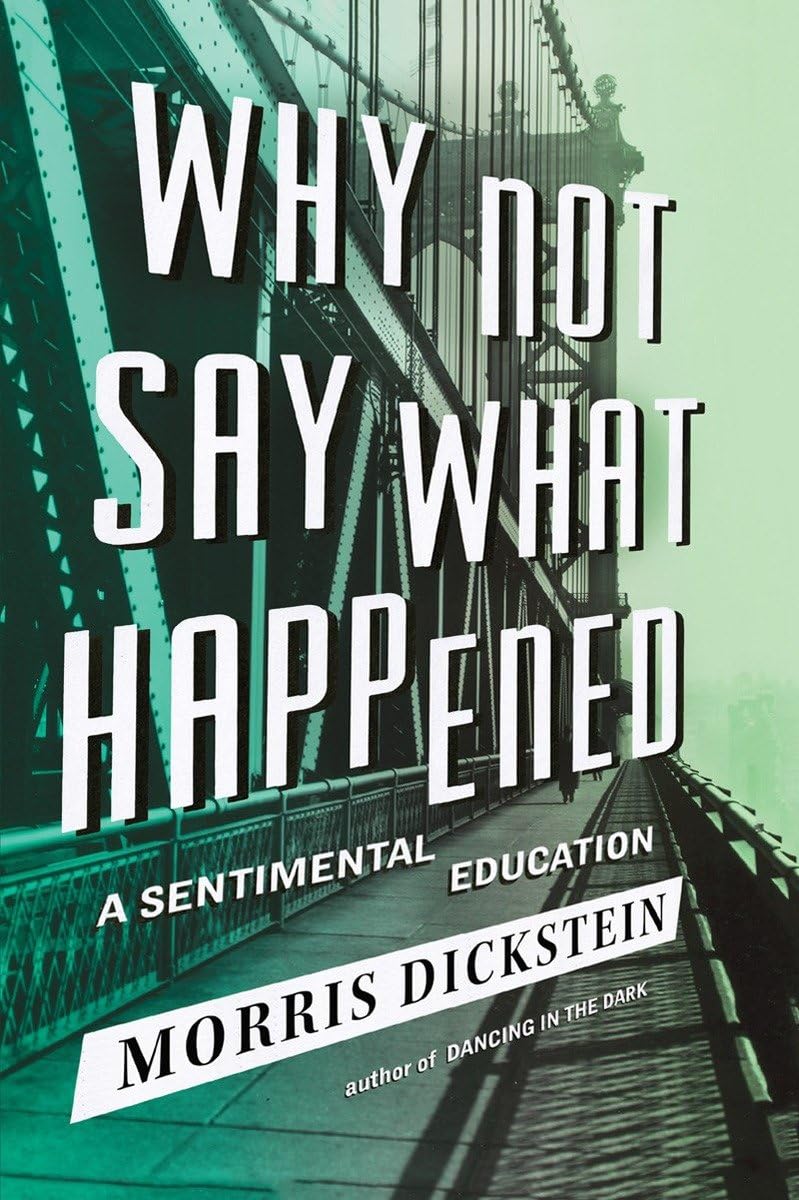



A renowned cultural critic tells his own deeply engaging story of growing up in the turbulent American culture of the postwar decades. At once a coming-of-age story, an intellectual autobiography, and vivid cultural history, Why Not Say What Happened is an eloquent, gripping account of an intellectual and emotional education from one of our leading critics. In this "acutely observed, slyly funny memoir" (Molly Haskell), Morris Dickstein evokes his boisterous and close-knit Jewish family, his years as a yeshiva student that eventually led to fierce rebellion, his teenage adventures in the Catskills and in a Zionist summer camp, and the later education that thrust him into a life-changing world of ideas and far-reaching literary traditions. Dickstein brilliantly depicts the tension between the parochial religious world of his youth and the siren call of a larger cosmopolitan culture, a rebellion that manifested itself in a yarmulka replaced by Yankees cap, a Shakespeare play concealed behind a heavy tractate of the Talmud, and classes cut on Wednesday afternoons to take in the Broadway theater. Tracing a path from the Lower East Side to Columbia University, Yale, and Cambridge, Dickstein leaves home, travels widely, and falls in love, breaking through to new experiences of intimacy and sexual awakening, only to be brought low by emotional conflicts that beset him as a graduate student―homesickness, a sense of cultural dislocation―issues that come to a head during a troubled year abroad. In Why Not Say What Happened we see Dickstein come into his own as a teacher and writer deeply engaged with poetry: the "daringly modern" Blake, the bittersweet "negotiations of time and loss" in Wordsworth, and the "shifting turns of consciousness itself" in Keats. While eloquently evoking the tumult of the sixties and a culture in flux, Why Not Say What Happened is enlivened by Dickstein's "Zelig-like presence at nearly every significant aesthetic and political turning of the second half of the American twentieth century" (Cynthia Ozick). Dickstein crafts memorable portraits of his own mentors and legendary teachers like Lionel Trilling, Peter Gay, F. R. Leavis, and Harold Bloom, who become inimitable role models. They provide him with a world-class understanding of how to read and nourish his burgeoning feeling for literature and history. In the tradition of classic memoirs by Alfred Kazin and Irving Howe, this frank and revealing story, at once keenly personal and broadly cultural, sheds light on the many different forms education can take. 8 pages of illustrations "Leading critic/historian Dickstein… here turns that spotlight mind on a subject close to home as he details his Lower East Side childhood, then breaking away from his close, observant Jewish family as he discovers Beat-imbued New York and the rich literary life at Columbia University. Then it’s on to oh-so-proper Yale and Cambridge and the wild Sixties." ― Library Journal "Morris Dickstein's magnetically intimate memoir is as much a record of an ardent young man's besotted hunger for literature as it is of his Zelig-like presence at nearly every significant aesthetic and political turning of the second half of the American twentieth century. And more: first love and first fatherhood; first immersion in the heady air of Cambridge, London, and Paris; portraits of illustrious teachers and critics (Leavis, Trilling, Bloom); the tremors and vagaries of first entering the demanding life of the academy; and an exhilarating glimpse into Dickstein's ripened mastery as he joins the storied generations of influential teachers, mentors, and cultural virtuosos." ― Cynthia Ozick "In this acutely observed, slyly funny memoir, we see the evolution of one of our foremost critics during a watershed moment of cultural history. Dickstein, a precocious, parochial yeshiva boy from the Lower East Side, makes the great trip to Columbia University, losing his virginity and wising up along the way. His naturally expansive sympathies are nurtured under some of the legendary teachers of the day, even as he gets caught up in the turbulence and changing tastes of the sixties. For me, this was both a page-turner and an intellectual joy ride―Dickstein put me in a front row seat of classes I’d give anything to have attended, and discussions I'd love to have been in on." ― Molly Haskell "A humane and benevolent account of an ideal education, by an ideal mentor and guide. A wonderful book." ― Mark Edmundson "Morris Dickstein's new book is at the same time a personal, cultural, and intellectual autobiography and an indispensable study of the tumultuous sixties. Charting the progress of an archetypical Jewish intellectual, Dickstein describes his evolution from Catskills innocent to Ivy League sophisticate, from Jewish minor to English major, from Lower East Side yeshiva bokher to apostle of higher Western learning, all the while paying generous tribute to his teachers, hi