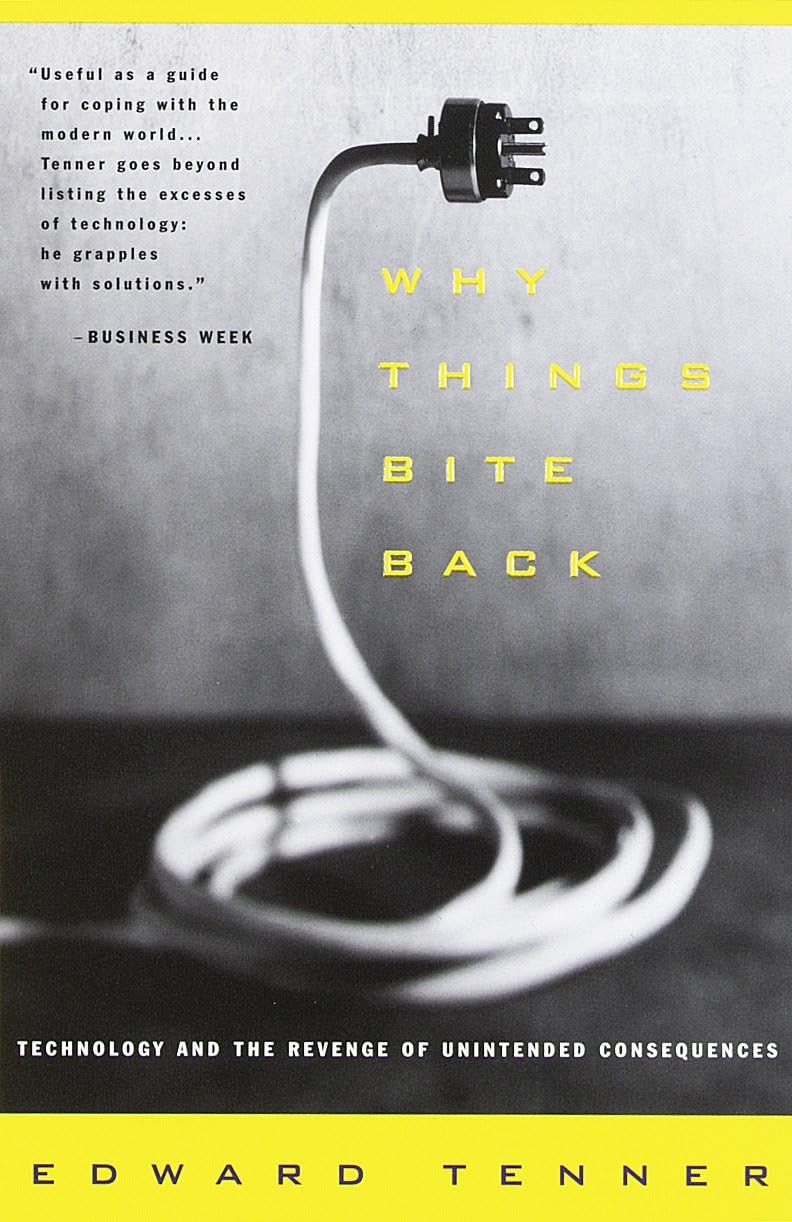
Why Things Bite Back: Technology and the Revenge of Unintended Consequences (Vintage)
$12.59
by Edward Tenner



In this perceptive and provocative look at everything from computer software that requires faster processors and more support staff to antibiotics that breed resistant strains of bacteria, Edward Tenner offers a virtual encyclopedia of what he calls "revenge effects"--the unintended consequences of the mechanical, chemical, biological, and medical forms of ingenuity that have been hallmarks of the progressive, improvement-obsessed modern age. Tenner shows why our confidence in technological solutions may be misplaced, and explores ways in which we can better survive in a world where despite technology's advances--and often because of them--"reality is always gaining on us." For anyone hoping to understand the ways in which society and technology interact, Why Things Bite Back is indispensable reading. "A bracing critique of technological determinism in both its utopian and dystopian forms...No one who wants to think clearly about our high-tech future can afford to ignore this book."--Jackson Lears, Wilson Quarterly If it can go wrong, it will--thus Murphy's Law. Science journalist Edward Tenner looks more closely at this eternal verity, named after a U.S. Air Force captain who, during a test of rocket-sled deceleration, noticed that critical gauges had been improperly set and concluded, "If there's more than one way to do a job and one of those ways will end in disaster, then somebody will do it that way." Tenner concurs, and he gives us myriad case studies of how technological fixes often create bigger problems than the ones they were meant to solve in the first place. The indiscriminate use of antibiotics, by way of example, has yielded hardier strains of bacteria and viruses that do not respond to pharmaceutical treatment; the wide-scale use of air conditioning in cities has raised the outdoor temperature in some places by as much as 10 degrees, adding stress to already-taxed cooling systems; the modern reliance on medical intervention to deal with simple illnesses, to say nothing of the rapidly growing number of elective surgeries, means that even a low percentage of error (one patient in twenty-five, by a recent estimate) can affect increasingly large numbers of people. Tenner examines what he deems the "unintended consequences" of technological innovation, drawing examples from everyday objects and situations. Although he recounts disaster after painful disaster, his book makes for curiously entertaining, if sometimes scary, reading. --Gregory McNamee Early in Chapter 1 (entitled, by the way, "Ever Since Frankenstein"), Why Things Bite Back sets forth its central premise and agenda: "Wherever we turn we face the ironic unintended consequences of mechanical, chemical, biological, and medical ingenuity -- revenge effects, they might be called." The book surveys these revenge effects of modern technology across a wide spectrum of contexts and applications, organizing them under the general headings of health care, the environment, agriculture and pest control, the computerized office, and sports. The two chapters on computers and information systems are disappointingly sketchy. They focus primarily on repetitive stress injuries, eyestrain, software viruses, and the so-called "productivity paradox" (which, of course, is not turning out to be such a paradox after all). Some obvious targets for an in-depth analysis -- the Y2K crisis and fly-by-wire systems -- are completely ignored. The computing chapters, unlike the rest of the book, have distinct neo-Luddite overtones, and are not even consistent internally, criticizing TEX on one hand and graphical user interfaces on the other. However, the bibliography provides a good starting point for further reading in this area. Probably the most telling commentary on Why Things Bite Back is the time it took me to slog my way through it. I bought it on the strength of the title and clever cover photo, which unfortunately turned out to be its most compelling features. The author plods through superficial, diffident examinations of a seemingly endless litany of revenge effects, giving a discussion of chronic illness equal time with the economic impact of high-tech tennis rackets and golf balls. I'm normally a very fast reader, but I picked this book up and put it down for over a year before I finally finished it off. Revenge effects are fascinating, pervasive, and critically important, but they need a more passionate, more insightful treatment than they found here. --Ray Duncan, Dr. Dobb's Journal -- Dr. Dobb's Journal eptive and provocative look at everything from computer software that requires faster processors and more support staff to antibiotics that breed resistant strains of bacteria, Edward Tenner offers a virtual encyclopedia of what he calls "revenge effects"--the unintended consequences of the mechanical, chemical, biological, and medical forms of ingenuity that have been hallmarks of the progressive, improvement-obsessed modern age. Tenne