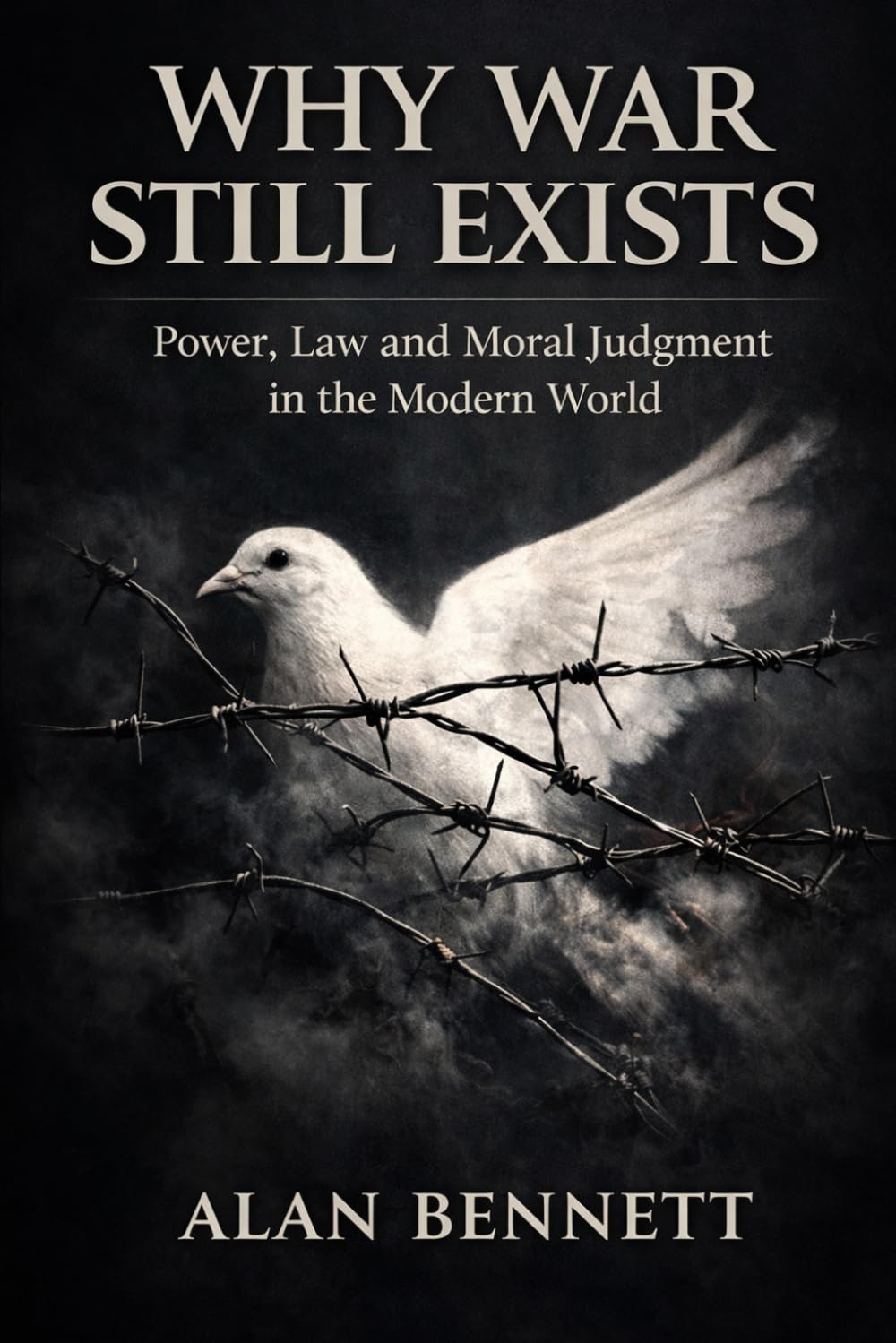
Why War Still Exists: Power, Law and Moral Judgment in the Modern World
$23.00
by Mr Alan Bennett



Why does war still exist? In an age of law, diplomacy, trade, technology, and moral progress, that question should trouble every serious reader. Yet war has not disappeared. It returns in old forms and new ones, across borders, through proxies, through economic coercion, through drones, cyber operations, and doctrines of deterrence. Governments still speak in the language of security, justice, survival, honour, and necessity, but behind those words lie broken cities, ruined institutions, shattered families, and grievances that can endure for generations. In Why War Still Exists , Alan Bennett examines one of the oldest and hardest questions in political and moral life. He asks why organised violence remains such a persistent feature of human civilisation, despite centuries of legal development, religious reflection, philosophical thought, and institutional effort designed to restrain it. This is not a book of slogans, and it is not a book of sentimental abstractions. It is a serious and accessible inquiry into the deeper causes of war and the fragile limits that law and morality try to place upon it. Bennett begins with the enduring realities of the human condition, fear, pride, ambition, resentment, insecurity, memory, and identity, and shows how these forces are magnified through states, sovereignty, strategic rivalry, religion, and historical grievance. The book then turns to the law. It traces the birth of international law, the promise and limits of the United Nations, the weakness of enforcement, the language by which states justify force, and the humanitarian ideals embodied in the Geneva Conventions. Throughout, Bennett asks a difficult but necessary question: can legal principle meaningfully restrain organised power when survival, interest, or historical memory are believed to be at stake? From there, the inquiry moves into moral judgment. The book revisits the just war tradition, the discipline of justified force, and the continuing controversy surrounding self defence, necessity, and proportionality. It then confronts the transformed reality of modern conflict, including irregular combatants, remote warfare, cyber conflict, weapons of mass destruction, nuclear deterrence, sanctions, blockades, civilian suffering, and the long aftermath of war after the fighting formally stops. What makes this book distinctive is its refusal to separate strategy from humanity, or law from moral seriousness. Bennett does not treat war as merely a technical subject for generals and diplomats. He shows that war is also a question of judgment, character, memory, institutional failure, and civilisational responsibility. He insists that the changing methods of conflict do not remove the need for moral clarity. They make that need more urgent. Written in clear and forceful prose, this book speaks to lawyers, policymakers, students, military readers, and general readers who want to think more deeply about power, restraint, and the conditions of peace in the modern world. It is both analytical and humane, historical and contemporary, sober in judgment yet alert to the possibility of better principles. At a time when conflict is becoming more ambiguous, more technologically mediated, and more difficult for ordinary citizens to understand, Why War Still Exists offers a disciplined and compelling guide to the forces that drive war, the rules that seek to limit it, and the moral questions that no civilised society can afford to ignore.