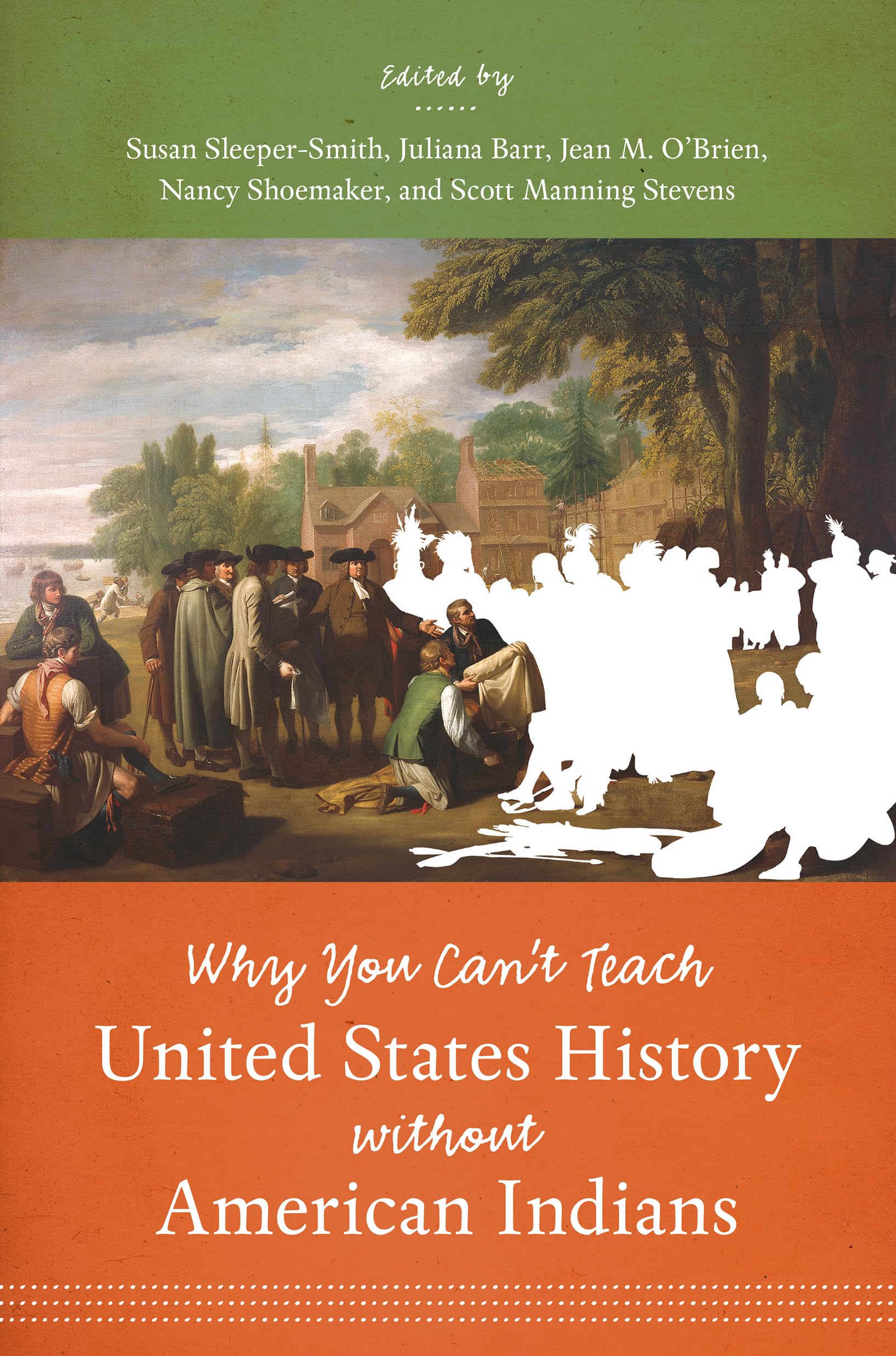
Why You Can't Teach United States History without American Indians
$32.80
by Susan Sleeper-Smith



A resource for all who teach and study history, this book illuminates the unmistakable centrality of American Indian history to the full sweep of American history. The nineteen essays gathered in this collaboratively produced volume, written by leading scholars in the field of Native American history, reflect the newest directions of the field and are organized to follow the chronological arc of the standard American history survey. Contributors reassess major events, themes, groups of historical actors, and approaches--social, cultural, military, and political--consistently demonstrating how Native American people, and questions of Native American sovereignty, have animated all the ways we consider the nation's past. The uniqueness of Indigenous history, as interwoven more fully in the American story, will challenge students to think in new ways about larger themes in U.S. history, such as settlement and colonization, economic and political power, citizenship and movements for equality, and the fundamental question of what it means to be an American. Contributors are Chris Andersen, Juliana Barr, David R. M. Beck, Jacob Betz, Paul T. Conrad, Mikal Brotnov Eckstrom, Margaret D. Jacobs, Adam Jortner, Rosalyn R. LaPier, John J. Laukaitis, K. Tsianina Lomawaima, Robert J. Miller, Mindy J. Morgan, Andrew Needham, Jean M. O'Brien, Jeffrey Ostler, Sarah M. S. Pearsall, James D. Rice, Phillip H. Round, Susan Sleeper-Smith, and Scott Manning Stevens. A mandatory purchase for all libraries." — Choice Well-written and generously illustrated, this rich resource merits a place on the bookshelves of everyone teaching American history."— Journal of American History [This] collection succeeds admirably, providing a variety of tools for incorporating Native American history in ways that promise to challenge and excite our students. It deserves to be read widely, and it will reward those teachers who take its message to heart."— Journal of Southern History [An] exceptional set of chapters. . . . [Brings] together impressive scholars from a broad range of fields. . . . [And] recognize[s] the need to go beyond the usual retelling of U.S. history."— Journal of Interdisciplinary History Provide[s] a usable 'toolkit' for non-specialists to incorporate contemporary scholarship on American Indian history into the undergraduate curriculum." — Register of the Kentucky Historical Society An excellent book...forces instructors to reexamine their pedagogy and think twice about what they teach and what students may be unconsciously taking away from the standard narratives." — The Chronicles of Oklahoma A tremendously powerful book." — Minnesota History Contains a wealth of information that reorients the U.S. history narrative. Anyone who teaches U.S. history should read this easily accessible, thought-provoking book." — New Mexico Historical Review Exciting and practical suggestions for reconsidering how we approach making Indians central to our narratives of US history." — H-Net There are insights in this volume that can benefit even the most seasoned instructors."— NAIS Why You Can't Teach United States History without American Indians confronts a fundamental problem for historians: how do we rethink the U.S. history survey to meaningfully include Indian peoples and Indian experiences? In tackling this complex and multifaceted question, these essays identify specific problems with the current curriculum and give us a new set of tools with which to chip away at the old block. This book stands as a much-needed addition to the field of indigenous studies." —Colin Calloway, Dartmouth College A sourcebook for history teachers Susan Sleeper-Smith is professor of history at Michigan State University. Juliana Barr is associate professor of history at the University of Florida. Jean M. O'Brien is professor of history at the University of Minnesota. Nancy Shoemaker is professor of history at the University of Connecticut. Scott Manning Stevens is associate professor of Native American studies at Syracuse University.