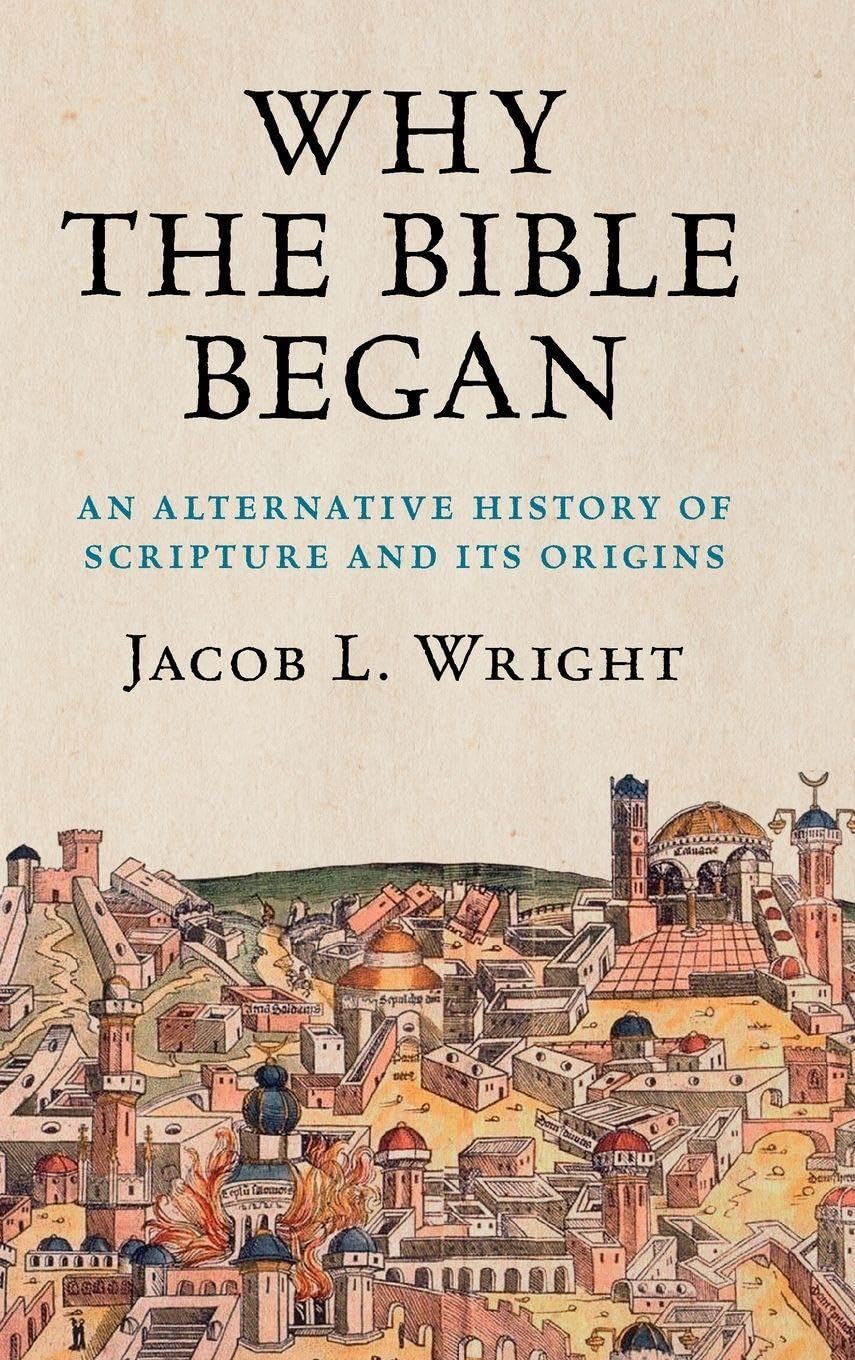
Why the Bible Began: An Alternative History of Scripture and its Origins
$27.32
by Jacob L. Wright



***On The New Yorker 's list of The Best Books We've Read in 2023 ***One of the five books on religion selected by Publishers Weekly 's for their list of The Best Books of 2023 *** ------------------------------------------------------------------------- "A revelation, even to those who have read the Bible for a lifetime! "We witness how in the aftermath of catastrophic defeat and devastation, the biblical authors fashioned a new form of political community--one in which a shared body of texts provided common ground for deeply divided communities and the marginalized in their communities. At the heart of the Hebrew Bible is, as Wright shows, not a creed but a question: What does it mean to be a people? In our time of deepening divisions, both this question and the ways in which these ancient writers addressed it deserve renewed, and serious, attention." -- Robert M. Franklin, President Emeritus, Morehouse College Why did no other ancient society produce something like the Bible? That a tiny, out of the way community could have created a literary corpus so determinative for peoples across the globe seems improbable. For Jacob Wright, the Bible is not only a testimony of survival, but also an unparalleled achievement in human history. Forged after Babylon's devastation of Jerusalem, it makes not victory but total humiliation the foundation of a new idea of belonging. Lamenting the destruction of their homeland, scribes who composed the Bible imagined a promise-filled past while reflecting deeply on abject failure. More than just religious scripture, the Bible began as a trailblazing blueprint for a new form of political community. Its response to catastrophe offers a powerful message of hope and restoration that is unique in the Ancient Near Eastern and Greco-Roman worlds. Wright's Bible is thus a social, political, and even economic roadmap - one that enabled a small and obscure community located on the periphery of leading civilizations and empires not just to come back from the brink, but ultimately to shape the world's destiny. The Bible speaks ultimately of being a united yet diverse people, and its pages present a manual of pragmatic survival strategies for communities confronting societal collapse. "A fascinating look at the Bible and its origins — not necessarily who, what, when, and where, though those are all discussed, but above all, why? Why was it created? Why did it originate where it did? Why did it survive and resonate so much down through the ages? Armed with a scholar's acumen and a writer's dexterity with prose, Jacob Wright addresses these questions and offers us an intriguing alternative look at the origins of the Hebrew Bible and why it mattered both back then and still today. "Sure to elicit much discussion and debate, this is a must read by one of the most interesting and provocative scholars working today." -- Eric Cline, archeologist, historian, and author of the best-selling 1177 BCE: The Year Civilization Collapsed. "The Bible began, Jacob Wright argues, for reasons that have everything to do with why the terms nation and religion remain so fearfully combustible to this day. A large and important topic engaged in a fresh and welcome way." —Jack Miles, author of the Pulitzer-Prize winning God: A Biography A sweeping, and stunning, account of the making of the Bible — and of the "People of the Book." Writing with both vision and compassion, Wright explores how generations of scribes responded to collective trauma by inventing new roles for writing and reading. These counter-cultural thinkers not only placed scripture at the heart of religion; they also discovered how texts have the capacity to consolidate and shape robust reading-communities. Why the Bible Began is a majestic achievement, one worthy of wide attention! —The Imam Abdullah Antepli, globally recognized interfaith-scholar and Vice President & Provost of Duke University. "Profoundly insightful. Wright demonstrates how ancient Israel and Judah developed the resources to construct a resilient nationhood not in spite of but, paradoxically, because of the experience of military defeat, economic devastation, and diaspora. No other kingdom of the ancient Near East was able to do so. Today, as so many communities, peoples and nations face similar critical threats to their existence, Wright's book provides a fascinating and incisively argued case study of how one people drew upon its cultural resources not simply to survive but to generate a vibrantly creative intellectual and spiritual tradition." —Carol A. Newsom, Candler Professor Emerita of Old Testament/Hebrew Bible, Emory University "This book takes questions about the Bible's origins to another level of historical inquiry.... Superbly written and a fascinating approach that expands the normal range of biblical studies in a remarkable way!" —Konrad Schmid, co-author of The Making of the Bible: From the First Fra