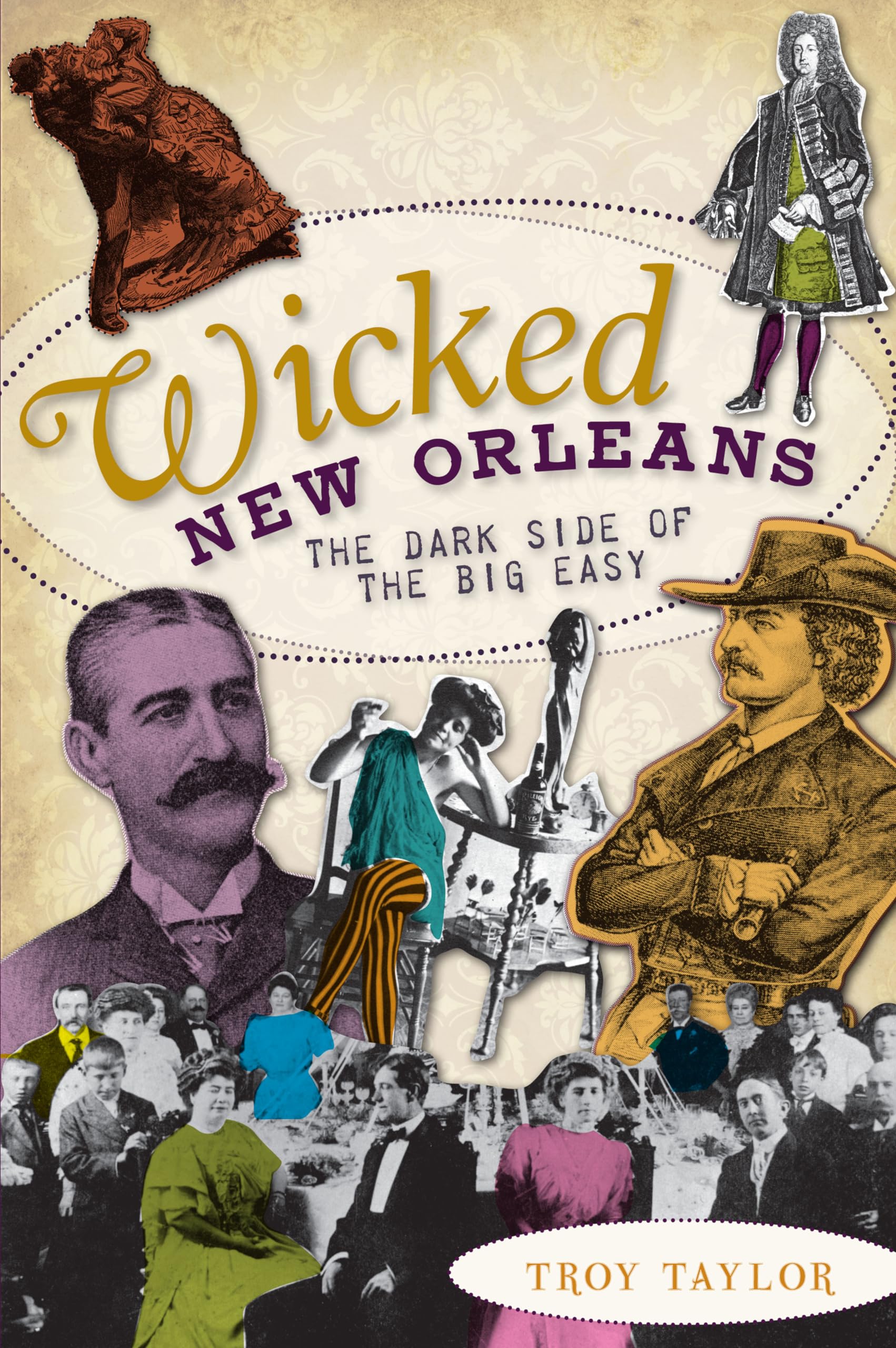



A look back at New Orleans's early wicked days and historic crimes Since as early as the 1700s, New Orleans has been a city filled with sin and vice. Those first pioneering citizens of the Big Easy were thieves, vagabonds and criminals of all kinds. By the time Louisiana fell under American control, New Orleans had become a city of debauchery and corruption camouflaged by decadence. It was also considered one of the country's most dangerous cities, with a reputation of crime and loose morals. Rampant gambling and prostitution were the norm in nineteenth-century New Orleans, and over one-third of today's French Quarter was considered a hotbed of sin. Tales in this volume include that of the notorious Axeman who plagued the streets of the Crescent City in the early 1900s and Kate Townsend, a prostitute who was murdered by her own lover, a man who later was awarded her inheritance. Troy Taylor is an occultist, supernatural historian and the author of seventy-five books on ghosts, hauntings, history, crime and the unexplained in America. He is also the founder of the American Ghost Society and the owner of the Illinois and American Hauntings Tour companies. Taylor shares a birthday with one of his favorite authors, F. Scott Fitzgerald, but instead of living in New York and Paris like Fitzgerald, Taylor grew up in Illinois. Raised on the prairies of the state, he developed an interest in "things that go bump in the night" at an early age. As a young man, he channeled that interest into developing ghost tours and writing about haunts in Chicago and Central Illinois. Troy and his wife, Haven, currently reside in Chicago's West Loop neighborhood. Wicked New Orleans The Dark Side of the Big Easy By Troy Taylor The History Press Copyright © 2010 Troy Taylor All rights reserved. ISBN: 978-1-59629-945-0 Contents Acknowledgements, A City Born in Sin, The Bloody Field of Honor, Under the Black Flag: The Pirate Jean Lafitte, "Roll the Bones": Gambling in New Orleans, "Hell on Earth": New Orleans Crime and Vice, From Basin Street to Storyville: Prostitution in New Orleans, The Mafia in New Orleans, The Axeman's Jazz: New Orleans's Most Mysterious Unsolved Murders, Bibliography, About the Author, CHAPTER 1 A CITY BORN IN SIN New Orleans is a city that was literally born in sin. From the original charters that were based on fraud to the emptying of the French prisoners to provide settlers to the region, widespread government corruption, gaudy social functions, rampant prostitution and frequent lapses in any civilized moral code, New Orleans has a long and very colorful history of crime and vice. The corrupt city of legend and tradition began during the days of French governor Marquis de Vaudreuil and continued through the years of the city's domination by Spain. It flourished between 1800 and 1803, when the province was neither French nor Spanish, and when a general sense of freedom allowed and encouraged the arrival of vagabonds and adventurers from all parts of the world. It the end, it would be as property of the United States that New Orleans would embark upon its "golden age" of crime and spectacular wickedness and would achieve its status as America's leading city of sin. In September 1717, John Law's Company of the West, popularly known as the Mississippi Company, obtained, by royal grant, control of the French province of Louisiana. At the time, there were almost no settlements in the region, which had long ago been claimed for France by the explorer LaSalle. The small outpost that existed nearby had a population of fewer than 300, consisting of a garrison of 124 soldiers, a few priests, 28 women and 25 children. The men were mostly adventurers and frontiersmen who had wandered into the province from Canada and Illinois, but the women, almost without exception, were deportees from the prisons and brothels of Paris. The hardships of life in the wilderness had not changed their manners and customs. When a worried priest suggested that sending away all of the immoral women would improve the culture of the province, Lamothe Cadillac, who was then governor of Louisiana, replied, "If I send away all loose females, there will be no women left here at all, and this would not suit the views of the King or the inclinations of the people." This was not the first time that a commercial enterprise had attempted to settle Louisiana. The Bourbons of France were broke by the early 1700s. They had spent vast amounts of money on exploration and now had vast lands under their control but not the money to actually develop them. When Scotsman John Law approached them with his grand scheme, he must have seemed like a godsend. The terms of the royal franchise issued to the Mississippi Company were granted to John Law with the understanding that he would import six thousand white settlers and three thousand slaves to the colony. They would then work, as a commercial enterprise, the gold and si