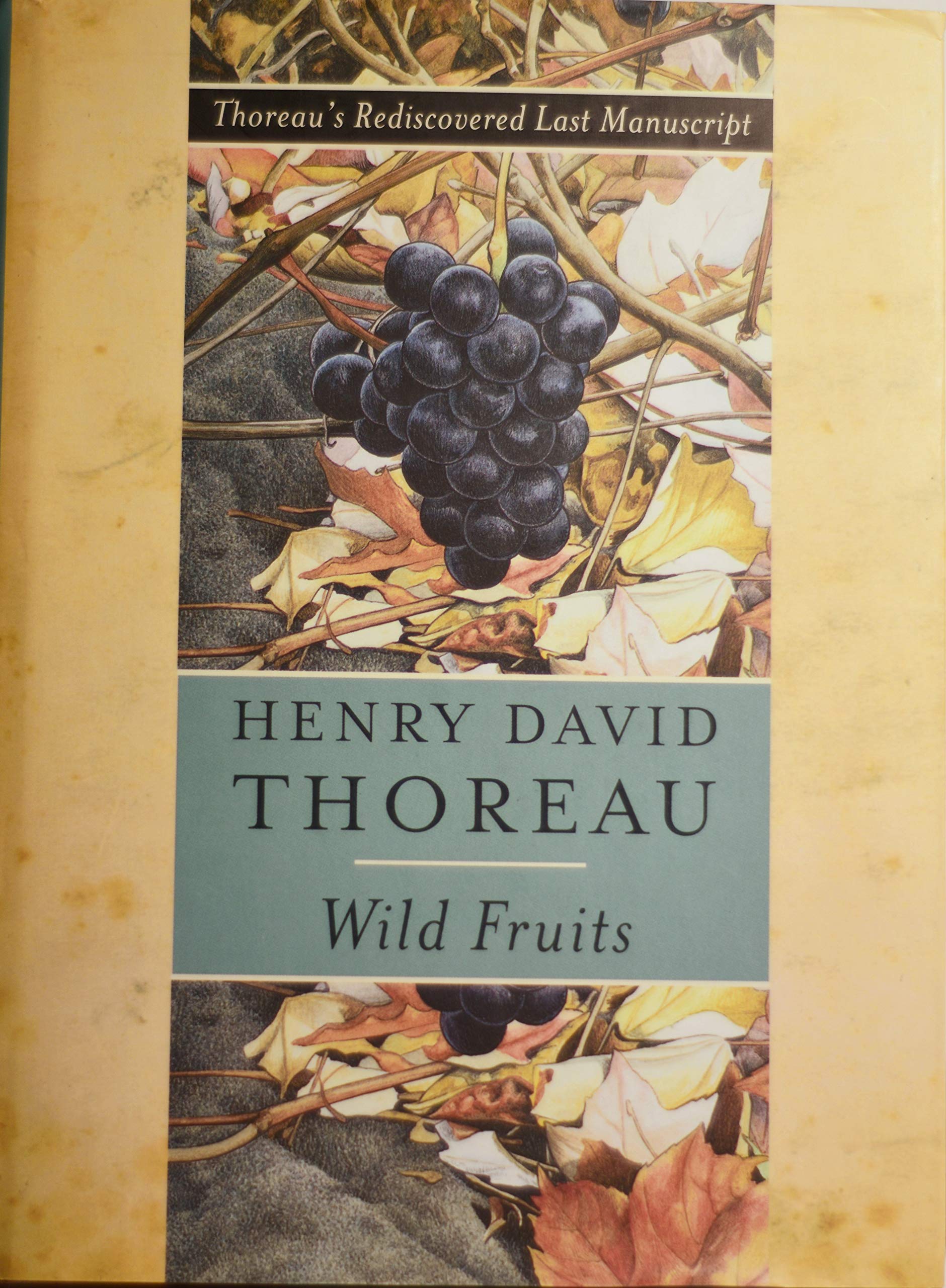



A collection of musings by one of America's premier philosophers, previously kept from publication due the difficulty of the composition, includes illustrations of the wild fruit Thoreau describes. Henry David Thoreau was 44 years old when he died of tuberculosis in the early spring of 1862. He had acquired a measure of notoriety in his lifetime largely for his fervent support of abolitionism and his refusal to pay taxes to support the American war of conquest against Mexico, the subject of his widely circulated pamphlet Civil Disobedience . Closer to his hometown of Concord, Massachusetts, he was known as something of an eccentric who kept a home in the woods and took long walks when the citizens of the town were at work or church. We scarcely know Thoreau better, writes archivist and scholar Bradley Dean: we still remember him today for having spent time in jail and spinning philosophy out of the New England woods. On the strength of this lost, and now published, final manuscript of Thoreau's, Dean would have us think of him as a protoecologist, and for very good reason. In the last years of his life, Thoreau resolved to learn better the science behind nature, and in Wild Fruits he collected the lore and facts surrounding the plants around his home, observing such things as the quantity of chestnuts that local trees were producing, the myriad shapes of pine cones as they unfold, the taste of "fever bush," and the smell of sweet gale. The unfinished manuscript, cataloging dozens of species, affords a fascinating glimpse into Thoreau's method as an amateur student of nature--a method worthy of close study and imitation. Dean adds greatly to it with his intelligent commentary, which revisits Thoreau's sources, corrects a few of his errors, and emphasizes the writer's importance to natural history and belles-lettres alike. --Gregory McNamee When he died in 1862, Thoreau left the fragmentary manuscript of Wild Fruits, itself to be part of a projected natural history of Concord. Dean, director of the Media Center at the Thoreau Institute, has edited Thoreau's manuscript, publishing it for the first time. Thoreau proposes to shift his focus from himself and the examination of his own deliberate life in nature to the careful observation of nature itself. Toward this end, he offers a series of paragraphs or brief essays describing the condition of each of the wild fruits he finds around Concord and supplementing these accounts with notes on the relevant lore. Thoreau writes with the same incisive style and dry wit characteristic of Walden. If this books lacks Walden's scope, it continues its spirit. Dean includes textual notes, a glossary, and a chronology as well as a succinct but substantive introduction. In bringing forth Wild Fruits, he has performed an immense service. Recommended for public and academic libraries.AThomas L. Cooksey, Armstrong State Coll., Savannah, GA Copyright 1999 Reed Business Information, Inc. A work that has escaped publication since Thoreau wrote it, Wild Fruits will only strengthen the author's renown for his unique voice. A keeper of the Thoreau flame and Thoreau scholar, Bradley Dean (editor of a similar Thoreau work, Faith in a Seed, 1993, prematurely described in these pages as ``no doubt [the] final Thoreau book of the century''), has now transcribed and brought to life still another of the Concord naturalist and philosopher's manuscripts that was never published in his lifetime. It is, as Dean wisely characterizes it, both a sacramental and scriptural work. The product of years of naturalistic observation, these lovely essayssome extended, some as short as a sentenceabout flowers, bushes, and trees were originally culled by their author for lectures he delivered. They reveal his characteristic Transcendentalist views, his never-ending search ``to find God in nature.'' A mix of empirical science, philosophical speculation, and occasionally tart wit, they are wonderfully pleasing for the knowledge they evince and for their calm, melodious cadences. Fortunately, too, Thoreau the keen and distinctive thinker is ever-present. Indignant, for example, at his contemporaries' failure to appreciate the huckleberry, he likens their obtuseness to the loss of ``natural rights,'' thus giving fresh meaning to an ancient term. While never intruding onin fact, scarcely explainingThoreau's prose, Dean artfully provides notes glossing terms, names, and references that might be obscure to a modern reader. He thus makes this 150-year-old work fully accessible to everyone. A work of often incandescent prose likely to find many readers among historians, naturalists, literary scholars, and, most of all, those who have long loved and learned from the author of Walden and other beloved texts. (Line drawings throughout; 3 facsimile manuscript pages.) -- Copyright ©1999, Kirkus Associates, LP. All rights reserved. Wild Fruits is a passionately attentive "Kalendar" of botanical observations, and wi