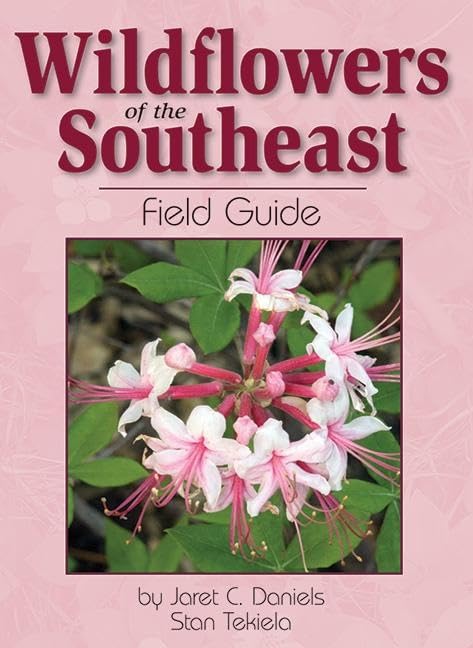
Wildflowers of the Southeast Field Guide (Wildflower Identification Guides)
$12.34
by Jaret C. Daniels



Learn to identify wildflowers in the Southeast with this handy field guide, organized by color. With this famous field guide by professional nature photographer Jaret C. Daniels and by award-winning author and naturalist Stan Tekiela, you can make wildflower identification simple, informative, and productive. There’s no need to look through dozens of photos of wildflowers that don’t grow in the Southeast. Learn about 200 of the most common and important species found in Alabama, Arkansas, Florida, Georgia, Kentucky, Louisiana, Mississippi, North Carolina, South Carolina, Tennessee, Virginia, and West Virginia. They’re organized by color and then by size for ease of use. Fact-filled information contains the particulars that you want to know, while full-page photographs provide the visual detail needed for accurate identification. Book Features 200 species: Only Southeastern wildflowers! - Simple color guide: See a purple flower? Go to the purple section - Fact-filled information and stunning professional photographs - Icons that make visual identification quick and easy - Nature Notes, including naturalist tidbits and facts This field guide includes beautiful photography, relevant information, and expert naturalist insights. Grab Wildflowers of the Southeast Field Guide for your next outing―to help you positively identify the wildflowers that you see. A field guide to 200 of Georgias' beautiful wildflowers! Full-page photos and descriptions make this the best guide to Georgias' wildflowers o organized by color and size o icons make visual identification quick and easy o full-page, professional-quality photographs o easy-to-read format presenting information critical to accurate identification o identifies wildflowers most common in Georgia Jaret C. Daniels, Ph.D., is a professional nature photographer, author, native plant enthusiast and entomologist at the University of Florida, specializing in insect ecology and conservation. He has authored numerous scientific papers, popular articles and books on gardening, wildlife conservation, insects and butterflies, including butterfly field guides for Florida, Georgia, the Carolinas, Ohio and Michigan. He is also co-author of Wildflowers of Florida Field Guide. Jaret lives in Gainesville, Florida, with his wife, Stephanie. Stan Tekiela is a naturalist, wildlife photographer, and writer and is the originator of the popular state-specific field guide series. Stan has authored more than 190 educational books, including field guides, quick guides, nature books, children’s books, playing cards and more, presenting many species of animals and plants. With a Bachelor of Science degree in Natural History from the University of Minnesota and as an active professional naturalist for more than 30 years, Stan studies and photographs wildlife throughout the United States and Canada. He has received various national and regional awards for his books and photographs. Also a well-known columnist and radio personality, his syndicated column appears in more than 25 newspapers, and his wildlife programs are broadcast on a number of Midwest radio stations. Stan can be followed on Facebook and Twitter. Pinewoods Milkweed Asclepias humistrata Family: Milkweed (Asclepiadaceae) Height: 8-28" (20-71 cm) Flower: loose round cluster, 2 1/2-3 1/2" (6-9 cm) wide, of many pale, ashy pink flowers; each flower, 1/4" (.6 cm) wide, with 5 downward-curving petals and a deeply divided crown, made up of 5 scoop-shaped “hoods” and 5 inward-curving, beak-like “horns” Leaf: broad oval leaves, 2-4" (5-10 cm) long, pale green to purple with pale pink veins; sprawling or rising pink stem Fruit: elongated curved green pod, 3-5" (7.5-13 cm) long, tapering toward the tip; turns brown; splits open to release many dark brown seeds, each with cottony plumed tufts that carry it away on the wind Bloom: spring, summer Cycle/Origin: perennial, native Habitat: sandy disturbed sites, dry woods and pinelands Range: throughout AL, FL, GA, MS, NC, and SC Notes: Frequently occurs in dry sandy pinelands. Monarch butterflies on their flight northward in spring lay their eggs on the foliage, which becomes an important food for the resulting caterpillars. Its flower clusters are visited by a wide variety of other nectar-seeking butterflies such as swallowtails, hairstreaks and skippers. Humistrata means “ground spreading,” for its low, sprawling growth habit. Cluster type: Round - Flower type: Irregular - Leaf type: Simple - Leaf attachment: Opposite - Leaf attachment: Clasping - Fruit: Pod