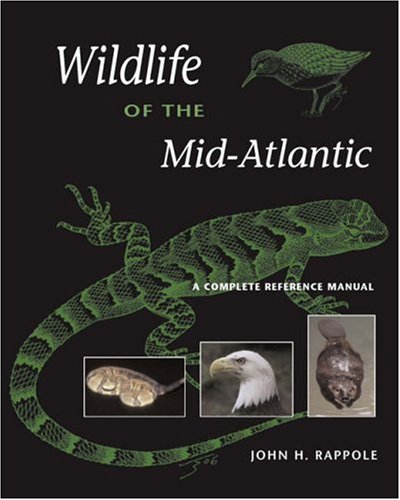



The Mid-Atlantic is a geographically and biologically diverse region, ranging from the sandy coastal beaches and blackwater swamps of southeastern Virginia to the boreal bogs and spruce-fir forests of northern Pennsylvania and the highest peaks of West Virginia's Appalachian Mountains. Scientists identify six distinct geologic provinces in the area, along with four climatic zones. As John H. Rappole explains, these varied landforms and climates create the environment for the variety of wildlife found in the region. This well-illustrated volume is the most comprehensive and up-to-date guide to the wildlife of Pennsylvania, New Jersey, Delaware, Maryland, Virginia, and West Virginia. Approximately 550 species are described, including all birds, mammals, reptiles, and amphibians known to inhabit the area, excluding open ocean species. Each species is illustrated and a distribution map is included with every entry. The species accounts contain a physical description, data on habitat and distribution, habits, diet, reproduction, conservation status, and one or more key references. Sections cover the major habitat types in the region (including descriptions and photos), physical geography, climate, and conservation challenges. In addition, the book has a glossary of nearly 400 technical terms. An appendix contains descriptions of casual, accidental, hypothetical, and extinct species, an index allows readers to locate specific information quickly, and a thorough bibliography suggests additional reading. Written by a respected scientist, Wildlife of the Mid-Atlantic provides the only complete summary of information on all the terrestrial species of the area, based on the most recent research. Designed to meet the needs of professional as well as nonprofessional readers, it is an essential resource for all natural history enthusiasts, from students to teachers, from birders to ornithologists, and from avid outdoors people to armchair naturalists. "A quick yet comprehensive guide for anyone interested in learning more about the permanent and migratory animals of the Mid-Atlantic region. . . . Rappole is a well-known natural scientist who provides an excellent resource for this diverse geographical niche. . . . Highly recommended."— Choice "This text is inviting from the moment it is encountered. . . . A valuable resource."— Journal of Mammalogy John H. Rappole is a Research Scientist at the Smithsonian National Zoological Park's Conservation and Research Center. He is the author of twelve books, including Birds of the Mid-Atlantic Region and The Ecology of Migrant Birds. Introduction The Mid-Atlantic region, for the purposes of this work, includes Pennsylvania, Virginia, West Virginia, New Jersey, Delaware, Maryland, and the District of Columbia (Figure 1). This area encompasses an impressive array of habitats and topography, ranging from the sandy coastal beaches and blackwater swamps of southeastern Virginia to the boreal bogs and spruce-fir forests of northern Pennsylvania and the highest peaks of West Virginia's Appalachian Mountains. In line with this diversity, the region has an extraordinary richness of terrestrial vertebrate fauna: 72 amphibian species; 62 reptiles; 81 mammals; and 331 birds. "Terrestrial" in this case means those that spend most or all of their life cycle on land, and thus excludes most pelagic vertebrates, e.g., seabirds, whales, and sea turtles, as well as fish. Some anomalous species are included, like the Hellbender and sirens, which are aquatic in all life cycle phases, because to exclude them would be to fall just short of complete coverage for the Amphibia. An additional purpose of this book is to summarize the conservation status and major problems confronting vertebrate populations in the Mid-Atlantic. This part of the country has experienced anthropogenic effects as radical as any on earth over the four centuries since European settlement began, and these changes have had profound effects on the area's wildlife. For instance, moose, lynx, bison, elk, cougars, wolves, Trumpeter Swans, Whooping Cranes, Passenger Pigeons, and Carolina Parakeets were part of the terrestrial vertebrate fauna when Lederer first pushed his westward explorations to the peaks of the Blue Ridge Mountains in the late 1600s (Talbot 1672). Thomas Lewis surveyed northern Virginia's Shenandoah-Rockingham county line in the mid-1700s, recording not only the large mammals and birds observed, but the dominant tree species as well, providing a glimpse of what the primeval forest must have been like in the Appalachians (Lewis 1746). Now, in the early twenty-first Century, few old growth stands of any habitat type remain in the region: Cook's Forest in northwestern Pennsylvania and Swallow River Falls State Park in the Cumberland of western Maryland serving as two notable exceptions. Structurally, at least, it makes quite a difference whether a forest is composed of trees 23 m (710 ft) in diameter at breast height