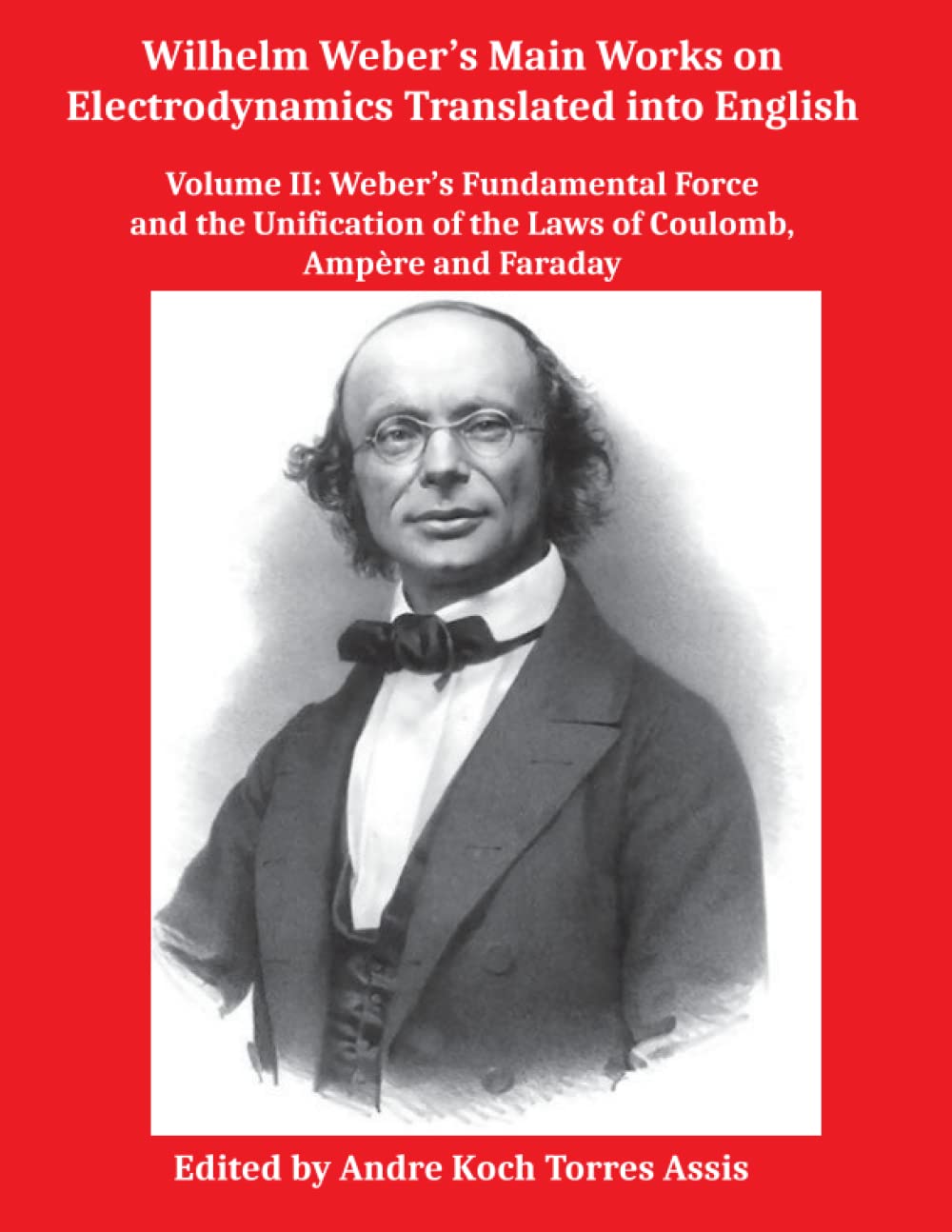
Wilhelm Weber’s Main Works on Electrodynamics Translated into English.: Volume II: Weber’s Fundamental Force and the Unification of the Laws of
$23.95
by Andre Koch Torres Assis



This second Volume begins with the text of the Gauss-Weber correspondence of 1845. It is related to Ampère's force between current elements and Weber's ideas about the unification of the electrostatic and electrodynamic laws. It is followed by a paper by Fechner published in 1845 in which he presented some qualitative ideas in the same direction. That is, to unify Ampère's force and Faraday's law of induction with electrostatics. To this end he suggested a force depending not only on the distance between the interacting electrified particles, but also on their velocities. At the end of his paper, Fechner mentioned that his work might be seen as a forerunner of Weber's investigations. Then comes Weber's First major Memoir on Electrodynamic Measurements, published in 1846. This work is probably Weber's most important publication. He introduced his bifilar electrodynamometer with which he could measure currents with high precision. Initially he utilized this instrument in order to prove Ampère's force. He then utilized Ampère's force between current elements in order to deduce his own force law between electrified particles. Weber's force between two electrified particles depends not only on their distance, but also on their relative velocity and relative acceleration. He showed that it was possible to unify the laws of Coulomb, Ampère and Faraday with his force law. This Volume contains also Weber's 1848 paper in which he introduced his velocity dependent potential energy. It is followed by Kirchhoff's 1849 paper on a deduction of Ohm's law in connection with the theory of electrostatics. This Volume finishes with Weber's Second major Memoir on Electrodynamic Measurements (1852). The main focus of this work was the absolute measure of resistance. Weber's Memoir contains also his pioneering calculation of the distribution of charges along the surfaces of resistive conductors carrying steady currents. In particular, he considered a cylindrical straight conductor and a resistive ring.