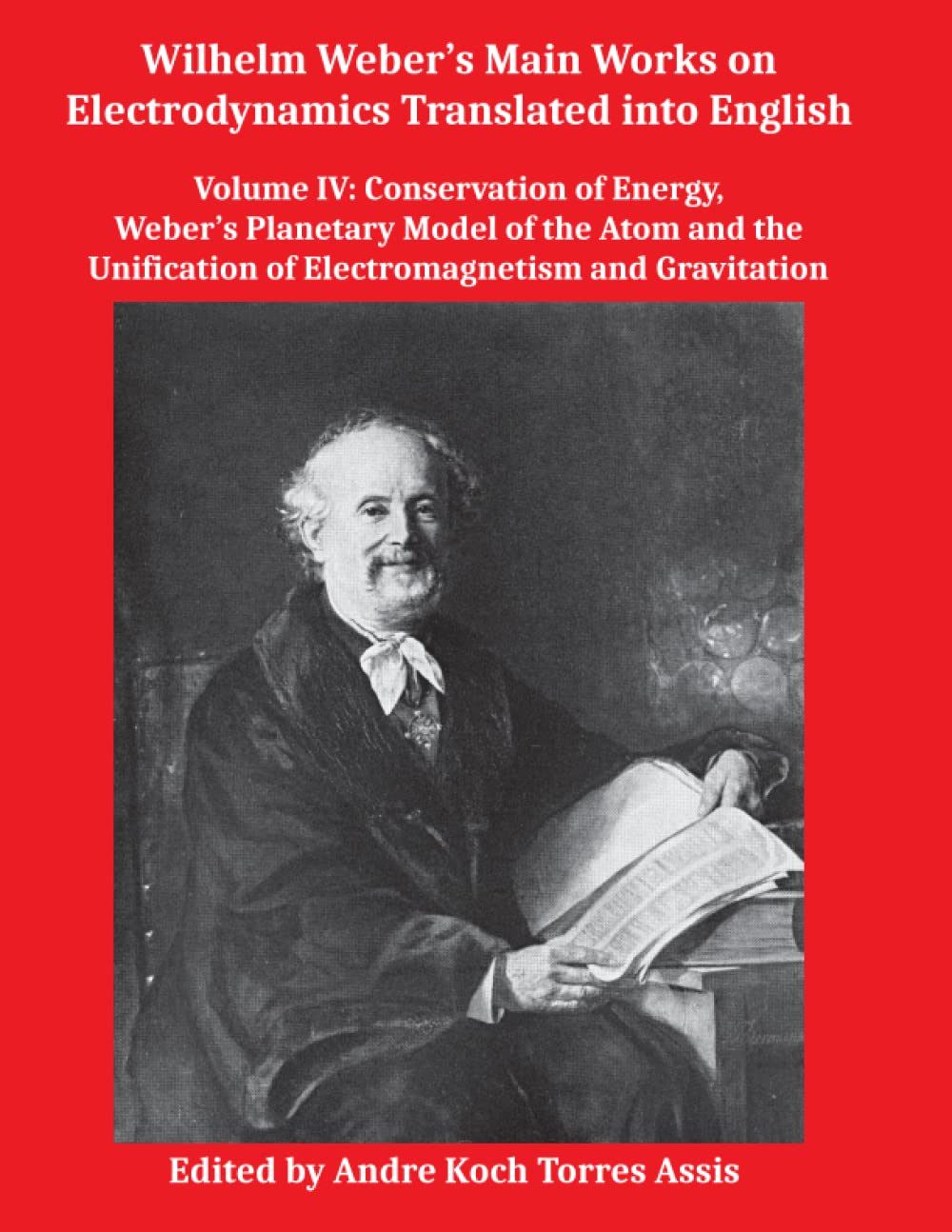
Wilhelm Weber’s Main Works on Electrodynamics Translated into English: Volume IV: Conservation of Energy, Weber’s Planetary Model of the Atom and the
$10.95
by Andre Koch Torres Assis



This fourth Volume begins with the English translation of Gauss' posthumous paper published in 1867. He arrived at a force law depending on the positions and velocities of the interacting electrified particles from which he could deduce not only electrostatics, but also the force between current elements. Then comes Carl Neumann's 1868 paper on the principles of electrodynamics. In this work Neumann introduced the Lagrangian and Hamiltonian formulations of Weber's electrodynamics. Moreover, he also showed that Weber's law was compatible with the principle of the conservation of energy. Then comes Weber's 1871 Sixth major Memoir on Electrodynamic Measurements. He showed once more in detail that his force law was compatible with the principle of the conservation of energy. Moreover, he studied the two-body problem according to his electrodynamics. He showed that in some conditions two particles electrified with charges of the same sign might attract one another. This Volume also contains the English translation of Tisserand's 1872 paper on the motion of planets around the Sun according to Weber's law. He calculated, for instance, the precession of the perihelion of the planets. Weber's Seventh major Memoir on Electrodynamic Measurements was published in 1878. It is devoted to the energy of interaction. His Eighth major Memoir, thought to be written in the 1880's, was published only posthumously in 1894 in his collected works. It is related to the connection of Weber’s force with the law of gravitation. Moreover, it contains his mature planetary model of the atom in which the nucleus is held together by purely electrodynamic forces according to Weber's law. This work closes with an overview of Weber's law applied to electromagnetism and gravitation, together with some possible future developments of his theory. The main topics are the unifications in physics: (a) Ampère's unification of magnetism, electrodynamics and electromagnetism; (b) Weber's unification of the laws of Coulomb, Ampère and Faraday; (c) unification of optics with electrodynamics; (d) unification of nuclear physics with electrodynamics; (d) applications of Weber's law for gravitation; (e) unification of gravitation with electrodynamics; and (e) unification of inertia with gravitation, in particular, the implementation of Mach's principle and the deduction of Newton's second law of motion from Weber's force.