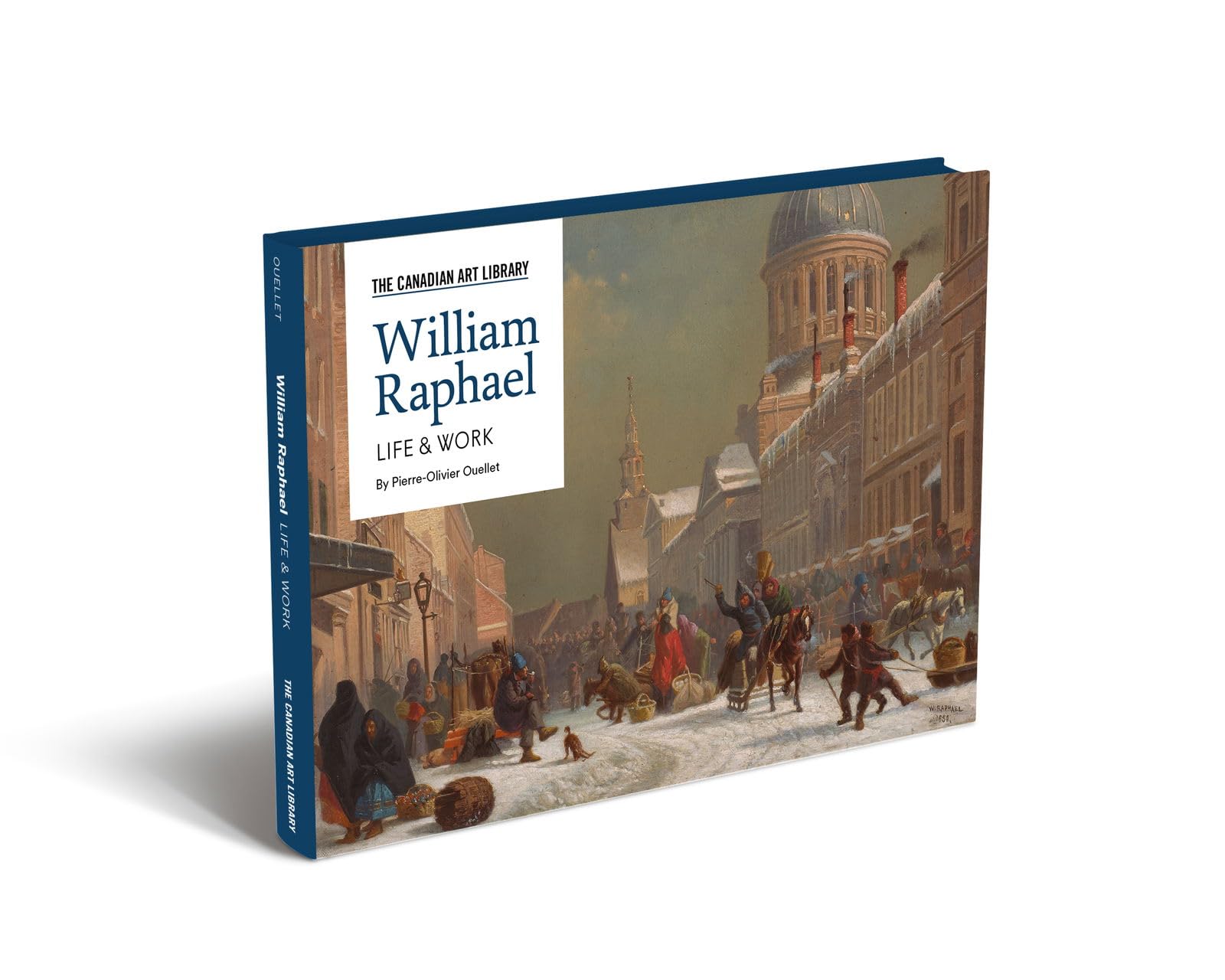
William Raphael: Life & Work (The Canadian Art Library Series, 0)
$50.00
by Pierre-Olivier Ouellet



A painter, art educator, and medical illustrator, William Raphael (1833?1914) was the first Jewish artist to establish a professional practice in Canada. Active during the latter half of the nineteenth century, Raphael made a name for himself as a portraitist, painting the likenesses of some of Quebec?s most prominent politicians, businessmen, and military figures. He further excelled at genre scenes, and his works are celebrated for their important documentation of Indigenous communities, urban life, leisure activities, and architecture in Canada before and after Confederation. In William Raphael: Life & Work , author Pierre-Olivier Ouellet traces the artist?s career from his early years in Prussia and his training in Berlin to his time in Quebec. The book details how after Raphael moved to Montreal in 1857, he met the famed photographer William Notman (1826?1891) and worked for him painting sets and colourizing photographs. This early career connection helped to situate Raphael within the province?s burgeoning cultural scene and made him a key figure in the formation of the Art Association of Montreal in 1860. Raphael?s unparalleled contributions to the visual folklore of Quebec have strengthened our understanding of nineteenth-century Canada. Combining realism with a picturesque sensibility, his portraits and depictions of daily life and civic spaces captured the spirit of an emerging country. Today, Raphael?s paintings hang in the nation?s leading institutions, including the National Gallery of Canada, the Montreal Museum of Fine Arts, and the Vancouver Art Gallery. William Rapahel (1833?1914) is celebrated for his unique artistic insight into the everyday activities and the people who inhabited Canada in the second half of the nineteenth century. Recognized today for his depictions of Montreal?s urban life and its landscapes, Raphael?s unparalleled contribution to the country?s visual folklore plays a crucial role in our understanding of a nation in full expansion. William Raphael: Life & Work traces the artist?s career from his birth in Nakel, Prussia, to his training in Berlin, where he familiarized himself with the principles of the Biedermeier style ? a movement emphasizing realism and simplicity rather than ornamentation and opulence ? which he brought to his chosen city of Montreal. After establishing himself as Canada?s first professional Jewish artist, Raphael worked with the famed photographer William Notman, an early-career connection that helped situate him within the province?s burgeoning cultural milieu. Revered and talented, he soon became one of the city?s most esteemed artists and painted the portraits of numerous most notable members of Quebec society. Pierre-Olivier Ouellet explores Raphael?s ability to represent a wide variety of subjects ? from medical illustrations to genre scenes, through urban and leisure activities, civic spaces and natural life? and the way he presents them in a style ranging from realism to visible brushwork, and even caricature. In addition, we learn how Raphael became an educator and played a key role in establishing institutions that would come to define the national cultural scene, notably the Art Association of Montreal. Enlightening and unforgettable, William Raphael: Life & Work unveils the story of an artist of broad outlook, fertile activity, and determination through an unprecedented body of work that captures the spirit of an emerging country. Pierre-Olivier Ouellet is a professor at Cégep du Vieux Montréal. He holds a PhD from Rennes 2 University in France, and his research touches on various themes linked to artistic production in Quebec and Canada before 1900. These include art collections developed under the French régime, the representation of Indigenous peoples, histories of artistic materials and techniques, and art historiography.